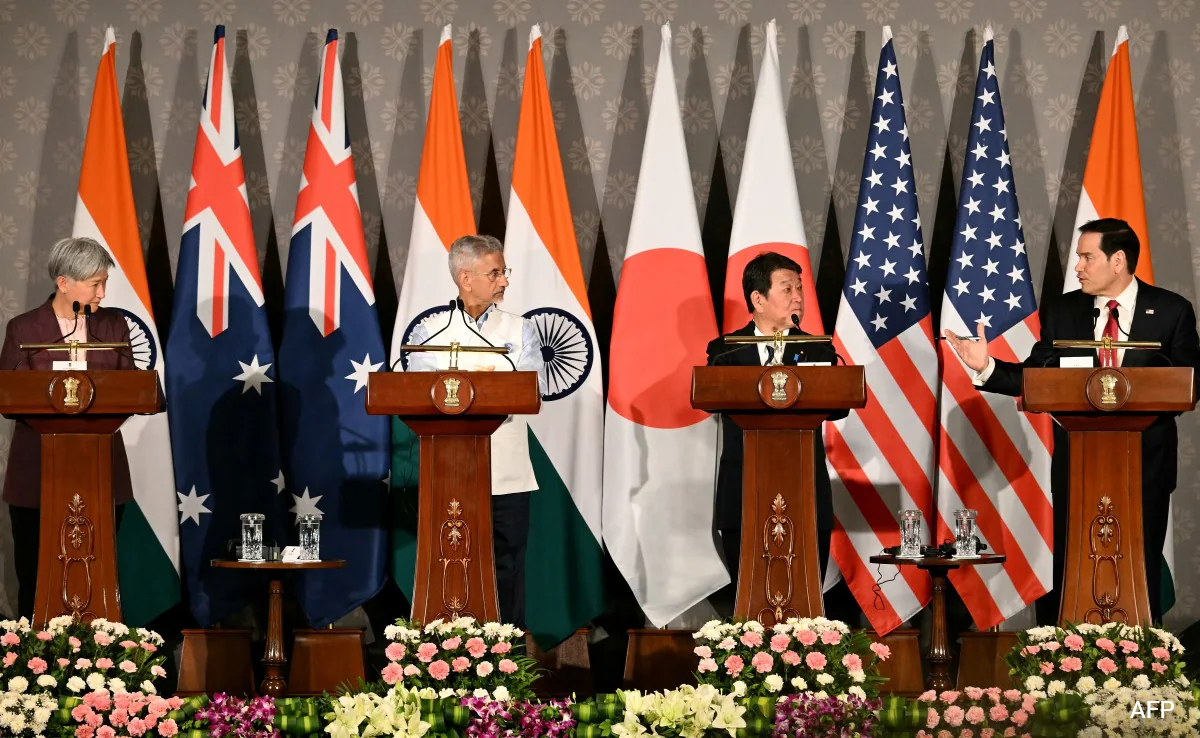
The foreign ministers of the four Quad nations gathered in New Delhi today and issued a sweeping joint statement that served as both a strategic manifesto and an operational blueprint for reshaping the Indo-Pacific order - one that, while never naming China directly, left little ambiguity about where the grouping's most urgent anxieties lie.
External Affairs Minister S Jaishankar, US Secretary of State Marco Rubio, Australian Foreign Minister Penny Wong, and Japanese Foreign Minister Takeshi Iwaya signed off on a document that ranged across maritime confrontation, nuclear proliferation, terrorist attacks on allied soil, undersea cable sabotage, and the weaponisation of critical mineral supply chains. The breadth and specificity of the statement reflected a grouping that has moved well beyond aspirational rhetoric and into the business of building architecture.
Maritime aggression in the crosshairs
The statement's most sharply worded passages focused on the South China Sea, where Beijing's coast guard and maritime militia forces have escalated confrontations with Philippine vessels in recent months. The four ministers expressed "serious concerns" over what they described as dangerous and coercive actions - specifically calling out the use of water cannons, flares, and ramming and blocking maneuvers, as well as interference with offshore resource development and obstruction of freedom of navigation.
In an implicit rebuke of China's position on the 2016 arbitral tribunal ruling - which Beijing has consistently dismissed - the joint statement pointedly noted that the award, now a decade old, "is a significant milestone and the basis for peacefully resolving disputes between the parties." The invocation of the ruling's tenth anniversary added legal weight to what has become a consistent Quad refrain.
Beyond the South China Sea, the ministers flagged the vulnerability of commercial shipping lanes through the Strait of Hormuz and the Red Sea, condemning attacks on commercial vessels and calling for unimpeded navigation consistent with international law. The statement reflected growing Quad concern that disruptions to these chokepoints ripple directly into Indo-Pacific food, fuel, and fertilizer security.
Terrorism gets named and located
In a notable escalation of Quad language on terrorism, the joint statement issued an unequivocal condemnation of two specific attacks on partner-nation soil: the Pahalgam attack in April 2025, which killed dozens of tourists in Jammu and Kashmir, and the Bondi Beach attack in Australia in December 2025. By naming both incidents in the same breath and calling for action against "cross-border terrorism" and its sponsors, the four governments delivered a message directed squarely at Pakistan - without stating so explicitly.
The grouping also flagged a less-discussed but rapidly growing threat: online scam centres proliferating across Southeast Asia, which the statement linked to broader networks of trafficking, drug running, cybercrime, and illicit financing. The Quad's commitment to deepen law enforcement cooperation on this front reflected intelligence-sharing that has grown considerably more robust in recent years.
The economics of strategic competition
The meeting produced two landmark economic announcements that together represent the Quad's most serious attempt yet to compete with China's state-directed industrial policy on its own terms.
The Quad Critical Minerals Initiative Framework commits the four nations to mobilizing up to $20 billion in blended public and private financing to build diversified supply chains for materials critical to advanced technology and defense manufacturing. The framework - covering mining, processing, and recycling - targets projects with a direct Quad nexus and includes tools ranging from development finance loans and export credit to equity stakes and offtake agreements. A dedicated regulatory alignment component takes aim at the slow permitting processes that have historically stalled Western mineral projects, giving state-backed Chinese enterprises a decisive time advantage.
Separately, the ministers announced the Quad Initiative on Indo-Pacific Energy Security, a new cooperation framework designed to stabilize energy markets and diversify supply chains across the region. The initiative acknowledged that disruptions to global energy markets and downstream products like fertilizers hit Indo-Pacific nations disproportionately hard - a lesson underscored by the commodity shocks that followed Russia's invasion of Ukraine.
Digital infrastructure and the cable wars
The statement devoted significant attention to undersea cable networks, calling them "the backbone of the global digital economy" and flagging risks including sabotage and foreign interference. The Quad reaffirmed a commitment to ensure all Pacific Island Forum nations are connected via undersea cables by year's end, and highlighted a Wavelength Forum hosted in New Delhi last July that brought together governments and private industry to advance cable resilience.
On artificial intelligence and next-generation communications, the ministers underlined the importance of open and interoperable architectures built on sound technical standards - a formulation that explicitly resists single-vendor dominance and points toward the exclusion of Chinese-made telecommunications infrastructure from trusted networks.
Operational, not just aspirational
Perhaps the most telling signal in the statement was its operational texture. India announced it will host the next Quad-at-Sea Ship Observer Mission, building on a first-of-its-kind exercise last July. A new Indo-Pacific Maritime Surveillance Collaboration framework will enable real-time vessel tracking and information sharing.
The Indo-Pacific Logistics Network, tested during humanitarian operations in Papua New Guinea and Myanmar, is being formalized with standard operating procedures and a second tabletop exercise scheduled in Japan later this year.
After years of skepticism about whether the Quad could move from summitry to substance, Tuesday's meeting in New Delhi offered the most persuasive evidence yet that it has.
Track Latest News Live on NDTV.com and get news updates from India and around the world


