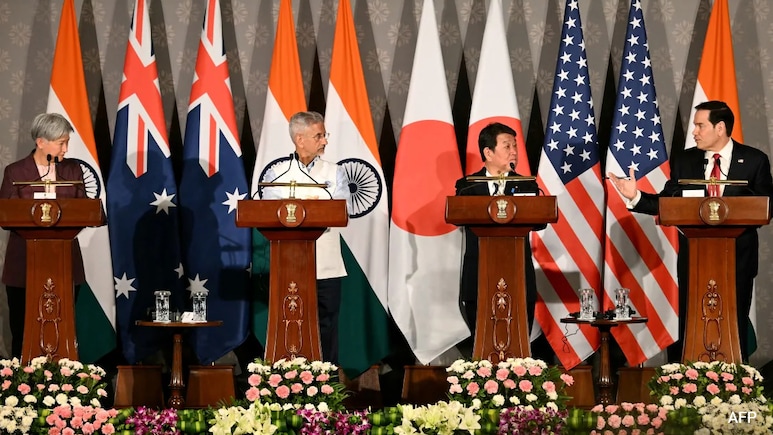
With oil tankers navigating an increasingly fraught Strait of Hormuz and fuel prices climbing to multi-year highs across Asia, the foreign ministers of India, Australia, Japan, and the United States gathered in New Delhi on Tuesday and delivered a pointed message: the Indo-Pacific will not be held hostage to the energy volatility reshaping the global economy.
The Quad's joint statement on Indo-Pacific Energy Security, issued at the close of the ministerial meeting, names the Strait of Hormuz explicitly - an unusually direct diplomatic signal - calling for "unimpeded freedom of navigation" and opposing "any restrictive measures hampering the flow of commercial vessels." The language reflects deepening concern over disruptions stemming from the widening conflict in the Middle East, which has unsettled shipping lanes that carry the bulk of the region's crude oil exports eastward to Asia.
The timing could not be more consequential. Since renewed hostilities flared across the Middle East in recent months, Brent crude has surged sharply, with downstream effects rippling through fertilizer costs, petrochemical supply chains, and household energy bills from Tokyo to Mumbai to Sydney. For Indo-Pacific economies that depend heavily on Gulf energy imports, the crisis has exposed structural vulnerabilities that policymakers have long acknowledged but struggled to address collectively until now.
Read | Quad Powers Draw Hard Lines On China, Terror, Critical Materials In Delhi
India's role at the centre of Tuesday's statement is notable. New Delhi, long protective of its strategic autonomy in multilateral energy forums, has stepped forward as a key pillar of the Quad's response architecture. The statement recognises India's ongoing support to energy security in South Asia and positions it alongside Australia's Southeast Asia and Pacific engagement as a regional stabilising force. For a country that is simultaneously one of the world's largest crude importers and an emerging clean energy hub, India's embrace of this framework marks a significant shift in how it projects its economic interests abroad.
The four nations announced the creation of a Quad Fuel Security Forum - a high-level coordination body designed to facilitate crisis response, policy alignment, and market analysis during periods of acute energy stress. Accompanying this is a broader Quad Initiative on Indo-Pacific Energy Security, which will develop an engagement plan spanning technology, emergency response exercises, and strategic petroleum system strengthening.
Australia brought concrete financial commitments to the table, pointing to its $2 billion Southeast Asia Investment Financing Facility and AUD 30 million in budget support to Fiji as evidence of its Pacific energy security mandate. Japan, meanwhile, highlighted its POWERR Asia initiative - the Partnership on Wide Energy and Resources Resilience - as a vehicle for regional energy diversification.
Read | Eye On China, Quad Expands Cooperation On Minerals And Maritime Security
The statement is careful to address not just the immediate crisis but the structural inequity of energy disruptions, acknowledging that the burden falls disproportionately on vulnerable developing nations and small island states in the Pacific, for whom even modest supply shocks can translate into acute economic hardship.
Analysts watching the meeting noted that while Quad cooperation has historically centred on maritime security and technology supply chains, Tuesday's statement represents a meaningful expansion of the grouping's economic security mandate - one driven, in large part, by the current crisis forcing the issue.
As foreign ministers departed New Delhi, the message from the Quad was unambiguous: the free flow of energy through the world's most critical chokepoints is not merely a commercial matter. It is, the four nations declared, essential to global economic stability - and they intend to defend it together.
Track Latest News Live on NDTV.com and get news updates from India and around the world


