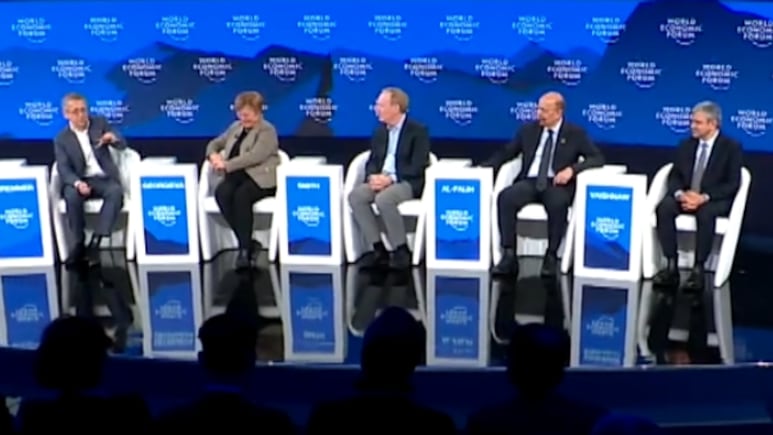
Union Minister Ashwini Vaishnaw pushed back against moderator Ian Bremmer's description of India as a “Tier 2 AI power” during their discussion at the World Economic Forum in Davos this week. Vaishnaw, the Minister for Electronics and IT, cited global data to argue that India was among the world's leading AI nations.
The exchange took place during the “AI Power Play” panel on Tuesday, which also featured International Monetary Fund (IMF) Managing Director Kristalina Georgieva, Microsoft President Brad Smith, and Saudi Arabia's Investment Minister Khalid Al-Falih.
Ashwini Vaishnaw-Ian Bremmer Face Off
During the session, Ian Bremmer, president of the Eurasia Group, referred to India as part of a “second grouping” of artificial intelligence powers, suggesting it lagged behind the global leaders. Vaishnaw countered this, citing Stanford University rankings, saying that India was third globally among AI nations.
He said, “ROI does not come from creating the largest models. Nearly 95 per cent of real-world use cases can be addressed using models in the 20-50 billion parameter range.”
AI Power Play, No Referees with @Khalid_AlFalih (@MISA), @ianbremmer (@EurasiaGroup), @KGeorgieva (@IMFNews), @BradSmi (@microsoft), @AshwiniVaishnaw (@GoI_MeitY) #WEF26 https://t.co/PvBhXLv165
— World Economic Forum (@wef) January 20, 2026
He said that India's AI strategy focuses on economically sustainable, real-world deployment rather than just building large models.
“I don't know what the IMF criteria is, but Stanford places India at 3rd in the world for AI preparedness. I don't think your classification is correct," Vaishnaw said in Davos.
On India's achievements, Vaishnaw said Stanford ranks India third globally in AI penetration and preparedness, and second in AI talent.
Over 38,000 GPUs have been empanelled in a shared national compute facility, subsidised for access by students, researchers, and startups. A nationwide AI skilling programme aims to train 10 million people.
India is working on all 5 layers of the AI architecture: application, model, chip, infra and energy. We are building the foundation for global AI services.
— Ashwini Vaishnaw (@AshwiniVaishnaw) January 21, 2026
📍 World Economic Forum, Davos pic.twitter.com/27lIbUBOl0
India is developing techno-legal safeguards for AI, including bias detection, deepfake authentication, and safe deployment mechanisms.
What Stanford University Study Said
Stanford's Global AI Vibrancy Tool, which assesses AI competitiveness based on research, talent, infrastructure, economic impact, policy, responsible AI, and public opinion, ranked the United States first, China second, and India third for 2025, using 2024 data.
India moved up from 7th place the previous year, surpassing countries like the UK, South Korea, Singapore, and Japan.
With a vibrancy score of 21.59, India ranks ahead of several advanced economies. The study showed India's rapid growth in AI talent, research output, innovation, and ecosystem activity, while also saying that gaps remain in investment levels and cutting-edge AI development compared to the US and China.
What IMF Chief Said
Following the panel, IMF Managing Director Kristalina Georgieva said, “Let me put the record straight: we have admiration for India, for how it has developed with respect to reforms, digital public infrastructure, and its IT-skilled labour force.”
She called Bremmer's remark a “small hiccup” and explained that the moderator had misrepresented the IMF's view. “The moderator was speculating. What we think is that India is one of the major forces in developing AI. We assess the potential of boosting global growth as a result of AI to 0.8 per cent. With AI, it will only get better. I'm impressed with the way India approaches AI to stay competitive with others choosing different avenues.”
Track Latest News Live on NDTV.com and get news updates from India and around the world


