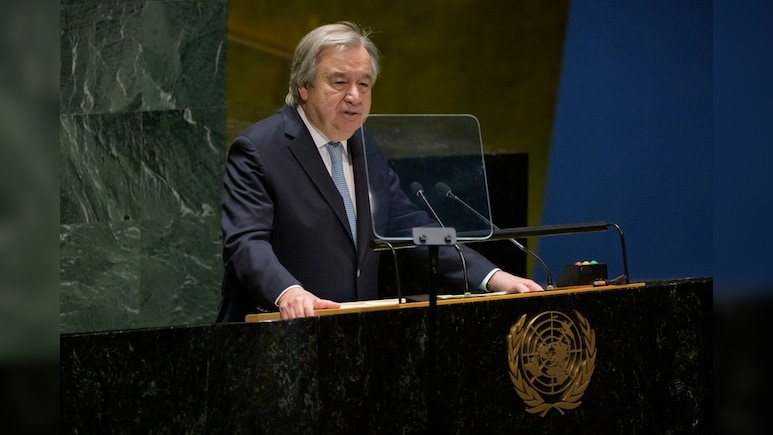
Asserting that the UN Charter is not "a la carte menu", UN chief Antonio Guterres denounced nations for brazenly violating international law, saying when leaders "pick and choose" which rules to follow, they undermine global order and set a "perilous" precedent.
As Guterres enters the final year of his tenure as UN Secretary General, he told the 193-member General Assembly on Thursday that he will make every day of 2026 count and remains fully committed and determined to keep working, fighting, and pushing for a better world.
Against the backdrop of the recent US military action in Venezuela, the 2022 Russian invasion of Ukraine as well as other geo-political challenges, Guterres said the world is brimming with conflict, impunity, inequality and unpredictability.
"A world marked by self-defeating geopolitical divides...brazen violations of international law...and wholesale cuts in development and humanitarian aid. These forces and more are shaking the foundations of global cooperation and testing the resilience of multilateralism itself," he said.
"That is the paradox of our era: at a time when we need international cooperation the most, we seem to be the least inclined to use it and invest in it. Some seek to put international cooperation on deathwatch. I can assure you: we will not give up," the UN chief said.
UN Secretary General's second five-year term at the helm of the world body comes to an end on December 31, 2026.
He made the remarks in his traditional address to the General Assembly on his priorities for the year ahead.
Guterres has expressed deep alarm at the escalation between the United States and Venezuela culminating in the capture of the country's President Nicolas Maduro, and had said that the developments constitute a "dangerous precedent" and expressed concern that rules of international law have not been respected.
Guterres, who has also consistently spoken out against the Russian invasion of Ukraine, told the General Assembly that no effort must be spared to stop the fighting in Ukraine and achieve a just and lasting peace in line with the UN Charter, international law and UN resolutions.
He, however, strongly criticised nations for violating international law and not adhering to the UN Charter, which he said is a "compact" that "binds us all." Underlining that the UN Charter is not an "a la carte menu" but is "prix fixe", Guterres said "we must adhere to the UN Charter - fully and faithfully. No ifs ... no ands ... no buts.
"The Charter is the foundation of international relations - the bedrock of peace, sustainable development, and human rights," he said.
Emphasising that while he is honoured to serve as custodian of the Charter, Guterres told the 193 UN Member States and their leaders that "each one of you has signed up to be a custodian of the Charter, too.
"When leaders run roughshod over international law - when they pick and choose which rules to follow - they are not only undermining global order, they are setting a perilous precedent," he said.
Guterres expressed concern that the erosion of international law is not happening in the shadows but is "unfolding before the eyes of the world, on our screens, live in 4K." He said people everywhere are witnessing, in real time, the consequences of impunity - "the illegal use and threat of force; attacks on civilians, humanitarian workers and UN personnel; unconstitutional changes of government; the trampling of human rights; the silencing of dissent; the plundering of resources."
The UN chief also lamented that the dangers do not stop with States or warring parties but are being amplified by "bottomless" greed and inequality in a world where the top one percent holds 43 percent of global financial assets and the richest 500 individuals added $2.2 trillion to their fortunes in the last year alone.
"Increasingly, we see a world where the ultra-wealthiest and the companies they control are calling the shots like never before - wielding outsized influence over economies, information, and even the rules that govern us all.
"When a handful of individuals can bend global narratives, sway elections, or dictate the terms of public debate, we are not just facing inequality - we are facing the corruption of institutions and our shared values," he said.
(Except for the headline, this story has not been edited by NDTV staff and is published from a syndicated feed.)
Track Latest News Live on NDTV.com and get news updates from India and around the world


