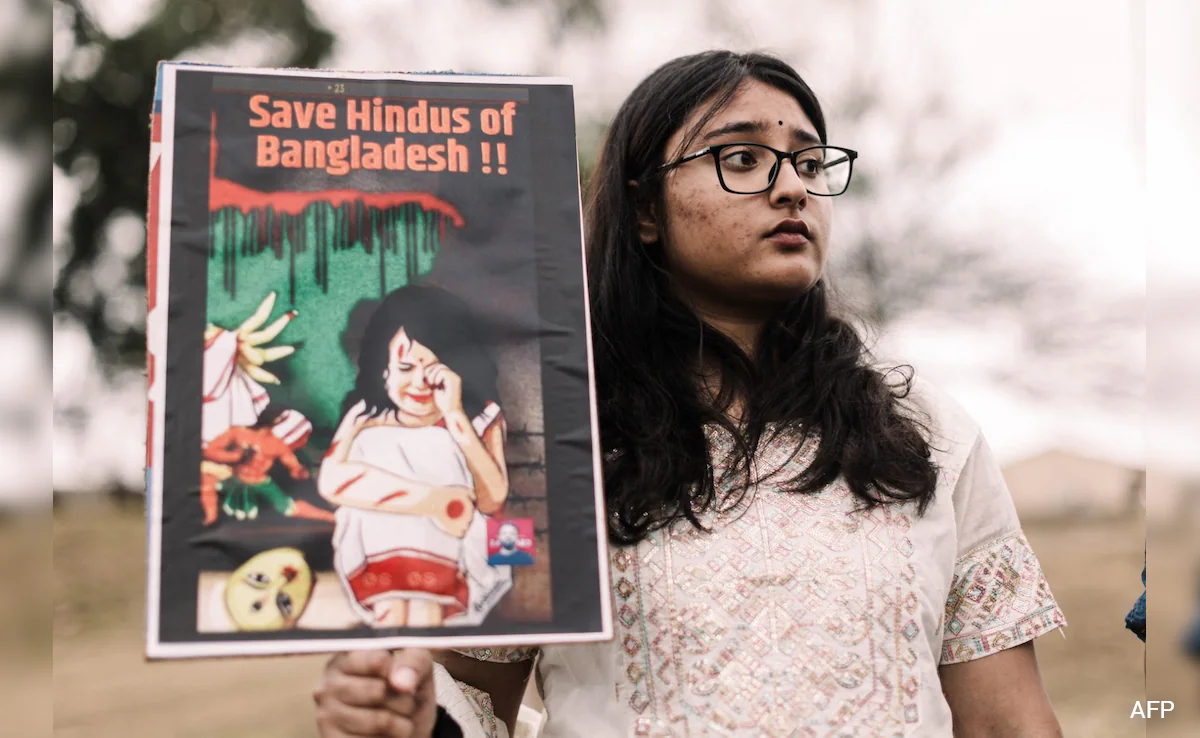
A broad international alliance of human rights organisations, faith groups, and civil society leaders has issued an urgent global appeal warning that Hindus in Bangladesh are facing escalating violence and systematic persecution under the interim government led by Muhammad Yunus, just days before national elections scheduled for February 12.
Coordinated by the Hindus Advancing Human Rights Initiative (HAHRI), the letter—endorsed by more than 125 organisations and individuals across 15 countries—called on the United Nations, the United States, the European Union, India, and other international stakeholders to take immediate, enforcement-orientated action, warning that continued inaction risks the erasure of an indigenous religious minority through what signatories describe as sustained ethnic and religious cleansing.
With Bangladesh heading into national elections on Thursday, mounting international concern is focusing on the deteriorating condition of the country's Hindu minority under the interim administration led by Muhammad Yunus. Human rights advocates warned that persistent violence, intimidation, and forced displacement of Hindus have intensified since the political transition of August 2024, raising serious questions about minority safety and democratic credibility ahead of the polls.
The global coalition calls for international intervention to protect Hindus in Bangladesh, saying that the systematic pattern of persecution has worsened under the Yunus-led interim government.
At the centre of global outrage is the public lynching of Dipu Chandra Das on December 18, 2025. Das, a Hindu man, was killed following false allegations of blasphemy. Graphic footage of the killing circulated widely online, underscoring what rights groups describe as a collapse of the rule of law and the normalisation of mob violence against religious minorities. The incident, they argued, is not isolated but emblematic of a broader climate of impunity.
According to data cited in the alliance letter, Bangladesh has witnessed thousands of attacks on minorities since August 2024, including murders, arson, temple desecration, and land seizures. Blasphemy accusations, often unsubstantiated, have increasingly been used to incite mobs, justify arrests, and destroy Hindu homes and businesses. International monitoring bodies, including the US Commission on International Religious Freedom, have reported a steady rise in intimidation and violence against Hindu communities throughout 2025.
The demographic impact is stark. Hindus constituted roughly 22 per cent of the population in 1951. Today, they account for less than 7 per cent. Human rights experts estimate that hundreds of thousands have fled to India over recent decades, calling the decline evidence of slow but sustained ethnic and religious cleansing rather than voluntary migration.
"A minority does not disappear at this scale without coercion," said Ajay Shah, Executive Chair of HinduPACT, warning that democracy cannot survive selective protection of rights.
As the election approaches, activists argue that minority insecurity threatens the legitimacy of the political process itself. Fear and displacement, they said, undermine free participation and reinforce extremist influence. The alliance has urged governments and international institutions to move beyond symbolic statements and adopt enforcement-oriented measures, including independent fact-finding missions, public reporting requirements, and accountability mechanisms.
In parallel with diplomatic advocacy, rallies have been held in more than 25 cities across the United States, reflecting growing grassroots and multifaith solidarity. Demonstrators described the situation as a "drip-drip genocide", a slow accumulation of terror and displacement that rarely triggers emergency responses but steadily erodes an indigenous community's presence.
HAHRI has also launched a global petition addressed to UN official Volker Turk, urging the United Nations to acknowledge the targeted nature of the violence, establish an independent monitoring mechanism, and investigate the misuse of blasphemy allegations. Thousands have signed the petition, signalling that concern extends well beyond policy circles.
With election day looming, rights advocates warn that the international community faces a critical test. "Human rights are not divisible," Shah said. "Protecting Hindus in Bangladesh is not a sectarian issue-it is a measure of whether global norms mean anything when an entire community is pushed toward erasure."
Track Latest News Live on NDTV.com and get news updates from India and around the world


