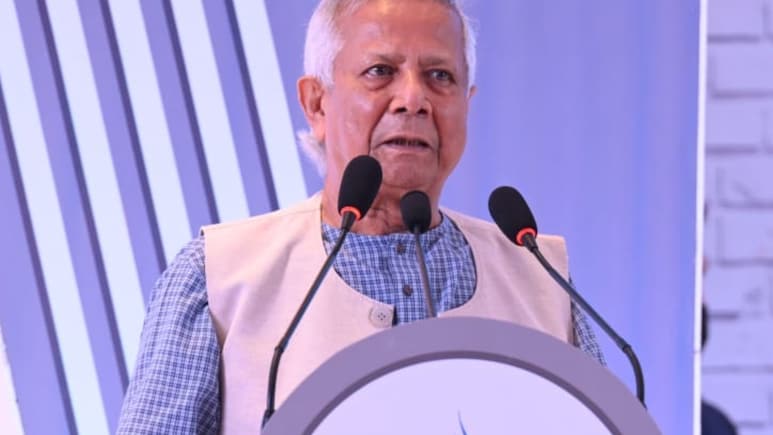
Bangladesh's interim government chief Muhammad Yunus late Monday made a strong appeal to people to vote 'Yes' in the February 12 referendum being held simultaneously with the general elections and back his proposed reform package.
"If the 'Yes' vote wins in the referendum, Bangladesh's future will be built in a more positive way," he said, addressing senior secretaries and top bureaucrats as the poll campaign ended at 12 midnight, 48 hours before the polls in line with election laws.
Yunus said a 'Yes' referendum would keep "misrule" away, after his administration actively campaigned to elicit public support for the complicated 84-point reform package the past several weeks.
In line with a Bangladesh Bank order, the commercial banks too display 'Yes' vote banners at government offices, while the central bank has also asked banks to use their CSR funds to support NGO campaigns for the referendum.
State functionaries who would be involved in conducting the polls continued canvassing till January 29, when the election commission strictly debarred government officials from engaging in such a campaign, calling it a "punishable offence".
Several legal experts said that since the referendum asks voters to choose either "Yes" or "No", the interim government was expected to maintain an impartial position instead of adopting an openly partisan role, given the considerable amount of public money required for it.
Some jurists also questioned the legitimacy of the referendum, since the Bangladesh Constitution does not have any provision for such a referendum.
The referendum sought the people's consent on the reform proposals called "July National Charter-2025", which Yunus announced in a drummed-up ceremony on October 17, after a protracted consultation between political parties and the National Consensus Commission that he headed.
Announcing the charter, Yunus said it represented a move toward a "civilised society from barbarism".
In a nationwide address last month, Yunus sought 'Yes' votes for his administration's reform package.
The referendum ballot features a single question covering four major reform areas of the July Charter, while voters are instructed to vote 'Yes' if they agree more strongly with the proposals and 'No' if they disagree.
But critics said the charter contains multiple complex reforms and so the referendum could be a complicated task even for informed voters who might support some changes but oppose others.
They said the referendum also seeks to make it obligatory for the next government to implement the charter and legitimise the Yunus-led regime, which was installed after a student-led street protest, dubbed the July Uprising, toppled then prime minister Sheikh Hasina's Awami League government on August 5, 2026.
The interim government also got the proposal signed by President Mohammed Shabuddin and subsequently issued an official gazette on it.
Several legal experts, however, questioned the legitimacy of the referendum itself. "Most of the decisions taken in the July Charter, including those in the gazette, are contrary to the current Constitution," said Swadhin Malik, a leading jurist.
He said that since the Constitution was still in force, the President cannot legally sign this gazette, while it could have been acceptable if the Constitution had been annulled or suspended under martial law.
"Since neither has happened, everything should proceed according to the existing Constitution," Malik said.
(Except for the headline, this story has not been edited by NDTV staff and is published from a syndicated feed.)
Track Latest News Live on NDTV.com and get news updates from India and around the world


