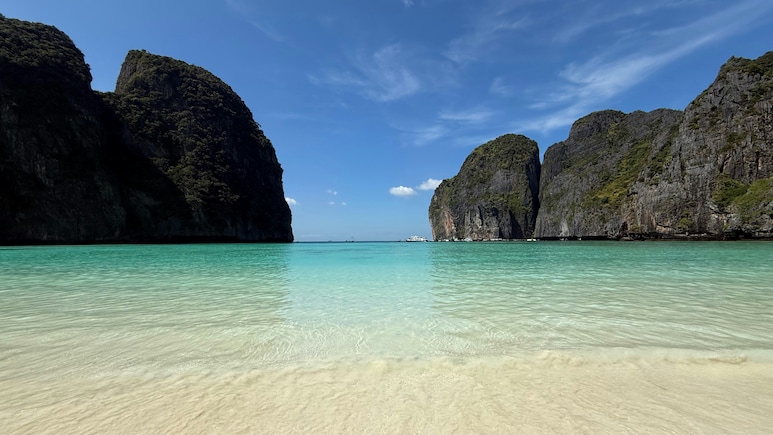
For many travellers, Thailand's Maya Bay represents paradise. With its luminous turquoise waters, powder-soft sand and dramatic limestone cliffs, the small cove on Phi Phi Leh island shot to global fame after featuring in the 2000 Leonardo DiCaprio film The Beach. Two decades on, it continues to draw visitors from around the world - but with one unexpected rule: swimming is not allowed.
At first glance, the restriction surprises visitors standing before such inviting waters. But beneath the surface of this picturesque bay lies a hard-won conservation story that has reshaped how tourism works here - and why strict limits are now in place.
From Hidden Cove To Global Sensation
Maya Bay is a 250-metre-long cove located in Krabi Province, within Hat Noppharat Thara-Mu Ko Phi Phi National Park. Surrounded by steep limestone cliffs and accessible only by boat, the bay once felt remote and untouched.
Everything changed after the release of The Beach in 2000. Its cinematic portrayal gave Maya Bay a near-mythical status, and over the following years, tourism surged. By 2018, as many as 5,000 visitors a day were arriving, often at the same time, crowding the narrow stretch of sand.
The pressure on the landscape soon became visible. Dozens of boats anchored directly in the bay, their propellers churning up sand and damaging coral reefs. Anchors struck the sea floor, while tourists unknowingly walked on fragile corals in shallow waters.

Still from 'The Beach'
A Fragile Ecosystem Pushed To The Brink
Marine biologists had begun monitoring coral health around Maya Bay roughly three decades ago, when an estimated 70 to 80 per cent of the coral reef was intact. Years of unchecked tourism reversed that balance dramatically. By the time authorities intervened, less than 8 per cent of the reef remained healthy.
The environmental damage also affected the visitor experience. Instead of uninterrupted views of the bay, tourists were met with long lines of speedboats blocking the horizon, engines running and crowds spilling across the sand.
Recognising the severity of the situation, Thai authorities made a decisive move in the summer of 2018: Maya Bay was closed indefinitely to all tourists.
Also Read: Too Many Tourists, Japan Is Now Adding A New Tax To Stay In The Country
Four Years Without Visitors - Maya Bay Recovery
The closure was intended to give the bay's ecosystems time to recover, particularly its coral reefs. Then the global pandemic arrived, extending the absence of tourists and providing nature with an even longer pause.
During this period, marine life began to return in remarkable ways. Most notably, blacktip reef sharks - a species that favours shallow, sandy waters as nurseries for their young - were spotted in increasing numbers. At one point, researchers recorded as many as 161 sightings.
These sharks are vital to the health of the ecosystem, helping control fish populations by feeding on weak or sick animals. Their return became a key indicator that the bay was healing.
Alongside this natural recovery, marine experts and volunteers undertook large-scale restoration efforts. More than 30,000 pieces of coral were replanted, much of it cultivated off the nearby island of Koh Yung. Around half of this coral survived early challenges such as bleaching, and it has since begun to grow and spread naturally.
Also Read: Why This Picturesque Italian Village Is Now Curbing Tourism At Its Hotspot
Reopening With Limits - And Lessons Learned
The prolonged closure came at a significant cost to the local economy, cutting income for surrounding communities by roughly half. With livelihoods affected, discussions began about how Maya Bay could be reopened without repeating past mistakes.
In November 2021, Thailand's Minister of Natural Resources and Environment announced that Maya Bay would reopen in January 2022, after conservationists agreed the area had sufficiently regenerated.
When the beach reopened, it did so under a new model of tightly controlled tourism.
- Visitor numbers are capped at 375 per hour, and access is limited to 10 am to 4 pm.
- Visitors may stay for only one hour.
- Motorboats are banned from entering the bay itself; instead, tour boats must anchor in another bay on the island's opposite side. No more than eight speedboats are allowed in nearby waters at any given time.
- Most notably, swimming is prohibited. Visitors may wade only a few steps into the water - roughly knee-deep - before park officials intervene.
Why Swimming Remains Off-Limits At Maya Bay
The swimming ban serves multiple purposes. According to park authorities, entering deeper waters risks disturbing the blacktip reef sharks that have returned to the bay. There is also concern that inexperienced swimmers could accidentally step on or break newly restored coral.
"The corals can be broken, our natural resources could again disappear," the park director has explained, reported CNN, noting that the current setup is considered a necessary compromise between access and protection.
Officials actively enforce the rules. Visitors who venture too far into the water are quickly signalled back by lifeguards stationed in discreet towers along the tree line.
Fines are issued for violations, with penalties reaching 5,000-10,000 baht (Rs 15,000-29,000) for ignoring the no-swimming rule.
A New Kind Of Travel Experience
Today, Maya Bay is less crowded, more orderly and, in many ways, closer to the natural wonder that first captured global attention.
As the Governor of the Tourism Authority of Thailand observed when the bay reopened, the return of sharks, regrowing coral reefs and clear waters proves that nature is capable of healing - provided it is given time and care.
For visitors, the experience now comes with a quieter lesson: that sometimes, the greatest way to enjoy a destination is to admire it without disturbing what lies beneath its beauty.
Got a follow‑up question on this article? Go on
Track Latest News Live on NDTV.com and get news updates from India and around the world


