





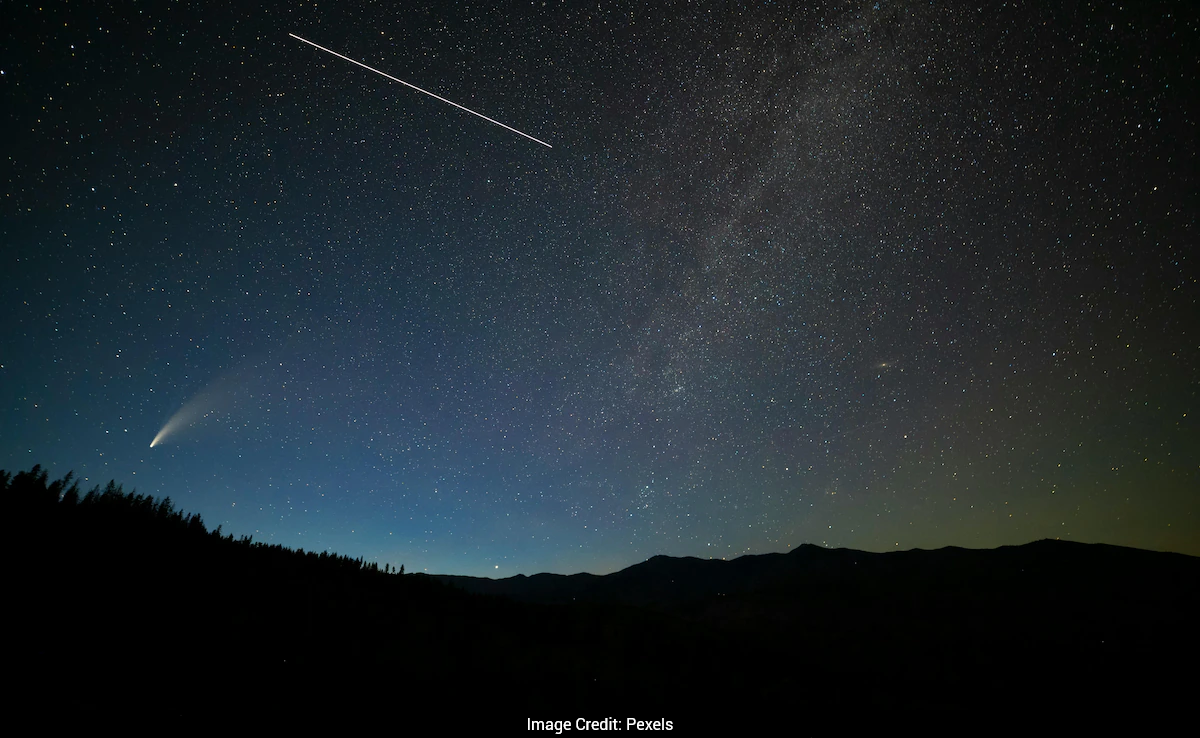
Stargazers around the world were treated to a rare and dramatic sight in 2025, as three remarkable comets swept into the inner solar system, survived close encounters with the sun, and then disappeared forever into deep space, reported Space.com.
The year stood out for its memorable comet activity, with interstellar visitor 3I/ATLAS, along with comets C/2025 A6 (Lemmon) and C/2025 R2 (SWAN), drawing global attention. While not all of these icy bodies survived intense solar radiation, each left a strong impact through scientific discovery, breathtaking images, and widespread public interest. In some cases, false claims and rumors also spread online, adding to the attention surrounding these cosmic visitors.
Of the three major comets, 3I/ATLAS was identified on July 1, 2025, by the NASA-funded ATLAS telescope in Rio Hurtado, Chile. Scientists quickly determined that it was the third known interstellar object to enter our solar system, following 1I 'Oumuamua and 2I Borisov. Its mysterious origin piqued the curiosity of both scientists and the public, with some falsely claiming it to be an alien spacecraft.
Further data from the Hubble Space Telescope revealed that 3I/ATLAS is the brightest and possibly the most massive interstellar object ever observed, estimated to be approximately 3.5 miles across. For these reasons, it was considered one of the most significant scientific comet discoveries of the year.
While 3I/ATLAS was the most significant scientific observation, Comet C/2026 A6 (Lemmon) captured everyone's attention with its spectacular view. Discovered on January 3rd, the comet rapidly increased in brightness and quickly became a favorite subject for astrophotographers. On November 8th, it became visible to the naked eye during its very close approach to the Sun. As it approached the Sun, the ice in its core began to transform into gas due to heat, and dust was ejected along with it. The solar wind subsequently shaped this material into a magnificent and complex tail.
Photographers captured every aspect of Comet Lemmon throughout its journey. On October 24th, astronomer Gianluca Masi recorded a rare sight when a streak of bright meteors visible in Earth's upper atmosphere appeared to be exactly aligned with the comet's distant tail. This sighting occurred in the constellation Serpens and created a remarkable optical illusion.
Another memorable moment involved Comet C/2025 R2 (SWAN), which impressed everyone on October 17th when it passed in front of the Eagle Nebula. Astrophotographer Daniele Gaspari captured a stunning image of the comet's glowing green coma against the clear skies of Chile's Atacama Desert, with the vast Eagle Nebula providing a striking backdrop.
The view also revealed the famous "Pillars of Creation," massive pillars of dust and gas shaped by the energy of nearby stars. These pillars glowed within the nebula near the comet's bright center. Together, these sights made 2025 a memorable year for comet watchers and space enthusiasts.
Track Latest News Live on NDTV.com and get news updates from India and around the world

