





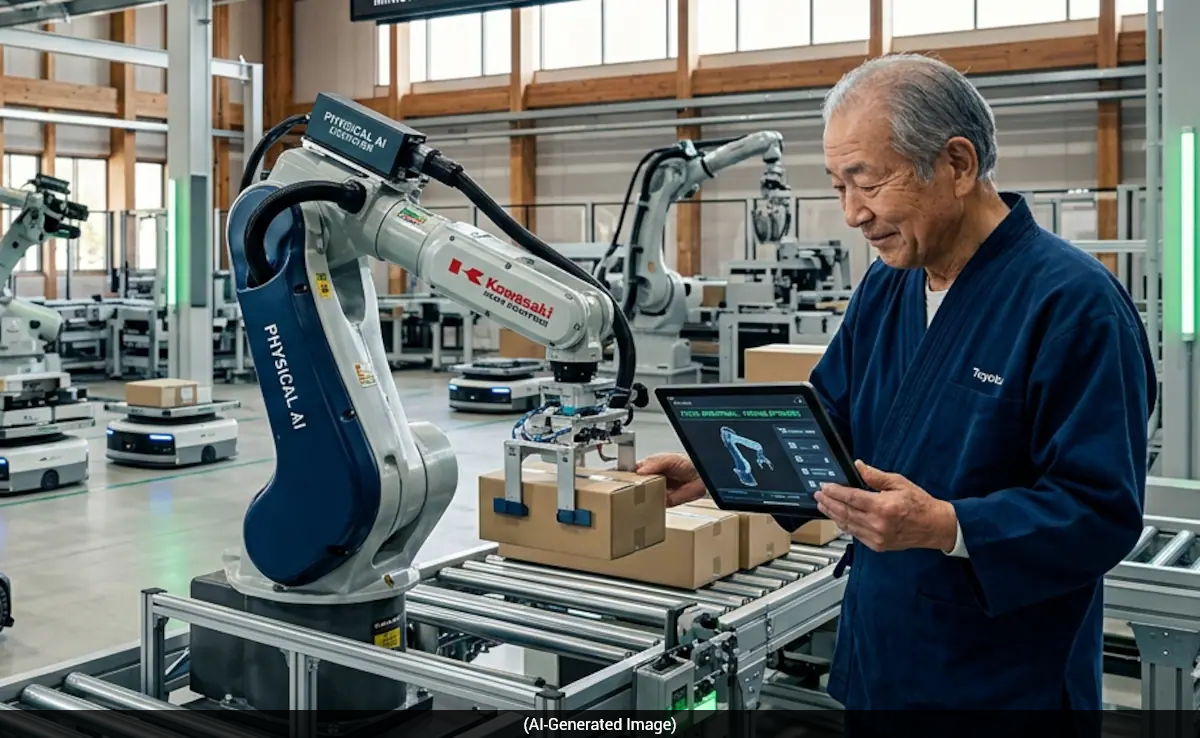
Japan is racing to become a world leader in physical AI, the technology that puts artificial intelligence into robots and machines operating in the real world, according to TechCrunch. But unlike the United States or China, where ambition and investment are the primary drivers, Japan's push is rooted in something more urgent: survival.
The country's workforce is shrinking at an alarming rate. Japan's population fell for a 14th consecutive year in 2024, with working-age people now making up just 59.6 per cent of the total population. That figure is expected to fall by nearly 15 million over the next two decades. Factories, warehouses, care facilities and critical infrastructure are already struggling to find enough workers to keep running.
"The driver has shifted from simple efficiency to industrial survival," Sho Yamanaka of Salesforce Ventures told TechCrunch. "Physical AI is a matter of national urgency."
In March 2026, Japan's Ministry of Economy, Trade and Industry set out its ambitions plainly, announcing a target to capture 30 per cent of the global physical AI market by 2040. The country already controls roughly 70 per cent of the global industrial robotics market, giving it a strong foundation to build upon. The government of Prime Minister Sanae Takaichi has committed approximately $6.3 billion to back the effort, covering AI development, robotics integration and industrial deployment.
Japan's strengths lie in hardware. Its manufacturers lead the world in precision components, actuators, sensors and robot motion control. Companies such as Mujin are now layering intelligent software platforms on top of that hardware base, allowing robots to handle complex logistics and picking tasks without human direction. Mobility startup WHILL, meanwhile, is drawing on Japan's celebrated manufacturing philosophy, known as monozukuri, to build a full-stack autonomous transport platform combining electric vehicles, sensors, navigation and cloud-based fleet management.
Where Japan faces greater competition is at the software and systems level. The United States and China are moving faster to build integrated platforms that combine hardware, software and data into seamless products. The US in particular leads in service-layer development and market reach, while China is rapidly expanding its full-stack capabilities.
"In physical AI, a deep understanding of hardware is critical," said Mujin chief executive Issei Takino. "This requires highly specialised control technologies that take significant time and considerable cost to develop."
Investors and executives broadly expect Japan's physical AI sector to evolve as a hybrid ecosystem rather than a winner-takes-all market. Large industrial players such as Toyota, Mitsubishi Electric and Honda will provide scale and reliability, while startups drive innovation in orchestration software, perception systems and autonomous workflows. SoftBank is already combining vision-language models with real-time control systems to deploy robots capable of interpreting their surroundings and acting independently.
"The most defensible value will sit with whoever owns deployment, integration and continuous improvement," said Hogil Doh of Global Brain.
Japan's defence sector is also beginning to shift, with startups playing a growing role alongside traditional contractors. Terra Drone, for instance, is using AI and operational data to develop autonomous systems for real-world defence infrastructure.
The transition from pilot projects to paid, full-shift deployments is now under way. For Japan, robots are not replacing workers. They are filling positions that nobody else can.
Track Latest News Live on NDTV.com and get news updates from India and around the world

