





Scientists using NASA's James Webb Space Telescope have made a discovery that could change what researchers know about the origins of supermassive black holes. New observations suggest that some of these giant objects may have formed already massive in the early universe, rather than growing slowly from the collapse of stars inside galaxies, reported NASA.
For many years, scientists believed that galaxies formed first. According to this idea, large stars inside galaxies eventually ran out of fuel and collapsed into black holes. These black holes then grew larger over time by consuming surrounding material and merging with other black holes.
However, this theory has struggled to explain how supermassive black holes, with masses millions or even billions of times greater than the Sun, appeared so quickly in the early universe.
Researchers now say new evidence suggests that some of these black holes may have formed without first going through a stellar collapse phase and without needing a much larger host galaxy to support their growth.
Roberto Maiolino of the University of Cambridge, a co-author of the studies published in Nature and Monthly Notices of the Royal Astronomical Society, described the finding as remarkable. He said the discovery represents a major shift in understanding and requires scientists to revisit traditional ideas about how black holes form and grow.
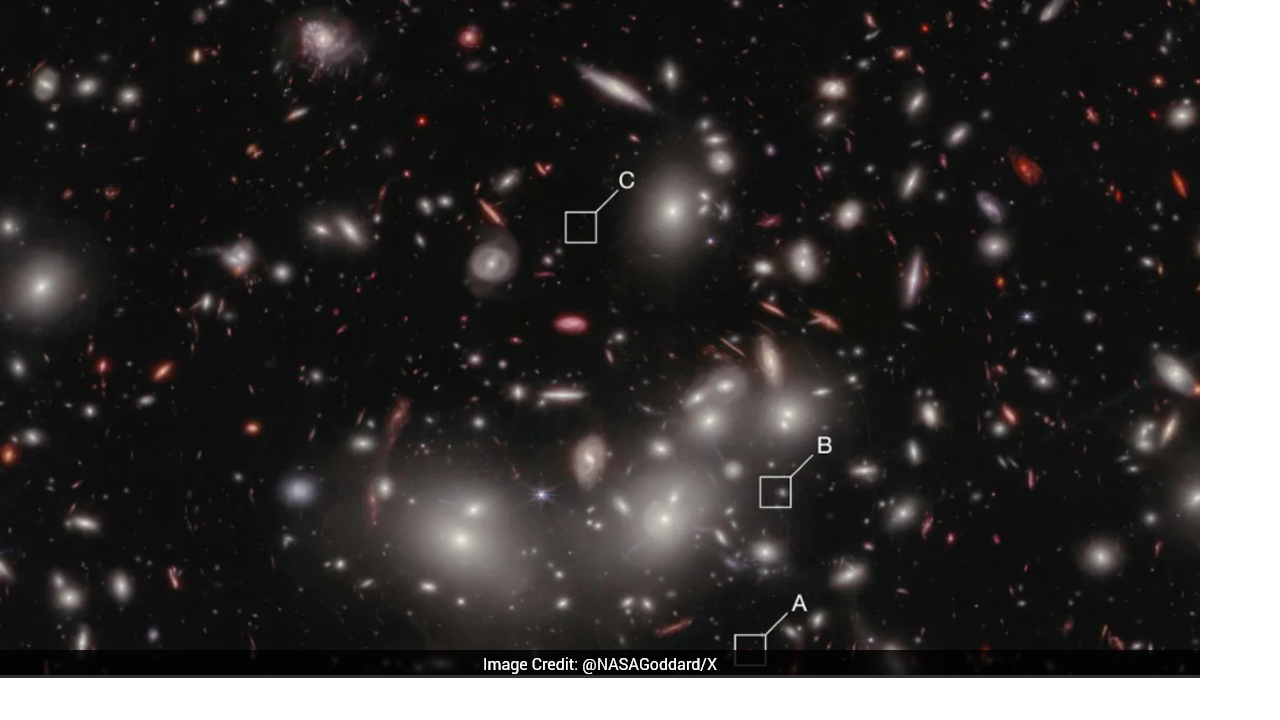
The research focused on an object known as Abell2744-QSO1, or QSO1, a member of a class of objects called Little Red Dots. QSO1 existed only about 700 million years after the Big Bang.
Although QSO1 is only around 1,300 light-years across, it is easier to observe than many similar objects because its light is magnified by the massive galaxy cluster Abell 2744, also known as Pandora's Cluster. This gravitational lensing effect causes the object to appear brighter and in three different locations in the sky.
Check Out The Post Here:
That's one big baby!
— NASA Goddard (@NASAGoddard) June 1, 2026
New science from @NASAWebb suggests some supermassive black holes are born big, rather than forming gradually within a galaxy - possible evidence for kinds of black holes that have been theorized but never seen. https://t.co/pBHrIz4PeF pic.twitter.com/dncTavFkdw
Earlier observations suggested that QSO1 could be a cloud of hydrogen and helium gas orbiting a supermassive black hole estimated to be about 40 million times the mass of the Sun. However, scientists were uncertain whether the black hole was truly that massive.
Francesco D'Eugenio of the University of Cambridge said previous measurements of black holes in the early universe were indirect and relied on assumptions based on nearby black holes.
To investigate further, the team used the integral field unit on Webb's Near Infrared Spectrograph. The instrument allowed them to study how gravity affected gas moving around the black hole.
Researchers Ignas Juodzbalis and Cosimo Marconcini mapped the motion of hydrogen gas surrounding the object. They found that the gas followed Keplerian motion, meaning it orbited a central point in the same way planets orbit the Sun.
Juodzbalis said this showed that most of QSO1's mass is concentrated in the black hole at its centre. He explained that if a large number of stars were present, the gas would not display such a clear orbital pattern.
The results showed that the black hole has a mass of roughly 50 million Suns. Researchers found that it accounts for at least two-thirds of QSO1's total mass.
This proportion is far larger than what is typically seen in nearby galaxies, where supermassive black holes make up only a small fraction of a galaxy's total mass.
The observations also revealed that the gas surrounding the black hole consists almost entirely of hydrogen and helium, with very little oxygen or other heavier elements.
Track Latest News Live on NDTV.com and get news updates from India and around the world

