US-Iran War Highlights: US President Donald Trump has said he persuaded Prime Minister Benjamin Netanyahu to call off the strike on Beirut, following which the Israeli leader "turned his troops around". Trump made the announcement on Truth Social amid reports that the conversation between the two leaders was "heated" and the US president told Netanyahu that he would have been in prison but for his intervention.
"I had a conversation with Bibi Netanyahu today (Monday), asking him not to go into a major raid of Beirut, Lebanon. He turned his Troops around. Thank you Bibi," he said, referring to the Israeli prime minister by his widely used nickname.
Trump's phone calls with Netanyahu came after Iran threatened to end the negotiations with the US over Israel's attacks on Lebanon. Netanyahu had said Israel would hit "terror targets" in Beirut if Hezbollah did not stop attacking Israel.
The president said he also had a conversation with the representatives of the leaders of Hezbollah, who agreed to "stop shooting at Israel and its soldiers".
"I also had a conversation with Representatives of the Leaders of Hezbollah, and they agreed to stop shooting at Israel and its soldiers. Likewise, Israel agreed to stop shooting at them. Let's see how long that lasts — Hopefully it will be for ETERNITY," he said.
US media outlet Axios reported that tempers flew during Trump's phone call with Netanyahu.
Here Are The US-Iran War Highlights:
Iran War News: Trump Says Iran Talks Happening 'Continuously'
President Donald Trump said Tuesday that the United States and Iran were speaking "continuously," denying reports that Tehran had broken off contact over Israel's attacks on Lebanon.
Trump added that "one never knows" where the negotiations would lead, as weeks of direct and indirect talks have failed to end the US-Israeli war on Iran that began on February 28.
"Fake News Reports that the Islamic Republic of Iran, and the U.S.A., stopped speaking a few days ago are false and erroneous," Trump said on his Truth Social network.
(AFP)
Iran War News: Rubio Says Mojtaba Khamenei Alive And 'Increasingly Engaging'
US Secretary of State Marco Rubio said Tuesday that Iran's supreme leader Mojtaba Khamenei, who was wounded in US-Israeli attacks and has not been seen in public since assuming office, is alive and increasingly active.
"I think there are indications out there that he is increasingly engaging at some level," Rubio told the Senate Foreign Relations Committee.
Mojtaba Khamenei, 56, succeeded his father Ali Khamenei, who was killed in the first wave of US-Israeli strikes that launched the war on February 28.
(AFP)
Iran War News: Iran War Strengthening UAE-Israel Ties: Israeli Official To AFP
Israel and the United Arab Emirates are growing closer because of the Middle East war, a senior Israeli official told AFP, citing increased military cooperation and opportunities to increase trade and business ties.
Two Israeli delegations will arrive next week, the Gulf-based official said, including a transport ministry team that will discuss a trade corridor linking India, the Middle East and Europe.
The visits will be the first since the war erupted on February 28, when the United States and Israel attacked Iran and triggered an Iranian backlash against nearby Gulf countries that host US military bases.
Weeks of drone and missile bombardment drew a hawkish response from the oil-rich UAE, aligning it more closely with Israel, which regards Iran as its arch-enemy.
(AFP)
Iran War News: Iran Stops Talking To Mediators Over Israel Fighting Hezbollah In Lebanon, Iranian Reports Say
Iran stopped communicating with mediators after Israel threatened to bomb Beirut as it continues fighting the Iranian-backed Lebanese militia Hezbollah, two semiofficial Iranian news agencies reported.
The reports by the Fars and Tasnim news agencies, both believed to be close to Iran’s paramilitary Revolutionary Guard, come as Iran insists the fighting in Lebanon is part of the wider ceasefire talks with the United States over the war. Israel and the U.S. maintain the fighting in Lebanon is separate from the Iran war talks.
A regional official involved in the mediation, speaking on condition of anonymity to discuss the talks, said Iran has not communicated at all on Tuesday after saying that a ceasefire needed to be enforced in Lebanon for negotiations to continue.
(AP)
Iran War News: Netanyahu Says Israel Will Help Make Iran 'Terror Regime' Disappear
Netanyahu says Israel will help make Iran 'terror regime' disappear
(AFP)
Iran War News: Iran's Inflation Hits World War II Levels, Deepening Economic Pain
Year-on-year inflation in Iran reached a level in May unseen since World War II, underlining the economic pain average Iranians face as the Islamic Republic worries about the war with Israel and the United States restarting.
A report Monday by Iran's Central Bank represents the first official acknowledgment of what Iranians shopping, paying for a taxi or visiting a medical clinic already know: The rial currency is battered by the war and uncertainty around it resuming.
Meanwhile, longtime problems of economic mismanagement and government corruption also appear to be dragging down Iran's oil-backed economy as it remains under a U.S. naval blockade.
Economic pressure in the past has sparked nationwide protests, something Iran's theocracy has been trying to avoid since a crackdown on demonstrators in January killed over 7,000 people, according to activists' estimates.
(AP)
Iran War News: Iran Studying Deal To Halt War As Stalemate Persists
Iran is reviewing a proposed agreement with the United States to halt the war between the two countries, Iran's Mehr news reported on Tuesday, after U.S. President Donald Trump said talks to reach a deal were continuing.
More than three months after the U.S. and Israel launched strikes against Iran, the conflict has hardened into a stalemate while largely indirect talks to negotiate an interim deal have proved inconclusive, leaving the Strait of Hormuz largely shut.
Iran has not yet responded to a proposed final text of the temporary deal, and was taking a "stern" approach given what it sees as a history of U.S. non-compliance and longstanding mistrust, Mehr cited a source as saying.
Trump said on Monday that negotiations with Iran were continuing and there would be a deal to extend the ceasefire and reopen the Strait of Hormuz over the next week.
(Reuters)
Iran War News: Crude Oil Futures Slip Amid Uncertainty Over US-Iran Ceasefire Talks
Crude oil prices fell marginally to Rs 8,697 per barrel in futures trade on Tuesday, tracking losses in global benchmarks even as investors remained cautious over the fluid geopolitical situation involving the US and Iran.
On the Multi Commodity Exchange (MCX), the most-traded June contract slipped by Rs 39, or 0.45 per cent, to Rs 8,697 per barrel in a business turnover of 9,045 lots.
The July contract also weakened, falling Rs 70, or 0.82 per cent, to Rs 8,466 per barrel in 2,512 lots.
Analysts said market sentiment was weighed down by uncertainty after diplomatic efforts aimed at resolving the crisis faced repeated hurdles, raising concerns over the outlook for global oil demand and supply.
Meanwhile, US President Donald Trump on Monday indicated that Israel and Hezbollah had agreed to halt hostilities, raising hopes that a broader regional conflict could be avoided.
Iran War News: Senior Iranian Officer Says Renewed War With US 'Inevitable'
A senior Iranian officer says renewed war with the US is 'inevitable', AFP reported quoting state TV
US-Israel-Iran War News LIVE: Israel, Hezbollah Clash Ahead Of US-Hosted Talks
Israel and Hezbollah clashed overnight despite US President Donald Trump's announcement that both sides had agreed to halt fighting ahead of US-hosted talks between Israel and Lebanon on Tuesday.
Israel's growing offensive in Lebanon, including heavy bombardment and its deepest ground invasion in two decades, has threatened to scupper a ceasefire in the wider Middle East war between the United States and Iran.
Hezbollah drew Lebanon into the conflict on March 2 by firing rockets at Israel in retaliation for the US-Israeli killing of Iran's supreme leader, and Tehran has demanded that Lebanon be included in any peace deal with Washington.
The overnight clashes came after Lebanon said Iran-backed Hezbollah had accepted a US proposal for a "mutual cessation of attacks" after Trump said he persuaded the warring sides to de-escalate.
Under the arrangement, Israeli strikes on Dahiyeh, Beirut's southern suburbs, would cease in exchange for Hezbollah refraining from launching attacks against Israel, according to a statement from the Lebanese embassy in Washington.
US-Israel-Iran War News LIVE: 'Nothing Can Justify' Prolonged Israeli Occupation In Lebanon, Says France FM
France's foreign minister said Tuesday that nothing could justify Israeli troops remaining deep inside Lebanon, following the deepest incursion into Lebanese territory in two decades.
Israel and Iran-backed Lebanese militant group Hezbollah clashed overnight despite US President Donald Trump's announcement that both sides had agreed to halt fighting ahead of US-hosted talks between Israel and Lebanon.
"Nothing can justify the continuation of military operations and Israel's prolonged occupation deep inside Lebanese territory," Foreign Minister Jean-Noel Barrot told France TV.
Israeli troops on Sunday seized the Beaufort castle, which commands sweeping views of south Lebanon.
Israeli forces used the castle, also known as Qalaat al-Chakif, as a base during their previous two-decade occupation of southern Lebanon that ended in 2000.
Tehran has said that a ceasefire in Lebanon remains a key condition for any deal with Washington to end the Middle East war.
Us Iran War News: Qatari PM, Iranian FM Discuss Mediation Efforts, Regional Developments
Qatar's Prime Minister and Minister of Foreign Affairs, Sheikh Mohammed bin Abdulrahman bin Jassim Al-Thani, held a phone call with Iranian Foreign Minister Seyed Abbas Araghchi to discuss regional developments, according to Qatar's Foreign Ministry. The ministry said in a statement on Monday (local time) that the two officials reviewed Pakistani mediation efforts between the United States and Iran, as well as the latest developments in Lebanon.
Al-Thani reaffirmed Qatar's support for reaching a comprehensive agreement to resolve the crisis, urging all parties to engage constructively with mediation initiatives to achieve lasting peace and regional stability, reports Xinhua news agency.
He also stressed that freedom of navigation is a fundamental principle that must not be compromised, warning that closing the Strait of Hormuz or using it as a tool of pressure would only deepen the crisis and jeopardise the vital interests of regional countries.
The Qatari prime minister reiterated the importance of pursuing diplomatic solutions and dialogue to address regional challenges and prevent further escalation, according to the statement.
Trump Wants Tougher Iran Deal, But It Looks More Like Obama's 2015 Pact
It seems that the draft memorandum of understanding (MoU), which is being discussed with Iran, is, in some ways, similar to the deal he had strongly opposed.
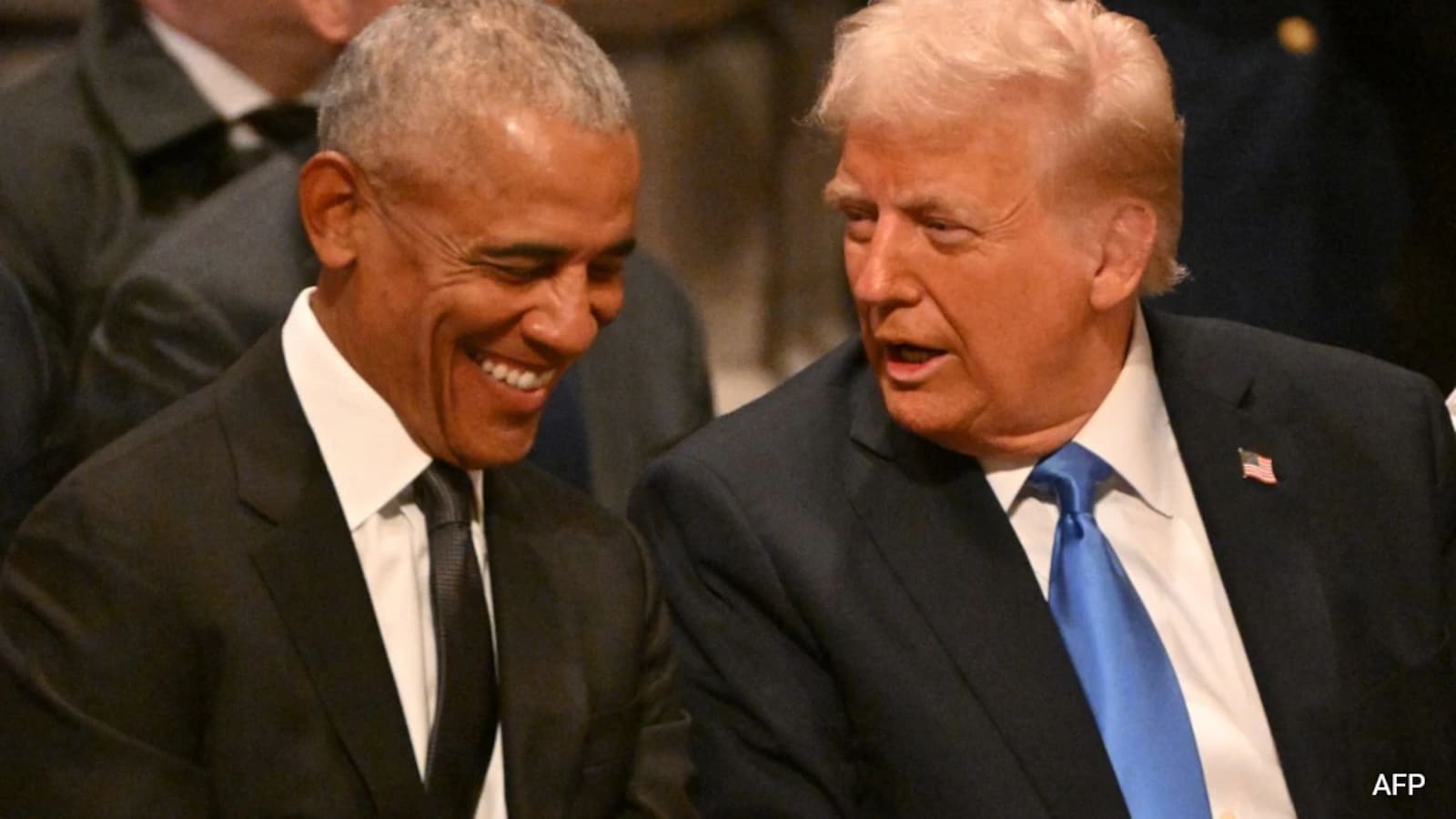
"You're F***ing Crazy, Everybody Hates You Now": Trump-Netanyahu Heated Call
US-Iran War Latest News: "You're F***ing Crazy, Would Be In Prison If It Weren't For Me": Trump Lashes Out At Netanyahu Over Lebanon
Iran US War News: Indian Shares To Open Lower As Iran War, Fund Outflows Continue To Weigh
Indian shares are likely to open lower on Tuesday as persistent anxiety around the war in the Middle East and unprecedented foreign outflows pressure markets.
Brent crude futures hovered around $94 per barrel amid stalled peace talks between the U.S. and Iran to resolve the three-month-old war that has pushed energy prices higher, raising inflation concerns.
GIFT Nifty futures were at 23,245.5 as of 7:49 a.m. IST, indicating the benchmark Nifty 50 would open below Monday's close of 23,382.6. The 50-stock index has shed 2.7% and the BSE Sensex is down 2.9% in the last four sessions.
Foreign investors sold shares worth 39.12 billion rupees ($411.83 million) on Monday, provisional data showed. They have offloaded $26.4 billion worth of shares so far in 2026, already surpassing 2025's record annual outflow of $18.91 billion.
India's forecast of the weakest monsoon in 11 years also fuelled concerns over crops, food prices and growth in the world's fifth-largest economy, which is already starting to battle inflation pressures from the Iran war.
US Iran War News: Israel Military Says Intercepted Projectiles From Lebanon
The Israeli military said early Tuesday air defences intercepted two projectiles from Lebanon, hours after US President Donald Trump announced that fighting would end. "Following the sirens that sounded at 01:35 (2235 GMT) in several areas in northern Israel, the IAF intercepted two projectiles that crossed from Lebanon into Israeli territory," the military said on Telegram.
A "suspicious aerial target" that later fell in Israeli territory near the Lebanese border was also identified it said, adding that no injuries were reported.
It came after Trump announced he had persuaded Israel and Hezbollah to de-escalate.
Hezbollah drew Lebanon into the Middle East conflict on March 2 by firing rockets at Israel in retaliation for the US-Israeli killing of Iran's supreme leader.
A truce was supposed to have halted the fighting since April 17, but has been repeatedly violated.
"There will be no Troops going to Beirut, and any Troops that are on their way, have already been turned back," Trump said on his Truth Social network after a "very productive" call with Israeli Prime Minister Benjamin Netanyahu.
US-Iran War Live Updates: Netanyahu Calls Off Lebanon Strikes After 'Explosive' Call With Trump
US President Donald Trump said he persuaded Prime Minister Benjamin Netanyahu to call off the strike on Beirut, following which the Israeli leader "turned his troops around".
Trump made the announcement on Truth Social on Monday evening amid reports that the conversation between the two leaders was "heated" and the US president telling Netanyahu that he would have been in prison but for his intervention.
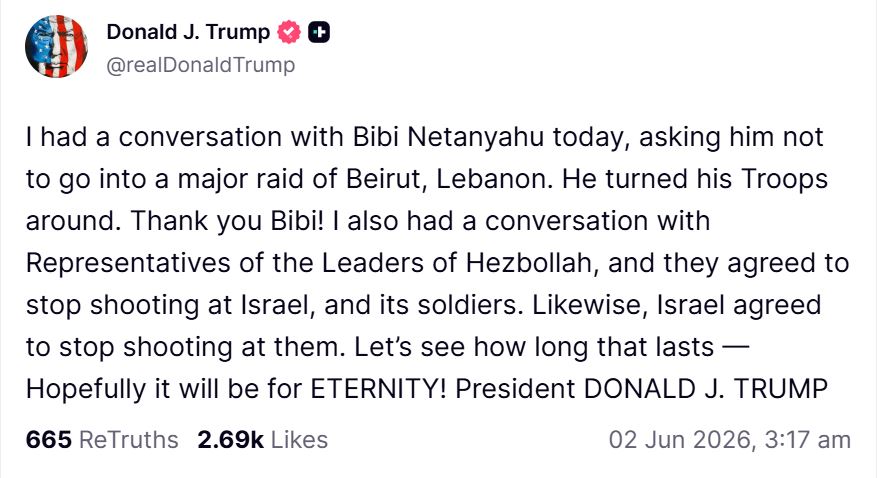
"I had a conversation with Bibi Netanyahu today (Monday), asking him not to go into a major raid of Beirut, Lebanon. He turned his Troops around. Thank you Bibi," he said, referring to the Israeli prime minister by his widely used nickname.
Trump’s phone calls with Netanyahu came after Iran threatened to end the negotiations with the US over Israel’s attacks on Lebanon. Netanyahu had said Israel would hit "terror targets" in Beirut if Hezbollah did not stop attacking Israel.
The president said he also had a conversation with the representatives of the leaders of Hezbollah, who agreed to "stop shooting at Israel and its soldiers".
"I also had a conversation with Representatives of the Leaders of Hezbollah, and they agreed to stop shooting at Israel and its soldiers. Likewise, Israel agreed to stop shooting at them. Let’s see how long that lasts — Hopefully it will be for ETERNITY," he said.
Deal With Iran On Truce, Hormuz Expected "Over The Next Week", Says Donald Trump
He told ABC News he has thus far withheld final approval on a Memorandum of Understanding (MoU) aimed at unblocking the vital shipping lane, explaining, "I still have to get a few more points."
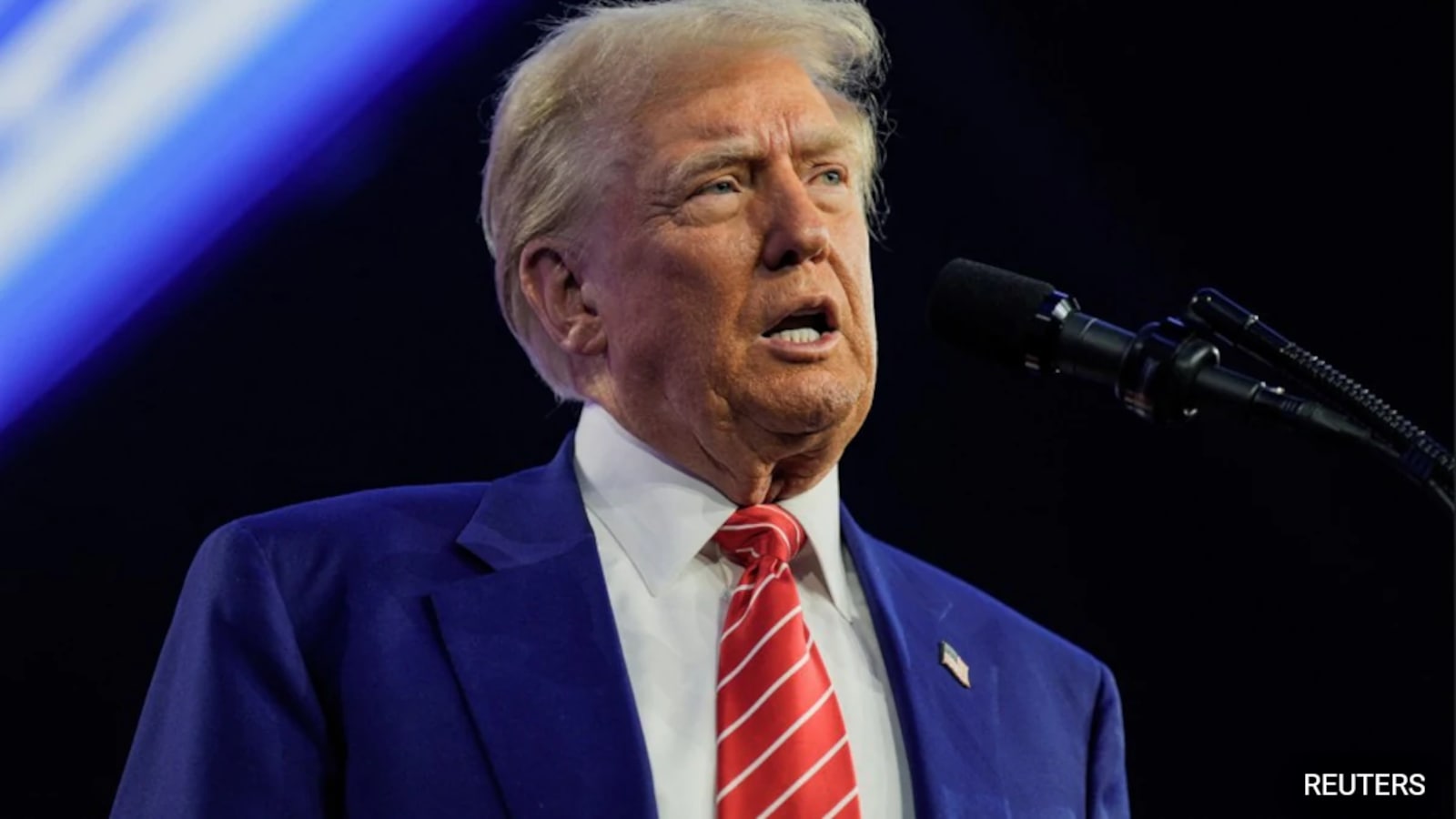
Iran War Live: Trump Urges Israel, Hezbollah To Stop Fighting "For Eternity"
Hezbollah Accepts US Proposal For Mutual Halt To Attacks With Israel
Lebanon's embassy in Washington said in a statement on Monday that Hezbollah had accepted a US proposal for a mutual cessation of hostilities that would be extended to encompass all Lebanese territory.
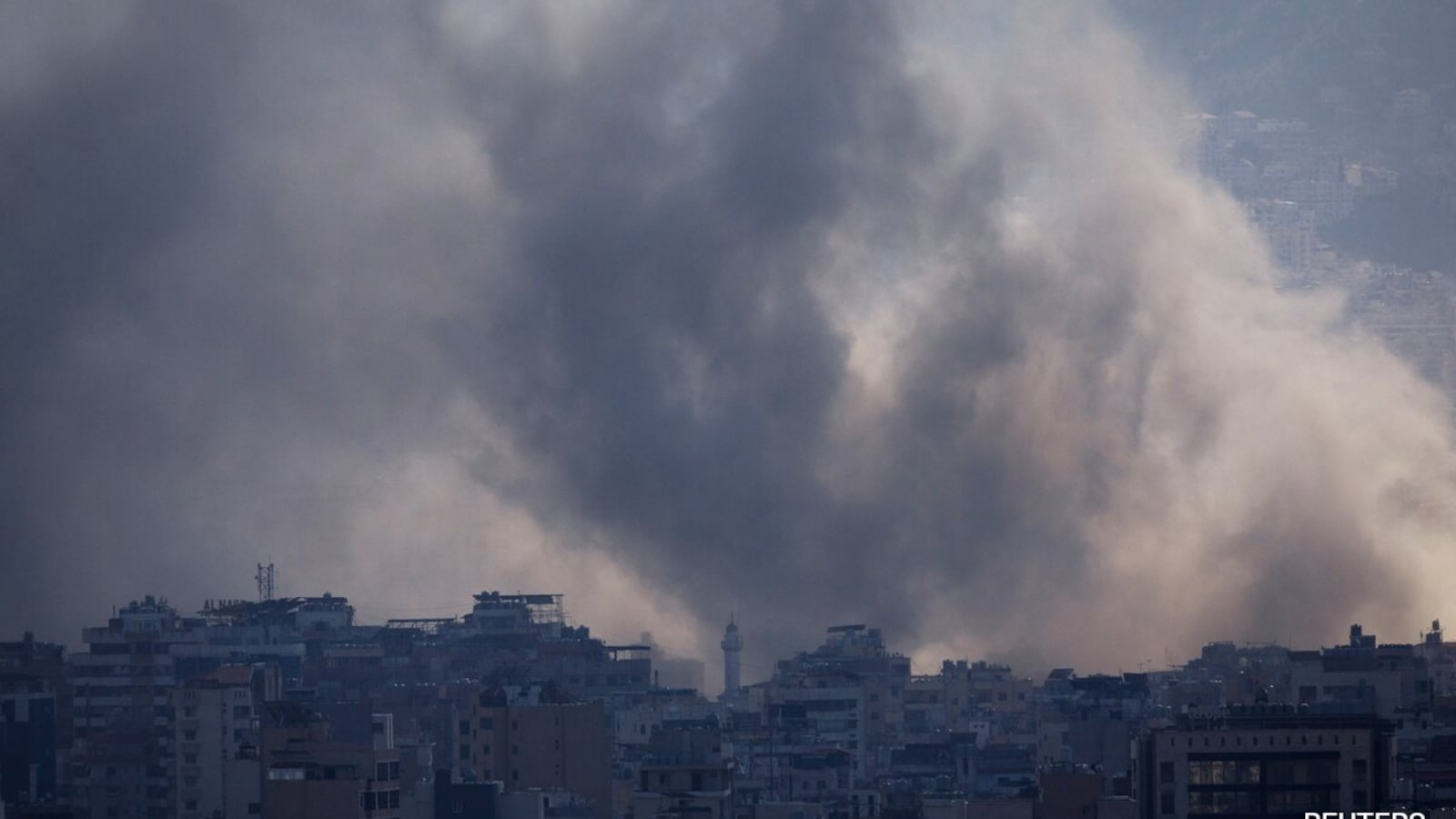
Israel Will Strike Beirut If Hezbollah Won't Stop Fire: Netanyahu To Trump
Israeli Prime Minister Benjamin Netanyahu said on Monday he told US President Donald Trump that his country would strike Beirut if Hezbollah doesn't stop attacking Israel.
"I spoke this evening with President Trump and told him that if Hezbollah does not cease attacking our towns and our citizens, Israel will strike terrorist targets in Beirut," Netanyahu said, according to a statement released by his office.
"Our position on this remains unchanged. At the same time, the IDF will continue to operate as planned in southern Lebanon," he added.
Iran War Live: Trump Says Talks Continuing At Rapid Pace
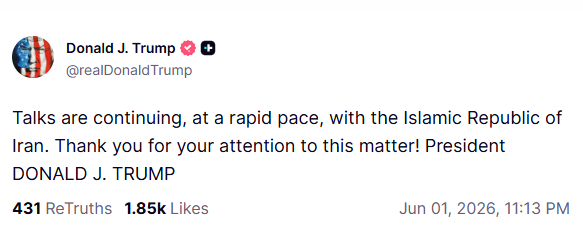
Iran War Live: Trump Says Israel And Hezbollah Will Stop Striking Each Other
"I had a very productive call with Prime Minister Bibi Netanyahu, of Israel, and there will be no Troops going to Beirut, and any Troops that are on their way, have already been turned back. Likewise, through highly placed Representatives, I had a very good call with Hezbollah, and they agreed that all shooting will stop - That Israel will not attack them, and they will not attack Israel," says US President Donald Trump.
Iran War Live: Trump Assures Talks Suspension Doesn't Mean US Will "Start Dropping Bombs"
Donald Trump on Monday told NBC he hasn't heard from Iran about reports it's suspending talks with the US, but if true, "that's okay."
"I think we've been talking too much... going silent would be very good," Trump said.
He said silence "doesn't mean we're going to start dropping bombs," adding: "We'll keep the blockade. Blockade is a piece of steel."
Asked if he can wait Iran out, Trump said, "I think I can wait as long as they want. They're losing a fortune."
Iran War Live: Trump, Netanyahu Hold Telephone Call, Says Report
Israeli news channel N12 reports Donald Trump and Benjamin Netanyahu held a phone call on Monday. This comes after reports suggested that Iran has suspended all talks with the US via negotiators.
Israel Orders Strikes On Beirut As UN Council Gears Up For Emergency Meet
Israel's Prime Minister Benjamin Netanyahu and Defence Minister Israel Katz said they had ordered strikes on Beirut's usually densely populated southern suburbs.
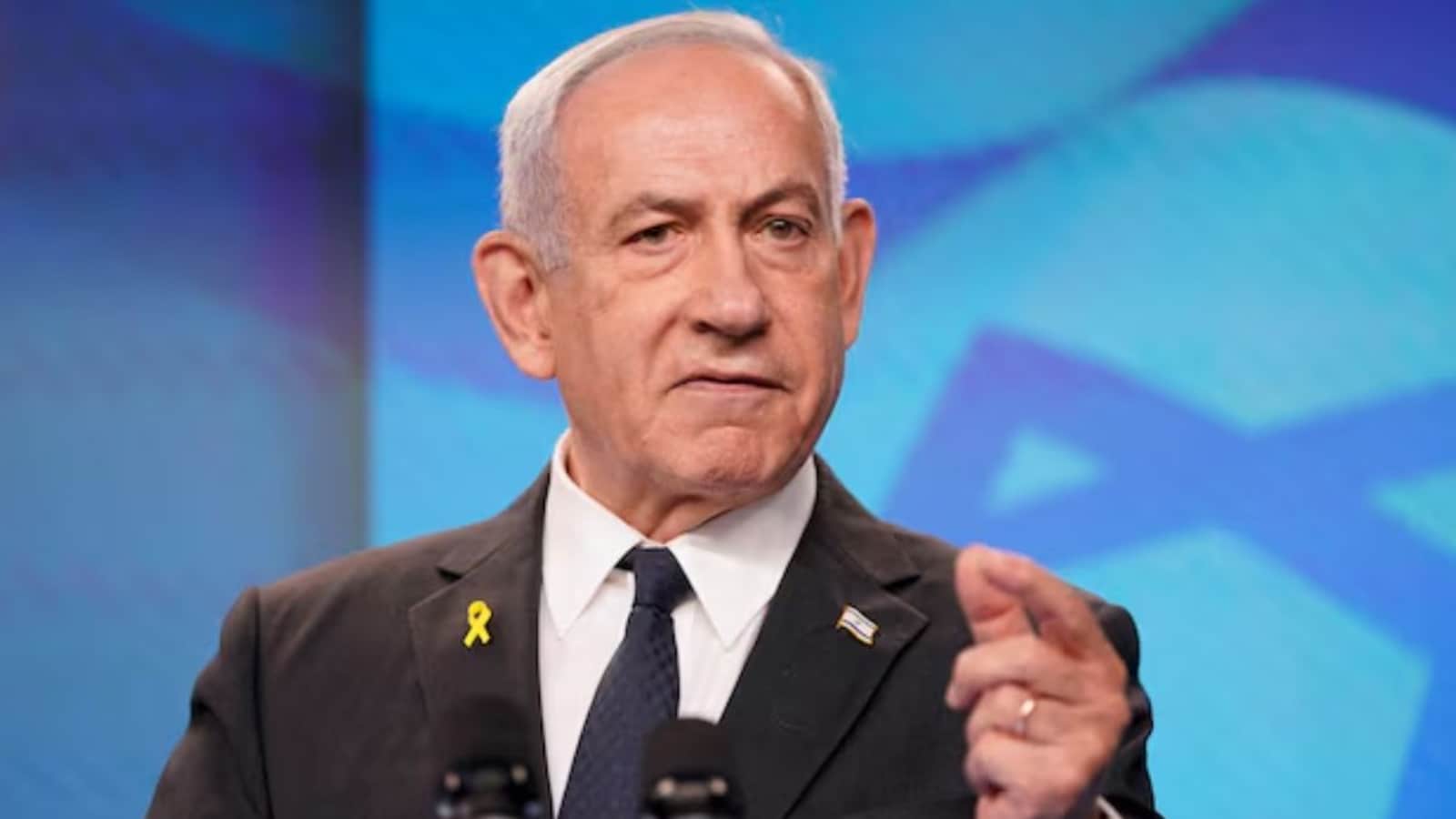
Iran War Live: Tehran Pushing For Limited US Deal To Fight Economic Strain, Says Report
Iran is pushing for a limited interim agreement with the United States in a bid to ease mounting economic pressure and stabilise the situation at home, while avoiding major concessions on its nuclear programme, according to sources and analysts.
The approach reflects a familiar playbook for the Islamic Republic: absorb pressure, avoid irreversible compromises and keep negotiations alive without shifting core positions, three Iranian sources close to decision-makers said.
But the latest push is also driven by more immediate concerns. Officials see a narrow deal as a way to buy time, unlock financial relief and contain rising domestic risks over a deteriorating economy without addressing the most contentious issues. (Reuters)
Iran War Live: France Bans Israeli Officials From Defence Show
Israel's Defence Ministry on Monday said France had banned Israeli government representatives from attending the Eurosatory defence exhibition in Paris this month.
France has also banned Israeli weapons makers from exhibiting offensive systems and will only permit them to display "air defence products". (Reuters)
Iran War Live: Any Temporary Understanding Must Be Followed With Deeper Talks, Says EU Official
Any temporary understanding between the US and Iran must be followed by deeper talks about Tehran's nuclear stockpile and other critical issues, a top European Union official said on Monday while offering the 27-member bloc's contribution to a sustainable and peaceful resolution in West Asia.
Iran War Live: Oil Jumps, Markets Tank As Iran Suspends Talks With US
Oil prices jumped and equities slid on Monday as Middle East peace talks stumbled and tensions mounted between Iran and the United States.
Crude futures shot more than 5 per cent higher as an Iranian news agency announced Tehran had suspended the negotiations with the United States via mediators.
Iran War Live: Tehran Suspending Talks With US Via Mediators, Says Report
Iran was suspending all exchanges with the United States via mediators on Monday, Iranian news agency Tasnim reported, as the two sides remained apart on a deal to end the Middle East war.
"Given the continuing crimes of the Zionist regime (Israel) in Lebanon and considering that Lebanon was one of the preconditions for the ceasefire and that this ceasefire has now been violated on all fronts, including Lebanon, the Iranian negotiating team is suspending dialogues and exchange of texts through mediators," Tasnim reported. (AFP)
Iran War Live: Japanese Prime Minister Talks To Iranian President, Urges Dialogue To Resolve War
Japan Prime Minister Takaichi Sanae on Monday spoke with Iranian President Masoud Pezeshkian, urging him to calm the situation in the Middle East through dialogue.
"I reiterated Japan's consistent position that the most important thing is to calm the situation through dialogue. Additionally, I stated that I strongly hope Iran will seize this opportunity firmly and continue to demonstrate the utmost flexibility so that an agreement can be reached as soon as possible," she wrote in a post on X.
先ほど、イランのペゼシュキアン大統領との間で3回目の電話会談を行いました。
— 高市早苗 (@takaichi_sanae) June 1, 2026
私からは、話し合いを通じた事態の沈静化が最も重要であるという、日本の一貫した立場を改めて伝えました。…
Iran war Live: Iran's Araghchi Says Ceasefire Must Be On All Fronts Including Lebanon
"The ceasefire between Iran and the US is unequivocally a ceasefire on all fronts, including in Lebanon. Its violation on one front is a violation of the ceasefire on all fronts. The US and Israel are responsible for the consequences of any violation," says Iran Foreign Minister Abbas Araghchi.
For immediate attention:
— Seyed Abbas Araghchi (@araghchi) June 1, 2026
The ceasefire between Iran and the US is unequivocally a ceasefire on all fronts, including in Lebanon.
Its violation on one front is a violation of the ceasefire on all fronts.
The US and Israel are responsible for the consequences of any violation.
Iran war Live: Ship Operators Urge Clarity To Return Hormuz To Normal
Shipping executives meeting in Athens on Monday said that any peace deal worked out between the United States and Iran would need to offer clear rules allowing vessels to resume normal business via the Strait of Hormuz.
Shipowners and maritime industry officials met at a Capital Link conference and other events to begin Posidonia, a week-long biennial shipping exhibition. (Reuters)
US Strikes Iran's Radar, Drone Control Sites In Goruk And Qeshm Islands
The United States has conducted what it called "self-defence strikes" on Iranian radar and drone control sites in the Islamic Republic's Goruk and Qeshm Islands over the weekend. The US Central Command (CENTCOM) said the new strikes were a response to "aggressive" actions from Tehran. The strikes came as the two nations are discussing a peace agreement to extend a ceasefire and open the Strait of Hormuz.
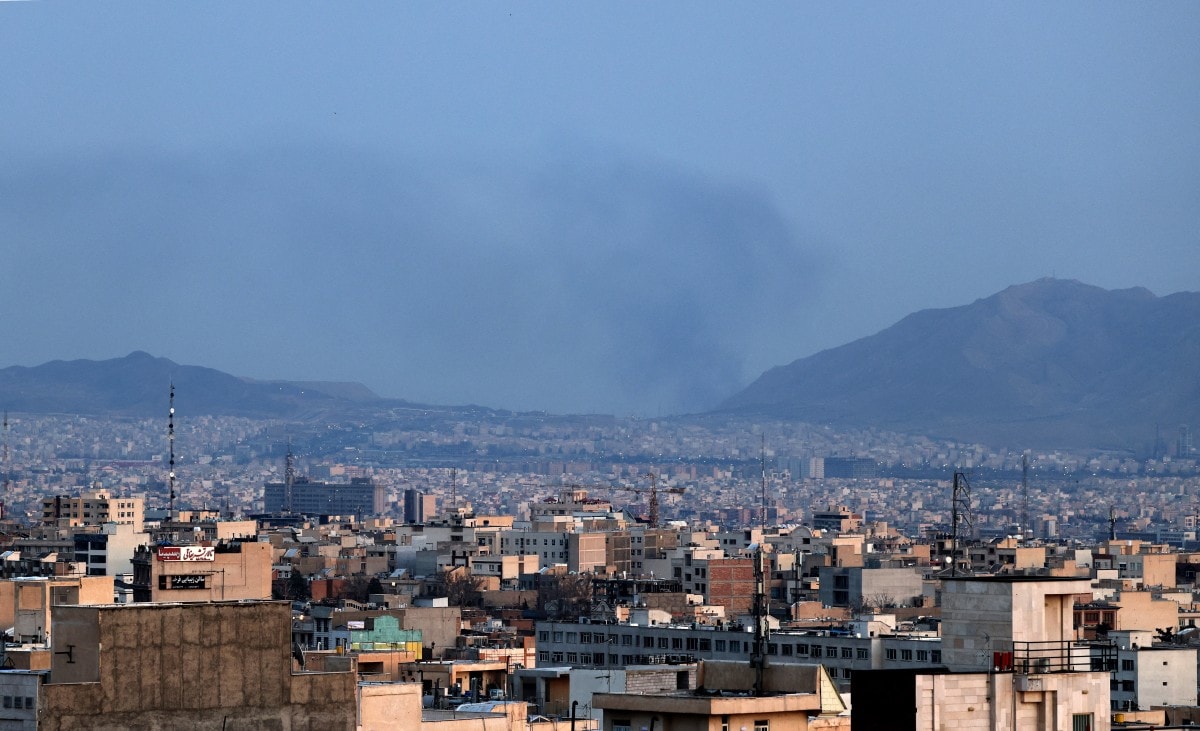
Iran war Live: Crude Rises As US Bombs Iranian Military Site, Tehran Shoots American Drone
Oil prices gained more than 3 per cent as US-Iran negotiations continued, including on the reopening of the Strait of Hormuz, a key waterway for global oil and natural gas transit. The US military said Monday the United States bombed Iranian military sites after Tehran shot down an American drone.
Brent crude oil, the international standard, rose 3.3% early Monday to $94.16 per barrel.
France's President Emmanuel Macron said on Monday he had encouraged his US counterpart Donald Trump to pursue his "determined efforts" to reach a ceasefire deal with Iran to end the Middle East war.
"I commended the determined efforts he is leading to quickly reach an agreement between the United States and Iran, which represents a unique opportunity to build a new security framework involving all concerned parties, in order to enable a lasting stabilisation of the region," he wrote in a post on X.
J’ai échangé hier soir avec le Président Trump au sujet de la situation au Moyen-Orient.
— Emmanuel Macron (@EmmanuelMacron) June 1, 2026
J’ai salué les efforts déterminés qu’il mène pour parvenir rapidement à un accord entre les États-Unis et l’Iran, qui constitue une opportunité unique de construire…
Iran war Live: US, Iran Trade Strikes As Peace Talks Continue
The United States and Iran traded strikes Monday as negotiations between the two sides stalled and Tehran again insisted any peace deal must also cover Israel's escalating offensive into Lebanon.
Weeks of indirect talks marked by stark threats and several waves of air strikes have so far failed to agree an end to the war or the reopening of the Strait of Hormuz, the key shipping channel for Gulf oil and gas.
The latest exchange of fire coincided with Israel expanding its offensive into Lebanon, with Prime Minister Netanyahu vowing to push deeper into the country and instructing the military to strike "terror targets" in a southern district of Beirut. (AFP)
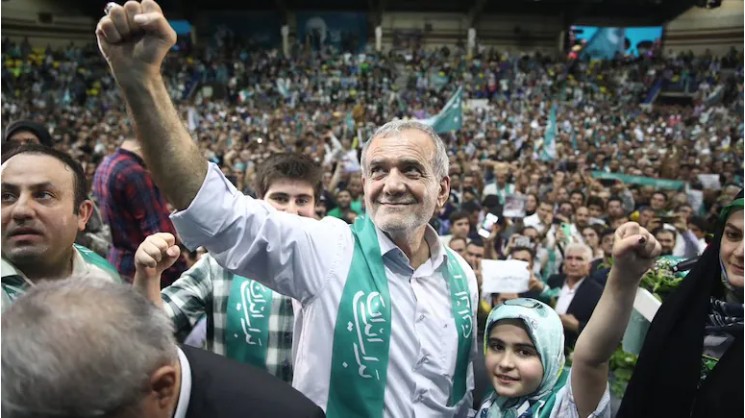
Iran war Live: Did Iran's President Masoud Pezeshkian Resign Over Disagreement With IRGC? A Fact Check
Iranian authorities have dismissed a report claiming Iran's President Masoud Pezeshkian has sought to step down in protest over the Islamic Revolutionary Guard Corps' (IRGC) unchecked dominance in Tehran's wartime decision-making.
The rebuttal came after UK-based Iran International reported that Pezeshkian had submitted his resignation to Supreme Leader Mojtaba Khamenei, saying that the elected government has effectively been excluded from vital decision-making processes in the country and that the vacuum created by this situation has enabled hardline factions within the IRGC to take control of affairs.
Iran war Live: Iran Says Currently No Talks With US Over Nuclear Issue
Iran's foreign ministry said on Monday that there were currently no exchanges with the United States over the details of Tehran's nuclear programme.
"We know when it is necessary to act on nuclear matters. No negotiations have taken place on the details of the nuclear file. At this stage, our priority is ending the war," foreign ministry spokesman Esmaeil Baqaei said in a weekly press briefing.
(AFP)
Iran war Live: Iran Says US Continues To Violate Ceasefire
Iran's foreign ministry said Monday that the United States had continued to violate the ceasefire, after US strikes on a southern port triggered a brief military flare-up.
"The United States is also violating the ceasefire including this morning," said foreign ministry spokesman Esmaeil Baqaei in a weekly press briefing, vowing that Iran will "take whatever measures we deem necessary to defend Iran's national security".
(AFP)
Iran war Live: Iran Says Ceasefire In Lebanon Remains Condition For US Deal
Iran's foreign ministry said on Monday that a ceasefire in Lebanon remains a key condition for a deal with the United States.
"We insist that a ceasefire in Lebanon is an essential condition for any deal aimed at ending the war," said foreign ministry spokesman Esmaeil Baqaei in a weekly press briefing, as Israel expands its offensive in Lebanon.
(AFP)
Iran war Live: Iran Really Wants To Make A Deal With The US: Trump
President Donald Trump on Monday said that Iran really wanted to make a deal with the US and that it would be a good one for Washington and its allies.
His post comes only hours after the US military said it struck Iranian military sites at the weekend and Iran's Revolutionary Guards said they had targeted a US base in response, the latest in a series of exchanges amid negotiations to end the three-month-old war.
"Iran really wants to make a deal, and it will be a good one for the USA and those that are with us," Trump posted on Truth Social.
However, Trump also said it was tougher for him to negotiate with Iran with all the political commentary surrounding the conflict.
"... it is MUCH tougher for me to properly do my job and negotiate, when political hacks keep negatively 'chirping,' at levels never seen before, over and over again, that I should move faster, or move slower, or go to war, or not go to war, or whatever," the president wrote on Truth Social.
"Just sit back and relax, it will all work out well in the end - It always does!"
(Reuters)
Iran war Live: Iran Guards Say Targeted Base Used By US
Iran's Revolutionary Guards said on Monday they had targeted a base used by the United States military to strike Iranian territory.
The base's location was not specified in the Guards' statement, broadcast by IRIB and other state media.
Earlier, Kuwait's military said their air defences were responding to a drone and missile attack.
(AFP)
Iran war Live: US Says Struck Iranian Radar And Drone Control Sites
The United States struck Iranian radar and drone control sites over the weekend, its military said on Sunday.
"US Central Command (CENTCOM) conducted self-defense strikes on Iranian radar and command and control sites for drones in Goruk, Iran and Qeshm Island this weekend," CENTCOM said in a post on X.
The strikes were in response to the shootdown of a US MQ-1 drone, it added.
Iran war Live: What To Know As Israel's Lebanon Incursion In 25 Years Complicates Iran Deal
Israeli forces are making their deepest incursion inside Lebanon since they withdrew from the country over a quarter-century ago, despite a nominal US-brokered ceasefire and the first direct talks between the countries in decades.
The Israeli advance presents a challenge in the emerging deal to extend the Iran war ceasefire as Tehran wants any agreement to end fighting in Lebanon, too. Qatar called it a "dangerous escalation." Germany's foreign minister said it was cause for serious concern, according to German press agency dpa. There was no comment by the United States.
(AP)
Iran war Live: Gold Slips On Stronger Dollar, Oil. Trump's Decision On Iran Ceasefire In Focus
Gold inched lower on Monday, pressured by a stronger dollar and rising oil prices, as investors awaited US President Donald Trump's decision on a proposed deal to extend the ceasefire with Iran.
Spot gold was down 0.2% at $4,527.36 per ounce, as of 0156 GMT, after rising to a two-week high in the previous session. US gold futures fell 0.8% to $4,558.10.
The dollar rose, making greenback-priced bullion more expensive for holders of other currencies.
US President Donald Trump said on Friday he would soon decide on a proposed deal to extend the ceasefire with Iran, though the two countries still appeared to differ on significant issues that have been central to the conflict.
Israeli Prime Minister Benjamin Netanyahu has ordered troops to move further into Lebanon in the battle against the Iranian-backed Hezbollah militant group, he said on Sunday, despite a ceasefire announced more than six weeks ago.
(Reuters)
Iran war Live: Dollar Steadies As Markets Await Signals On Iran War, Central Banks
The US dollar held steady on Monday after a weekly loss as markets awaited the results of peace talks in the Middle East and signals on the timing of central bank rate hikes.
The dollar index edged lower last week on hopes for a deal between the United States and Iran to open the Strait of Hormuz shipping lane for oil.
Oil jumped in early trade after Israel ordered troops to move further into Lebanon in the battle with Iranian-backed Hezbollah.
US President Donald Trump said on Friday he would soon decide on a proposed deal to extend the Iran ceasefire.
US jobs data later in the week will be in focus as Federal Reserve officials signal that the US central bank may need to raise rates if the war accelerates already-high inflation.
"USD will be heavily influenced by developments in the US-Iran war and the US non-farm payrolls report for May," said Joseph Capurso, head of FX at Commonwealth Bank of Australia.
(Reuters)
"Once the Strait is reopened, over time the oil price will fade and interest rates will return as a greater influence on the USD," he added in a note.
Iran war Live: Iran Says 28 Ships Passed Through Hormuz In Last 24 Hours
Iran's Islamic Revolutionary Guard Corps (IRGC) on Sunday said that 28 ships, including oil tankers, container vessels, and other commercial ships, passed through the Strait of Hormuz in the last 24 hours under the coordination and security of the IRGC Navy.
According to a statement carried by Iranian state media, Islamic Republic of Iran Broadcasting (IRIB), the vessels were allowed to transit after obtaining permission from the IRGC. The statement issued by the IRGC Navy's Public Relations Office highlighted that the Persian Gulf is a strategic waterway belonging to Muslim countries in the region and attributed recent insecurity to the "aggression and evils of the American terrorist army".
"Over the past 24 hours, 28 ships, including oil tankers, container ships, and other commercial vessels, passed through the Strait of Hormuz after obtaining permission with the coordination and security of the IRGC Navy," the statement read.
"The Persian Gulf is a water area belonging to the Muslim countries of the region, and the aggression and evils of the American terrorist army are the most important reason for its insecurity these days," it added
(ANI)
Iran war Live: Iran Says Does Not Trust US As Trump Toughens Terms
Iran's chief negotiator warned on Sunday the United States was not to be trusted, saying Tehran would not agree to any deal with Washington unless it fully secured Iranian rights.
Mohammad Bagher Ghalibaf's remarks came as reports emerged that US President Donald Trump had sent a tougher peace proposal back to Iran, and underlined the rift that the parties still need to close.
Any tweaks to the draft could further delay an agreement to formally end the Middle East war and reopen the Strait of Hormuz after weeks of fraught negotiations marked by sharp rhetoric and occasional flare-ups of violence.
Iran was already in talks with the United States about the fate of its nuclear programme in February when the US and Israel launched air and missile strikes that wiped out much of the Islamic republic's senior leadership.
And, while Tehran has long insisted that its nuclear programme is for purely civilian ends, the United States and its Western allies suspect it aims to develop a weapon.
(AFP)


