





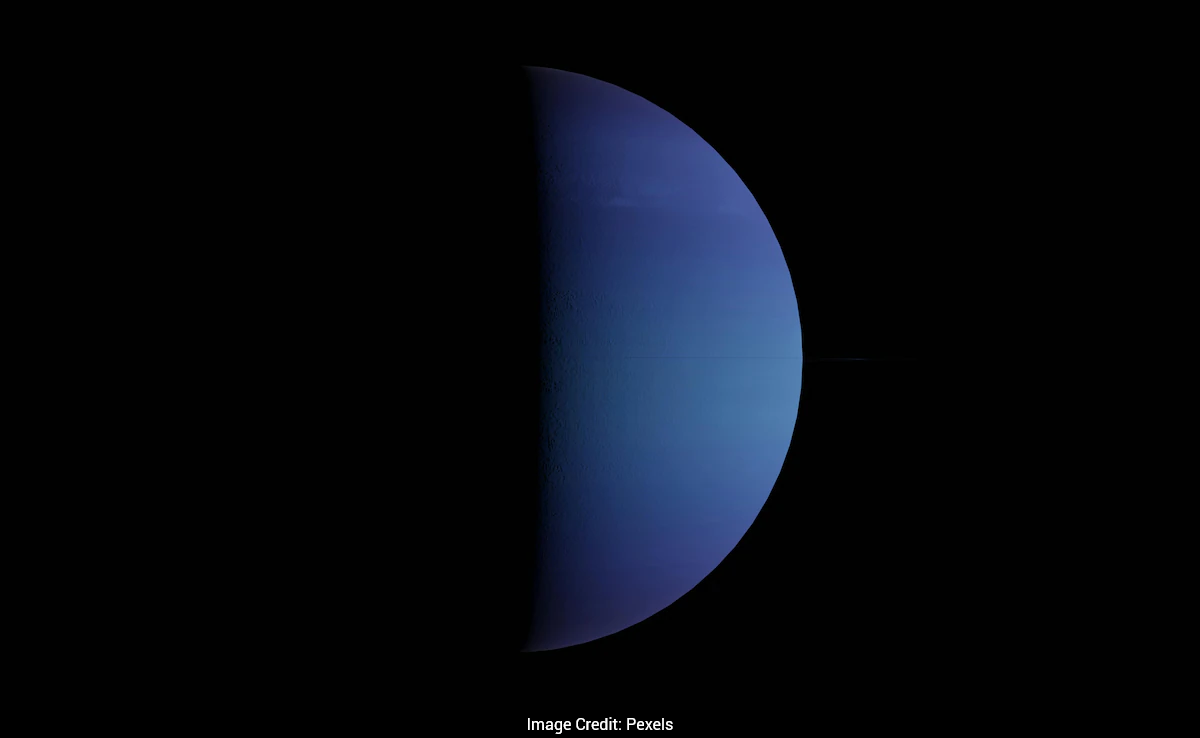
- Nereid may be the only intact survivor of Neptune's ancient moons destroyed billions of years ago
- Neptune's moon system is less organized and more chaotic than those of Jupiter, Saturn, and Uranus
- Triton, Neptune's largest moon, orbits oppositely and likely originated from the Kuiper Belt
A new study based on data from the James Webb Space Telescope suggests that Nereid, the third-largest moon of Neptune, may be the only intact survivor from an ancient group of moons that were destroyed billions of years ago during a major collision event in the early solar system, reported CNN. Neptune, the eighth and most distant planet from the sun, has a very different moon system compared to the other outer planets in the solar system.
Planets like Jupiter, Saturn and Uranus have more organised satellite systems, with several large moons orbiting in the same direction as the planet's rotation. However, Neptune's moons are fewer and more chaotic. Its largest moon, Triton, is much larger than Neptune's other moons and orbits in the opposite direction of the planet's rotation. Scientists say it is the only large moon in the solar system known to do this.
Astronomers believe Triton may not have originally formed around Neptune. Instead, they think it may have come from the Kuiper Belt, a ring-shaped area filled with icy objects at the edge of the solar system.
Researchers believe Triton entered Neptune's environment more than 4 billion years ago and was later captured by Neptune's gravity after passing close to the planet.
Previous studies suggested that after being captured, Triton moved inward and collided with Neptune's original moons. Scientists believe this event may have destroyed many of Neptune's early satellites. The planet's seven inner moons are thought to be remains from this ancient collision.
The new study suggests that Nereid may have escaped this destruction.
Matthew Belyakov, a graduate student in planetary science at California Institute of Technology and the first author of the study published in Science Advances, said he believes Nereid is the only intact survivor of the process.
He explained that Neptune's innermost moons cannot be considered fully intact because images captured by Voyager show that they appear to be disrupted rubble piles. According to him, those moons are surviving material from the original system, but not complete moons.
The findings could also change earlier ideas about Nereid's origin. Scientists had previously believed that Nereid, like Triton and some other Neptunian moons, may have been a captured object from the Kuiper Belt.
However, the new data from the James Webb Space Telescope showed that Nereid's composition does not match what scientists know about Kuiper Belt objects, raising the possibility that it may instead be a surviving moon from Neptune's original satellite system.
Track Latest News Live on NDTV.com and get news updates from India and around the world

