





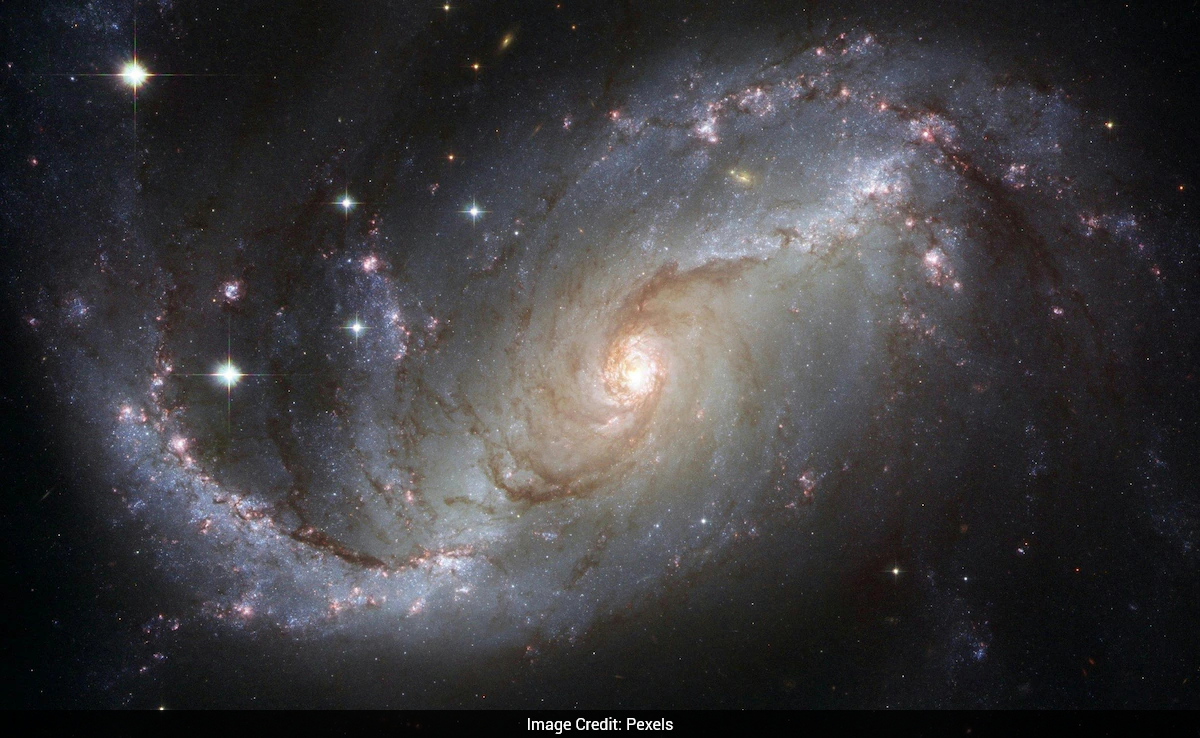
Contrary to long-held beliefs, the universe may not be expanding forever. A new study by South Korean researchers indicates that dark energy, once thought to accelerate cosmic expansion, might actually be causing the universe to contract. This could eventually lead to a dramatic cosmic event known as the "Big Crunch." Professor Young Wook Lee of Yonsei University in Seoul said that the fate of the universe will change. He explained in simple terms that the universe could be running out of energy, eventually collapsing under its own gravity and bringing all galaxies together, reported NYPost.
The study, published in Monthly Notices of the Royal Astronomical Society, challenges conventional beliefs about the future of the universe.
Scientists believe that the universe originated with the Big Bang about 13.8 billion years ago. For a long time, it was believed that the universe's expansion was gradually slowing down.
The discovery of dark energy in 1998 changed this thinking. Dark energy was seen as a force accelerating the universe's expansion. Studies of exploding stars called supernovae showed that distant galaxies were rapidly moving away from each other. Scientists thought this could lead to a catastrophic event like the "Big Rip" in the future, in which atoms could be torn apart.
Dark Energy Can Change Over Time
New research shows that dark energy is not constant. Professor Lee said the study shows that the universe is currently already in a phase of slowing expansion. He also explained that dark energy changes much faster over time than previously thought. He further stated that if this finding proves correct, it would be a major paradigm shift in cosmology since the discovery of dark energy in the past 27 years.
The team studied the brightness of Type IA supernovae, known as "standard candles" because they are helpful in measuring cosmic distances. Previously, low-luminosity supernovae were considered distant, leading to the belief that the universe was expanding rapidly.
Lee and his team found that the brightness of supernovae was more closely related to the age of the stars before their explosion, rather than their distance. Older stars exploded faster and brighter, while younger stars were less luminous. This suggests that dark energy is not constant and may weaken over time.
The study used models supported by the Arizona-based Dark Energy Spectroscopic Instrument (DESI). Professor Lee said their results are in perfect agreement with data from the cosmic microwave background (CMB) and baryonic acoustic oscillations (BAO). He explained that his analysis shows that the universe is already in a phase of slow expansion today.
No Immediate Danger
Scientists say this intergalactic contraction isn't going to happen anytime soon. According to experts at Cornell University, the end of the universe is still about 19.5 billion years away.
To confirm the results, Lee's team is conducting "evolution-free tests," focusing on supernovae in galaxies of similar age. The findings are expected to come from the Vera C Rubin Observatory in Chile. This observatory houses the world's most powerful digital camera and is expected to discover about 20,000 new supernova hosts over the next five years.
This study could transform our understanding of the future of the universe and raise the possibility that the universe may one day contract instead of expanding infinitely.
Track Latest News Live on NDTV.com and get news updates from India and around the world

