





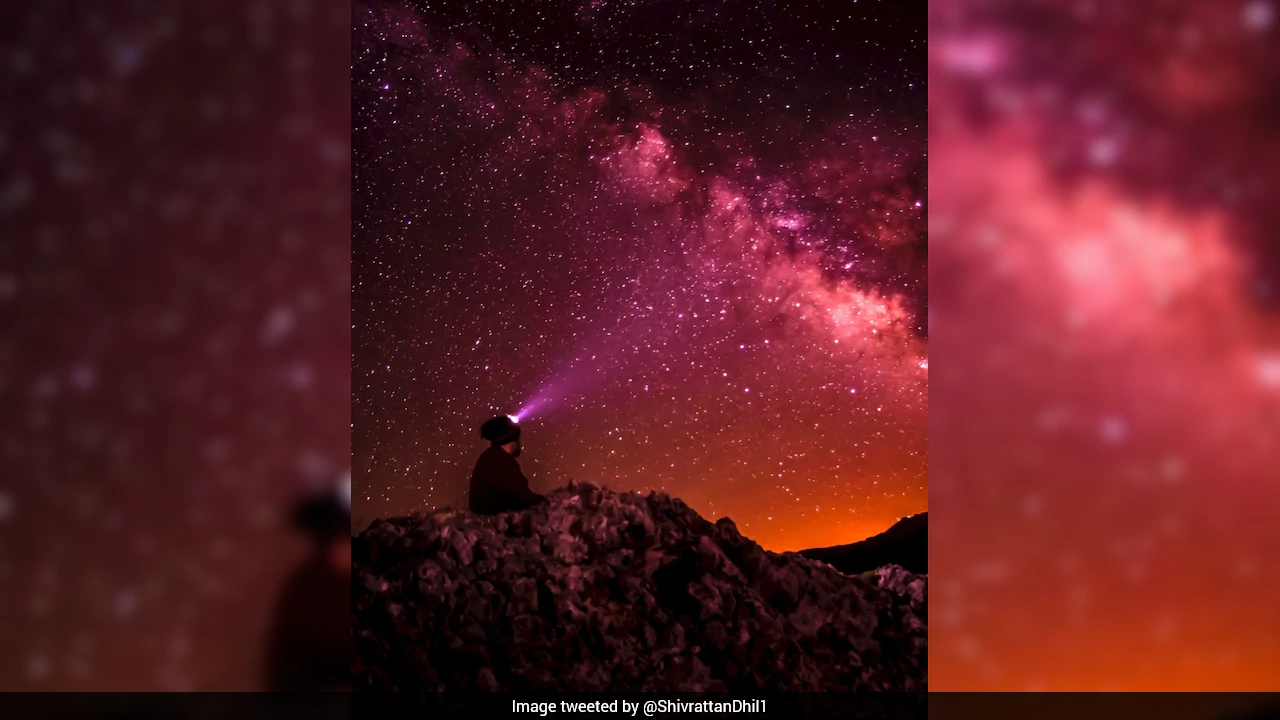
A powerful solar storm is expected to reach Earth tonight, creating a rare opportunity for skywatchers in parts of northern India to witness auroral activity - a phenomenon more commonly associated with the Arctic Circle. The US-based Space Weather Prediction Center (SWPC) has issued a geomagnetic storm watch for June 8 and June 9 after a massive cloud of charged solar particles erupted from the Sun and began moving toward Earth. The storm was triggered by a coronal mass ejection (CME) originating from Active Region 4461, a highly active zone on the Sun that recently produced an M1.8-class solar flare and a fast-moving filament eruption.
Scientists estimate the solar material is travelling at nearly 1,400 kilometres per second and is expected to collide with Earth's magnetic field, potentially triggering a strong G3-class geomagnetic storm. The latest forecast predicts geomagnetic conditions could peak at G3 (Strong) on June 8 before easing to G2 (Moderate) levels on June 9.
WATCH: Geomagnetic Storm Category G3 Predicted
— NOAA Space Weather Prediction Center (@NWSSWPC) June 6, 2026
Highest Storm Level Predicted by Day:
Jun 07: None (Below G1) Jun 08: G3 (Strong) Jun 09: G2 (Moderate)
THIS SUPERSEDES ANY/ALL PRIOR WATCHES IN EFFECT
Comment:
Issue Time: 2026 Jun 06 2211 UTChttps://t.co/ZbtuNtJdza
Could India See the Northern Lights?
While auroras are typically confined to regions close to the Earth's poles, strong geomagnetic storms can push the auroral oval much farther south than usual.
Because of the intensity of the incoming solar storm, experts say some high-altitude areas of northern India may have a chance of witnessing faint auroral activity. Visibility, however, will depend on several factors including cloud cover, local light pollution, atmospheric conditions and the eventual strength of the storm.
Unlike the dramatic green curtains often seen in polar countries, any aurora visible from India would likely appear as a faint red or crimson glow low on the northern horizon. These colours are produced when high-altitude oxygen atoms in Earth's upper atmosphere interact with charged particles from the Sun.
Astronomers caution that the display may be difficult to see with the naked eye. Cameras and smartphones equipped with night mode or long-exposure settings may offer a better chance of capturing the phenomenon.
Best Places in India to Watch for Auroras
If conditions remain favourable, skywatchers in the following regions may have the best chance of spotting the rare display:
- Ladakh: The high altitude, dry climate and extremely low light pollution make Ladakh one of India's premier stargazing destinations. Areas around Hanle and Pangong Lake could offer the clearest views.
- Kashmir: Remote locations around Gulmarg, Sonamarg and other higher-altitude regions may provide favourable viewing conditions if skies remain clear.
- Himachal Pradesh: The Spiti Valley, Kaza and surrounding Himalayan regions are among the darkest locations in India and could potentially offer views toward the northern horizon.
- Uttarakhand: Higher Himalayan regions such as Munsiyari and Auli may provide suitable conditions away from urban lighting.
Cities like Delhi, Mumbai, Bengaluru, Chennai, and Kolkata will not see the auroras due to intense urban light pollution and their geographic locations closer to the equator. The ideal viewing time is between 10:00 PM tonight (June 8) and 2:30 AM tomorrow (June 9) IST.
What Causes an Aurora?
Auroras occur when charged particles released by the Sun collide with gases in Earth's upper atmosphere. As these particles are guided by Earth's magnetic field toward the poles, they interact with oxygen and nitrogen atoms. The collisions release energy in the form of light, creating the shimmering displays seen in the sky. Different gases produce different colours:
- Green: Oxygen at lower altitudes
- Red: Oxygen at very high altitudes
- Blue and purple: Nitrogen molecules
The stronger the solar storm, the farther away from the poles these lights can be seen.
Why Are They Called the Northern Lights?
The phenomenon is commonly known as the "Northern Lights' because it is usually observed in regions near the North Pole and the northern magnetic pole. Its scientific name is Aurora Borealis. The word "Aurora" comes from the Roman goddess of dawn, while "Borealis" is derived from Boreas, the Greek god of the north wind. Together, the term literally means "Dawn of the North." The southern counterpart is called Aurora Australis, or the Southern Lights, which occur around Antarctica and the southern polar regions.
Track Latest News Live on NDTV.com and get news updates from India and around the world

