





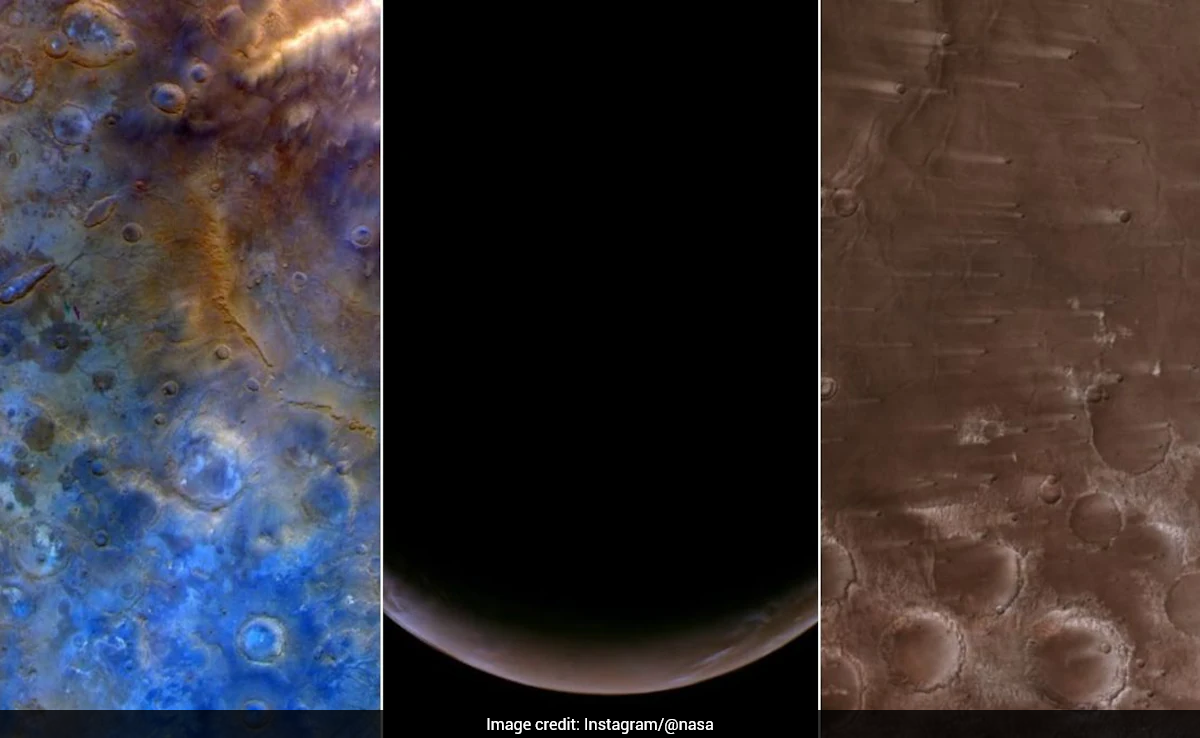
NASA's Psyche mission caught a striking view of Mars last week as it swung past the Red Planet for a speed boost toward its ultimate destination in the asteroid belt. When it completed its close approach, the spacecraft came within 2,864 miles (4,609 kilometres) of the planet's surface. Huygens crater and a view of crescent Mars against black space were among the pictures it took. "Although we were confident in our calculations and flight plan, monitoring the DSN's Doppler signal in real time during the flyby was still exciting," Don Han, Psyche's navigation lead at NASA's Jet Propulsion Laboratory in Southern California, said as quoted by NASA.
"We've confirmed that Mars gave the spacecraft a 1,000-mile-per-hour boost and shifted its orbital plane by about 1 degree relative to the Sun. We are now on course for arrival at the asteroid Psyche in summer 2029."
Also read | NASA Shares Stunning View Of Milky Way Captured From International Space Station
What the image shows
Huygens, a massive double-ring impact crater in the southern highlands, is visible in an amazing light. The crater spans about 290 miles (470 km) across and is one of Mars' largest impact structures. Psyche's shot also covers the surrounding southern highlands, a heavily cratered region near 15 degrees south latitude.
-

-
 Who Is Rajiv Mehta? Lilavati Hospital Trustee To Speak At NDTV World Summit 2026
 -
 Ex-CIA Director To Decode 'War In Times Of AI' At NDTV World Summit
 -
 From Call Centre To Billion-Dollar Disruptor: Nikhil Kamath At NDTV World Summit
 -
 'Every 5 Years, You'll See A New India': Swami Sarvapriyananda Ahead Of NDTV World Summit
 -
 AI Can Think, But Can It Be Conscious? Swami Sarvapriyananda Weighs In
 -
 Alain Ebobisse, Africa50 CEO, To Attend NDTV World Summit 2026. All About Him
 -
 Kriti Sanon At NDTV World Summit: A Look At Her Career And Business Ventures
 -
 Ex-CIA Director To Decode 'War In Times Of AI' At NDTV World Summit
 -
 Who Is Vikram Rai, CEO, South Asia GE Aerospace, Set To Attend The NDTV World Summit 2026
 -
 Rahul Kanwal: The World Is Changing. What Comes Next? | NDTV World Summit 2026
The swirls of blue, tan, and purple in the image likely reflect variations in dust, sand, and exposed bedrock - hints of the mineral makeup of this ancient landscape. Each pixel covers roughly 2,200 feet (670 meters) on the ground.
The Mars pass wasn't for science at Mars itself. Psyche used the planet's gravity to pick up speed and tweak its flight path, a manoeuvre called a gravity assist. That slingshot gives the spacecraft the energy it needs to reach asteroid Psyche without burning extra fuel.
Also read | Video: NASA Shares "Epic" Visuals Of Bright Object Streaking Through Upper Atmosphere
When Psyche arrives at the metal-rich asteroid in August 2029, it will slip into orbit and start mapping the surface. Scientists think asteroid Psyche could be the exposed metallic core of an ancient planetesimal
Studying it could offer a direct look at planetary interiors that we can't access on Earth. The Huygens image is part of Psyche's instrument checkouts during the long cruise.
"We've captured thousands of images of the approach to Mars and of the planet's surface and atmosphere at close approach. This dataset provides unique and important opportunities for us to calibrate and characterize the performance of the cameras, as well as test the early versions of our image processing tools being developed for use at the asteroid Psyche," said Jim Bell, the Psyche imager instrument lead at Arizona State University (ASU) in Tempe.
"As the spacecraft continues its journey after the flyby, we'll continue calibration imaging of Mars for the rest of the month as it recedes into the distance."
Track Latest News Live on NDTV.com and get news updates from India and around the world

