





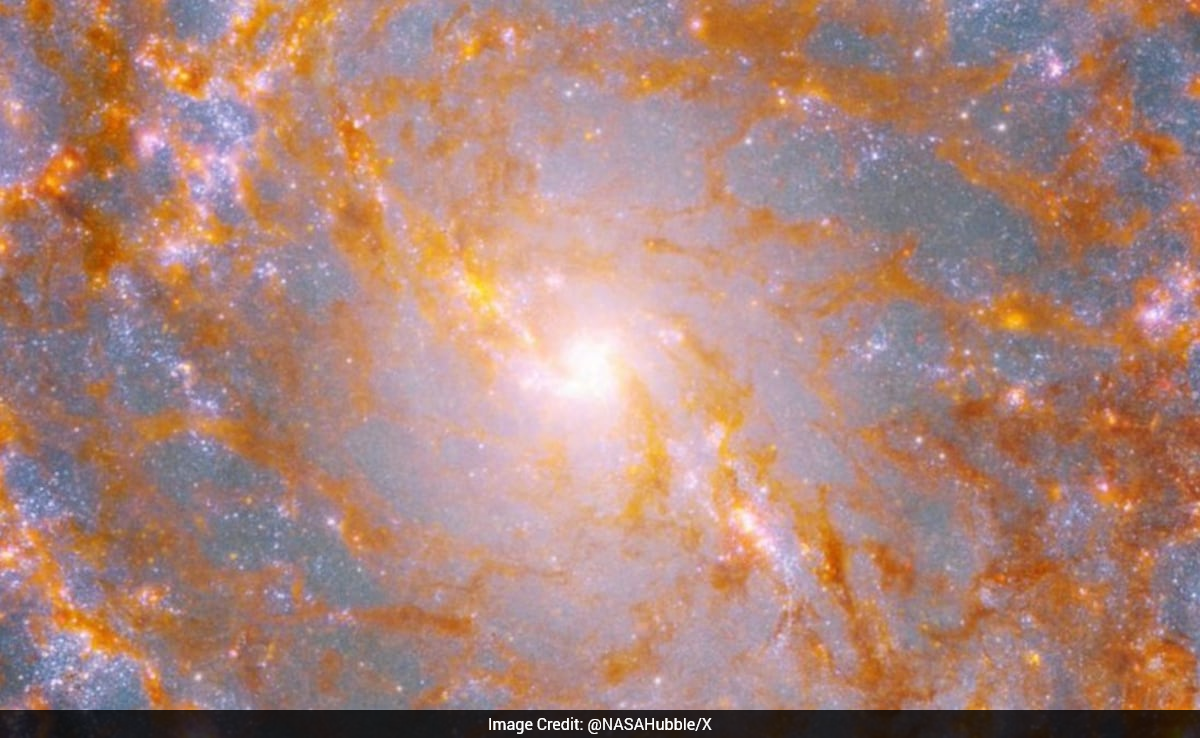
An image of the galaxy M101 (Pinwheel Galaxy) has been captured by NASA, showing its vast size and intricate structure in stunning detail. The image highlights the beauty of this spiral galaxy and offers a closer look at its stars, dust, and gas.
This image of M101, also known as the Pinwheel Galaxy, is one of the largest images ever taken of a spiral galaxy by the Hubble Space Telescope. It was created by combining 51 separate images taken in various studies over a period of about ten years, reported NASA.
The final image includes both infrared and visible light and measures 16,000 × 12,000 pixels. Ground-based images were used to fill in the areas Hubble couldn't see.
Galaxy Larger Than The Milky Way
The Pinwheel Galaxy has a massive spiral disk made up of stars, dust, and gas, spanning approximately 170,000 light-years. It is nearly twice the size of our own Milky Way galaxy. Scientists estimate that M101 contains at least one trillion stars.
The spiral arms of this galaxy are filled with massive star-forming nebulae. These are regions where new stars form within large molecular hydrogen clouds. Bright clusters of young, hot, and blue stars line the contours of these arms, reflecting the ongoing star-formation process.
Discovery And Location
The Pinwheel Galaxy was discovered in 1781 by Pierre Mechain, a colleague of Charles Messier. It is located about 25 million light-years from Earth in the constellation Ursa Major. Its apparent magnitude is 7.9, making it visible with small telescopes, and it is easiest to observe in June.
Track Latest News Live on NDTV.com and get news updates from India and around the world

