





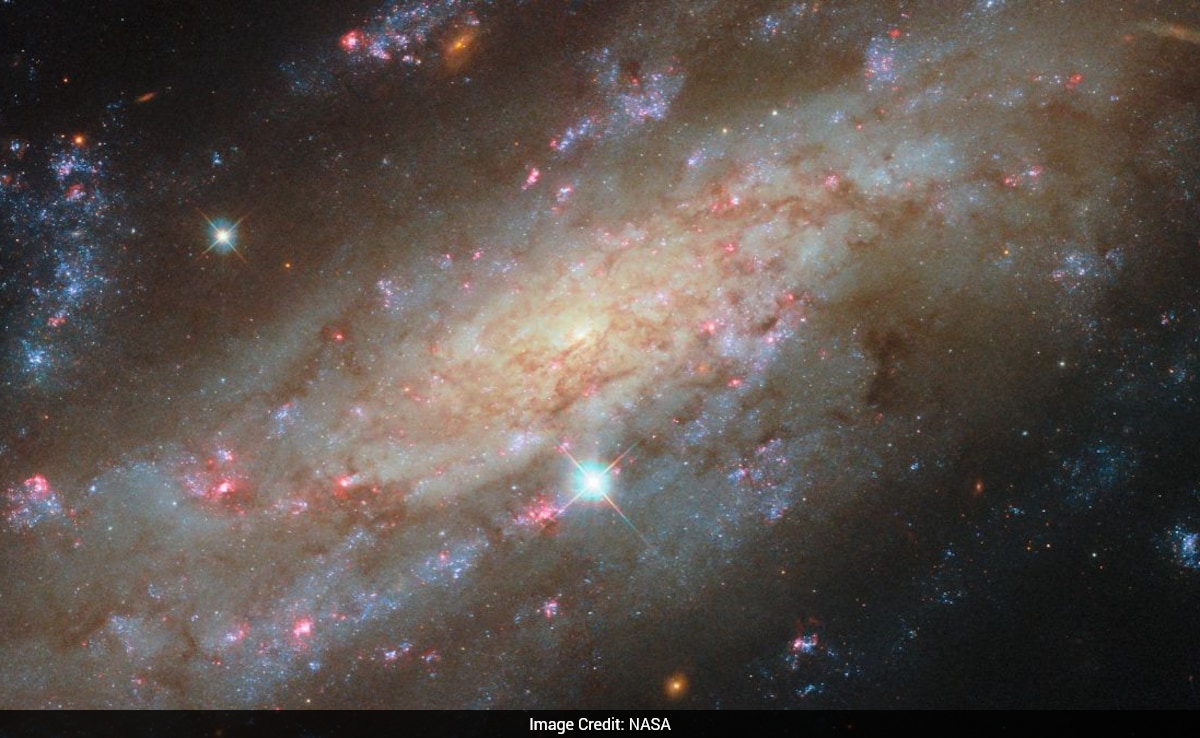
Space continues to reveal its beauty through powerful telescopes, helping scientists understand how galaxies form and change over time. A new image from NASA's Hubble Space Telescope has captured a stunning spiral galaxy filled with bright star clusters, offering valuable insights into the life cycle of stars, reported NASA.
The image shows a spiral galaxy known as NGC 3137, located about 53 million light-years away in the constellation Antlia. Because it is relatively close, this galaxy provides astronomers with a good opportunity to study how stars are born and how they die. It also offers a view of a galactic system that is similar to our own.
Astronomers are especially interested in NGC 3137 because it is part of a group of galaxies similar to the Local Group. This group, known as the NGC 3175 group, includes two large spiral galaxies: NGC 3137 and NGC 3175.
In comparison, the Local Group includes the Milky Way and Andromeda Galaxy as its largest members. Both groups also contain smaller dwarf galaxies. Researchers have identified more than 500 possible dwarf galaxy candidates in the NGC 3175 group, though the exact number is still not confirmed. Studying this group helps scientists better understand the structure and behavior of our own galactic neighbourhood.
The Hubble Space Telescope has captured NGC 3137 in remarkable detail. The image is created using observations in six different colour bands, allowing scientists to study different features of the galaxy.
At the centre of the galaxy lies a black hole estimated to be about 60 million times more massive than the Sun, surrounded by fine clouds of dust. The galaxy appears tilted from our point of view, offering a clear look at its loose and feathery spiral arms. The image also includes a few stars from the Milky Way and distant background galaxies.
The most striking feature of the image is its bright star clusters. The galaxy contains dense groups of blue stars along with glowing red gas clouds. These features indicate the presence of young, hot stars that are still forming within their birth clouds.
These star clusters are the main focus of ongoing research. Scientists are using Hubble as part of an observing program led by D. Thilker to study star clusters in 55 nearby galaxies. The data collected helps identify star clusters and the glowing nebulae around them, allowing researchers to estimate the ages of stars in galaxies like NGC 3137.
This work is part of the PHANGS-HST project, which combines observations from multiple powerful observatories. Along with Hubble, the James Webb Space Telescope and the Atacama Large Millimetre/submillimetre Array are also involved.
Together, these observatories provide a detailed view of how stars form and evolve in nearby galaxies, helping scientists better understand the universe.
Track Latest News Live on NDTV.com and get news updates from India and around the world

