





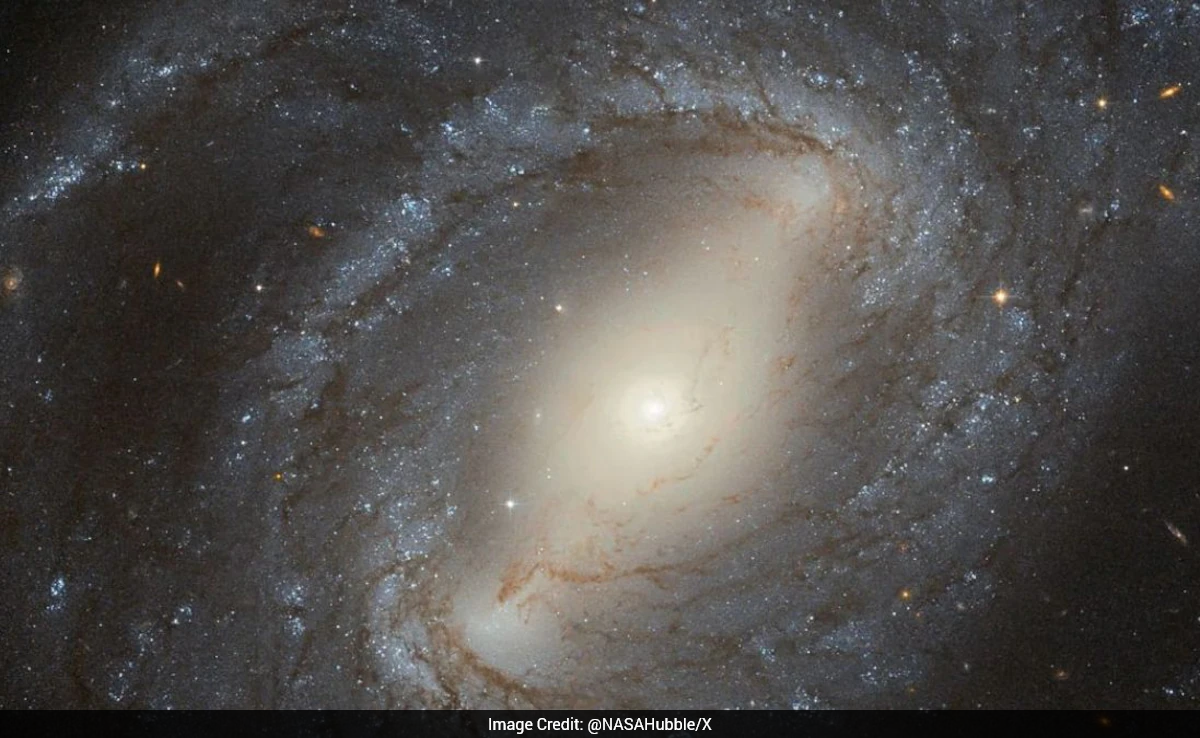
A distant galaxy discovered centuries ago continues to draw scientific interest due to its structure and activity. Known as NGC 4394, this galaxy offers important insights into how stars form and how energy is generated in space, reported NASA.
NGC 4394 was discovered in 1784 by William Herschel. It is located about 55 million light-years away from Earth in the constellation Coma Berenices, also known as Berenice's Hair. The galaxy is part of the Virgo Cluster.
NGC 4394 is considered a classic example of a barred spiral galaxy. It has a central bar-shaped structure that cuts through its core, with bright spiral arms extending from the ends of this bar. These arms contain young blue stars, dark strands of cosmic dust, and glowing regions where new stars are actively forming.
At the centre of the galaxy lies a region of ionised gas called a low-ionisation nuclear emission-line region, also known as a LINER. This region shows specific emission lines in its spectrum, mainly from weakly ionised atoms such as oxygen, nitrogen and sulphur. These features indicate ongoing energetic processes in the galaxy's core.
Although LINER regions are commonly observed in galaxies, scientists are still uncertain about the exact source of energy that ionises the gas. In many cases, this activity is believed to be linked to a black hole at the centre of the galaxy. However, it could also be caused by intense star formation.
In the case of NGC 4394, scientists believe that gravitational interaction with a nearby galaxy may have pushed gas toward its centre. This process likely provides material that can either fuel the central black hole or support the formation of new stars.
Track Latest News Live on NDTV.com and get news updates from India and around the world

