




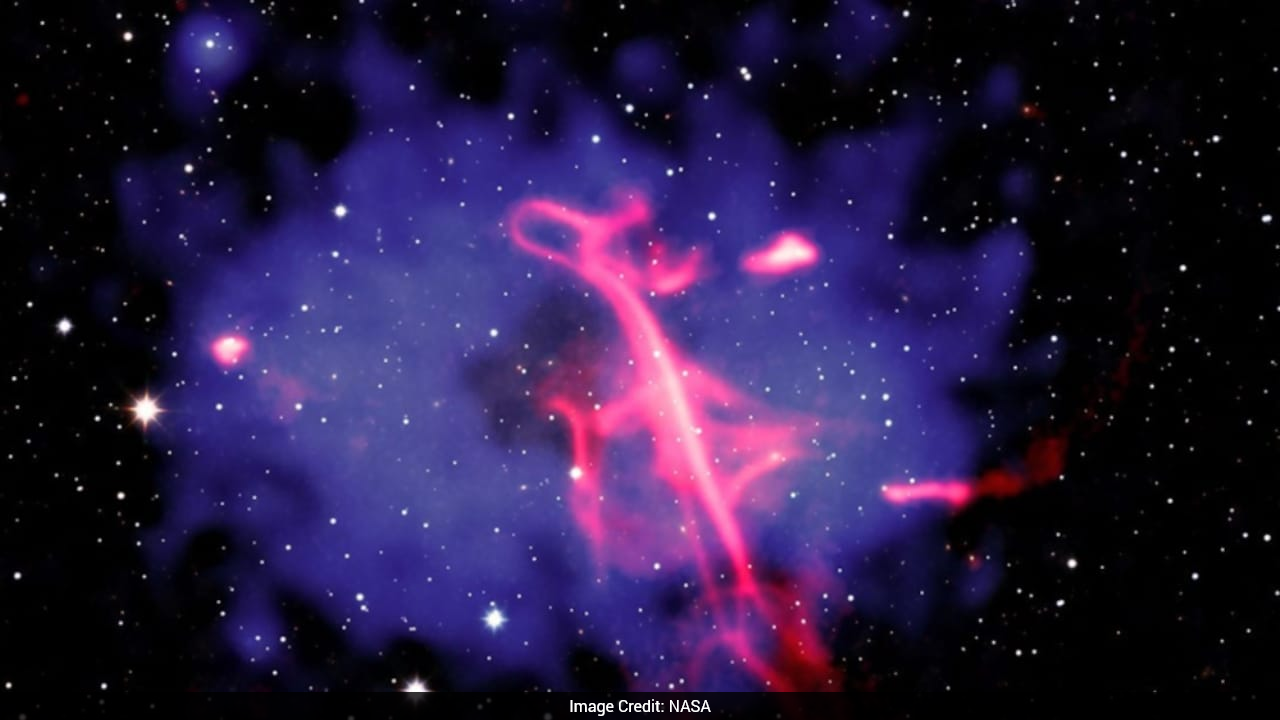
A strange formation of radio waves in space has caught the attention of astronomers because of its resemblance to a musical symbol called the treble clef. Using NASA's Chandra X-ray Observatory and other telescopes, researchers believe they have found an explanation for how this unusual structure formed. The formation, named the "Treble Clef" because of its shape, is likely the result of an outburst from a supermassive black hole followed by the collision of two galaxy clusters, according to NASA.
The findings were led by Andrea Botteon of Italy's National Institute for Astrophysics (INAF). The research paper was published in the journal Astronomy & Astrophysics.
Studying the formation was difficult because it lies almost directly behind the plane of the Milky Way. Stars, gas and dust in our galaxy block much of the view from Earth.
However, researchers used telescopes that can observe through this material to investigate its origin.
NASA's Chandra X-ray Observatory and Germany's eROSITA X-ray telescope detected widespread, extremely hot gas at the location of the formation. This showed that the Treble Clef is associated with a galaxy cluster.
Researchers found that the cluster is actually made up of two galaxy clusters in the process of merging. Galaxy clusters are among the largest structures in the universe and contain hundreds of galaxies along with huge amounts of superheated gas.
How Did The Formation Develop
Researchers believe the Treble Clef formed in two main stages.
First, an earlier outburst from a supermassive black hole at the centre of the galaxy cluster pushed clouds of charged particles and magnetic fields outward at speeds close to the speed of light. This produced bright radio waves, which later became weaker as the particles lost energy.
In the second stage, the collision between the two galaxy clusters compressed or reenergised the cloud, making it brighter again in radio waves. Shock waves from the collision may also have helped restore its brightness. These shock waves are similar to the sonic booms produced by supersonic jets.
X-Ray Images Reveal Clues About The Collision
To study the collision, researchers used a special method to examine the shape of the cluster's hot gas. Most of the gas had a roughly oval shape. They removed this symmetrical shape from the original X-ray image to highlight other features.
The remaining image showed stronger X-ray emissions on the left and right sides of the cluster's centre, with weaker emissions in the middle. This suggests that the collision took place along the left-to-right direction in the image.
The researchers believe the direct collision occurred a few hundred million years ago and that the two clusters are now moving away from each other.
Track Latest News Live on NDTV.com and get news updates from India and around the world

