





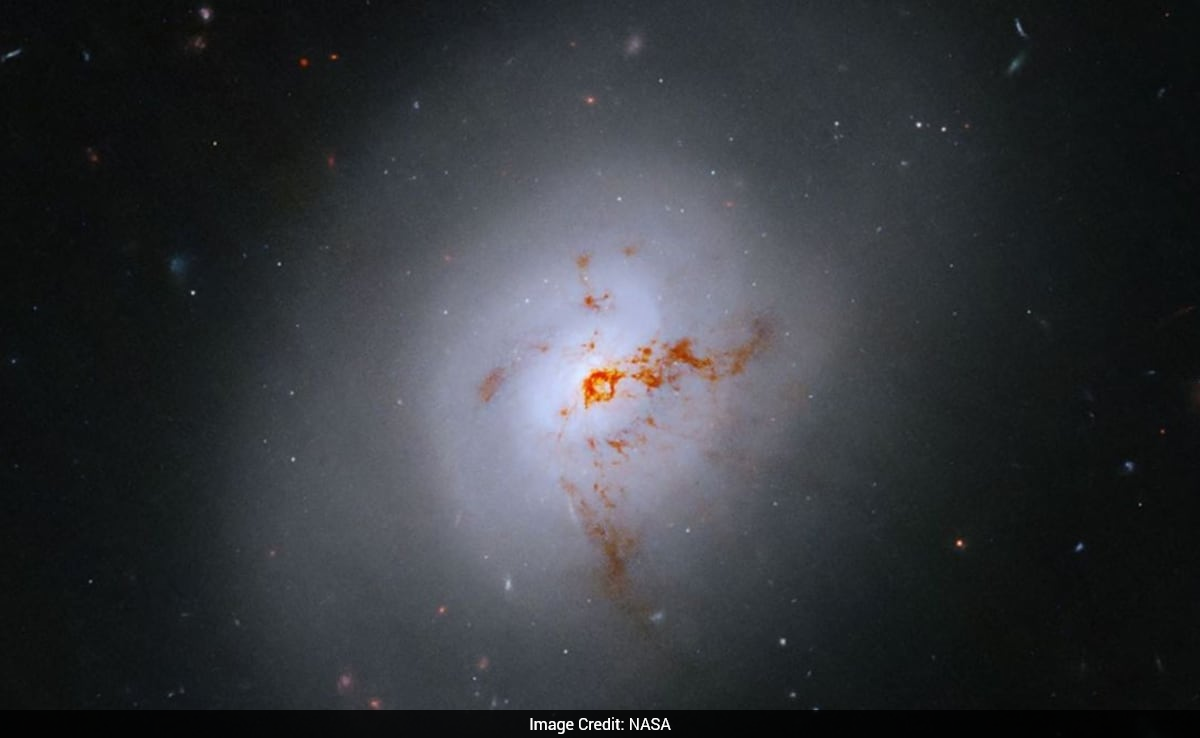
A new image captured by the NASA Hubble Space Telescope has revealed a mysterious galaxy with an unusual structure and behaviour. The galaxy shows a bright centre and a shape that suggests spiral features, but it does not have clear spiral arms, reported NASA.
The image shows reddish-brown dust clouds partially covering the galaxy, while light from distant galaxies can be seen through its outer regions and in the dark background.
The galaxy, known as NGC 1266, is located about 100 million light-years away in the constellation Eridanus. Scientists classify it as a lenticular galaxy, which is considered a transitional type between spiral and elliptical galaxies.
Lenticular galaxies are lens-shaped and have a bright central bulge and a flattened disk like spiral galaxies. However, they do not have spiral arms and show very little or no star formation, similar to elliptical galaxies.
A Rare Stage Of Evolution
NGC 1266 is also identified as a post-starburst galaxy, meaning it is in a stage between active star formation and a quieter phase. These galaxies contain young stars but have very few regions where new stars are forming. Scientists note that only about one percent of nearby galaxies fall into this category.
Impact Of A Past Merger
Astronomers believe that NGC 1266 experienced a minor merger with another galaxy around 500 million years ago. This event triggered a burst of star formation and increased the size of its central bulge. It also pushed gas towards the galaxy's central black hole.
The added material made the black hole more active, forming what scientists call an active galactic nucleus. This activity produced strong winds and jets of gas.
Over time, the burst of star formation and the powerful activity from the black hole reduced the galaxy's supply of gas needed to form new stars. The turbulence created during these processes also prevented the remaining gas from forming stars.
Observations from the Hubble Space Telescope and other observatories show that gas is flowing out of the galaxy and that the space between its stars is highly disturbed. Researchers found that any remaining star-forming regions are limited to the galaxy's core, with little to no activity elsewhere.
These findings suggest that the supermassive black hole at the centre may be preventing new stars from forming by pushing out or disrupting the gas needed for star formation.
Track Latest News Live on NDTV.com and get news updates from India and around the world

