





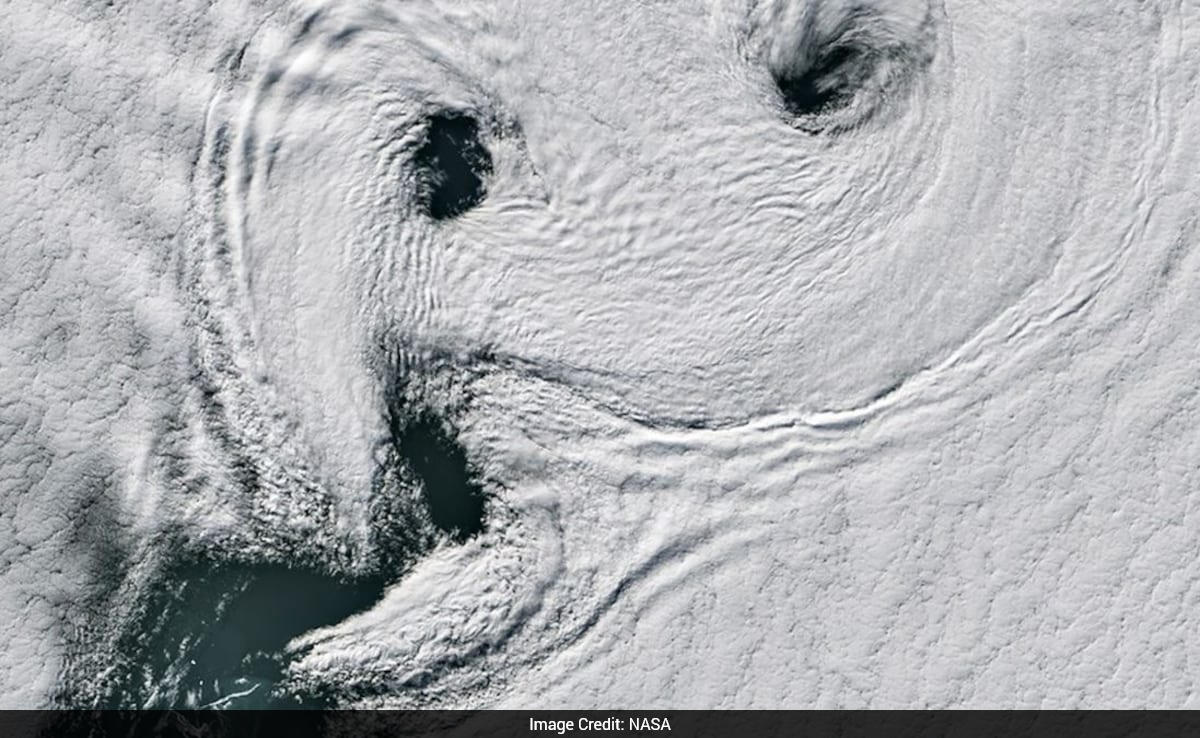
Strong winds moving across the Southern Ocean near Antarctica created striking cloud patterns around the remote Peter I Island, offering a rare view of a natural atmospheric phenomenon. The Southern Ocean is known for its powerful winds that travel around the globe with little interruption from land. Sailors once named these southern regions the Roaring Forties, Furious Fifties, and Screaming Sixties because of the intense prevailing winds, reported NASA.
Vortex Clouds Form Near Peter I Island
One of the obstacles in the path of these winds is Peter I Island, an ice-covered volcanic island located in the Bellingshausen Sea. The island lies about 400 kilometres off the coast of West Antarctica and more than 1,800 kilometres from Cape Horn, Chile.
During an austral summer day in 2026, the Landsat 8 satellite captured images of von Karman vortex streets forming downwind of the island. These swirling cloud patterns develop when moving air is blocked by an obstacle, causing the airflow to slow, shift direction, and spin into rotating eddies.
Scientists explained that wind speeds between 18 and 54 kilometres per hour are usually needed for these vortices to form. Stronger winds can break apart the eddies before they maintain their shape. The following day, similar vortex patterns appeared again among several cloud formations near the island.
As clouds cleared around the island, parts of its icy volcanic structure became visible. Peter I Island has a circular crater around 100 metres wide at its summit, which rises 1,640 metres above sea level.
The Smithsonian Institution's Global Volcanism Program describes the island as a shield-like volcano, although there are no records of recent eruptions.
Scientific research on Peter I Island has remained limited because of its isolated location and difficult ice conditions. The island was discovered in 1821 by Russian explorer Fabian Gottlieb von Bellingshausen and was named after a Russian tsar. However, no landing took place there until 1929.
The few studies conducted on the island have mainly focused on geology, biodiversity, and climate history preserved in the ice.
During a return flight from Antarctica to Chile, NASA's DC-8 aircraft crew captured a rare view of the remote island after spending the day measuring the Getz Ice Shelf and Thwaites Glacier from the air.
Track Latest News Live on NDTV.com and get news updates from India and around the world

