





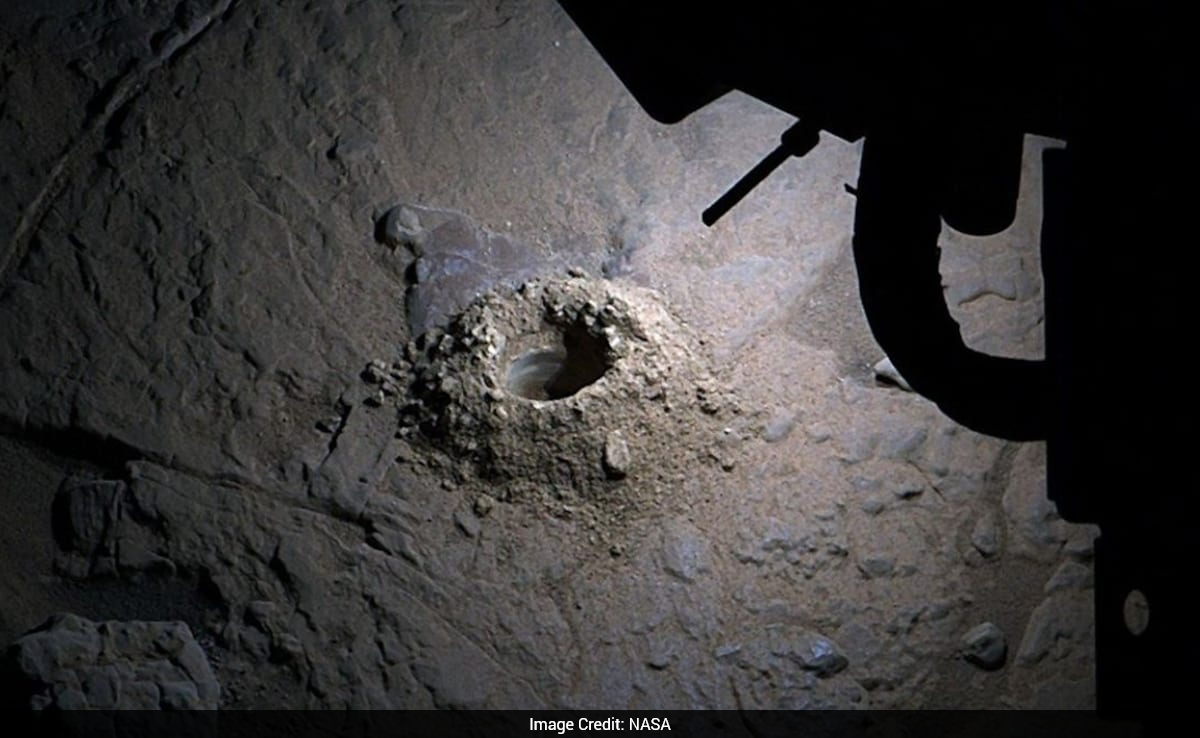
- Curiosity rover captured rare nighttime Mars image using robotic arm LED lights
- Image taken on December 6, 2025, the 4,740th Martian day of Curiosity's mission
- MAHLI camera LEDs illuminated drill hole walls for detailed surface study at night
NASA's Curiosity rover has captured a rare and striking nighttime view of Mars, giving scientists a new way to look closely at the planet's surface. The image was taken using special lights on the rover's robotic arm, showing details that are usually hidden in darkness. This unusual photo was recorded on December 6, 2025, which was the 4,740th Martian day, or sol, of Curiosity's mission, reported NASA.
The rover illuminated the Martian surface using LED lights mounted on the end of its robotic arm. These lights are part of the Mars Hand Lens Imager (MAHLI), a camera mounted on the rover's arm. This scene was captured by a second camera, called Mastcam, mounted on the rover's mast, its "head."
Scientists have previously used MAHLI's LED lights during the day to illuminate areas that are typically in deep shadow. This includes the interior of drill holes and the inlet tubes that lead to instruments inside the rover. Early in the mission, the Curiosity team also used these lights at night to see layers or other structures within the walls of drill holes and better understand the rock composition.
Later, when the mission's drilling procedures were changed, the drill holes became more rough and dusty. This made it difficult to see such fine details clearly.
On November 13, 2025, the mission's 4,718th sol, Curiosity drilled into a rock formation called Nevado Sajama. The team found that the walls of the drill hole were smooth enough to allow another attempt to see the underlying layers. Therefore, they decided to look inside the hole at night using LED lights.
This drill hole was made in an area where Curiosity was studying geological structures called "boxworks." These structures stretch for several miles and, when viewed from space, resemble a giant spiderweb.
Curiosity was developed by NASA's Jet Propulsion Laboratory, which is operated by Caltech in Pasadena, California. The lab is conducting this mission for NASA's Science Mission Directorate in Washington, as part of NASA's Mars Exploration Program.
San Diego-based Malin Space Science Systems built and operates both the Mastcam and MAHLI cameras that captured this remarkable image.
Track Latest News Live on NDTV.com and get news updates from India and around the world

