





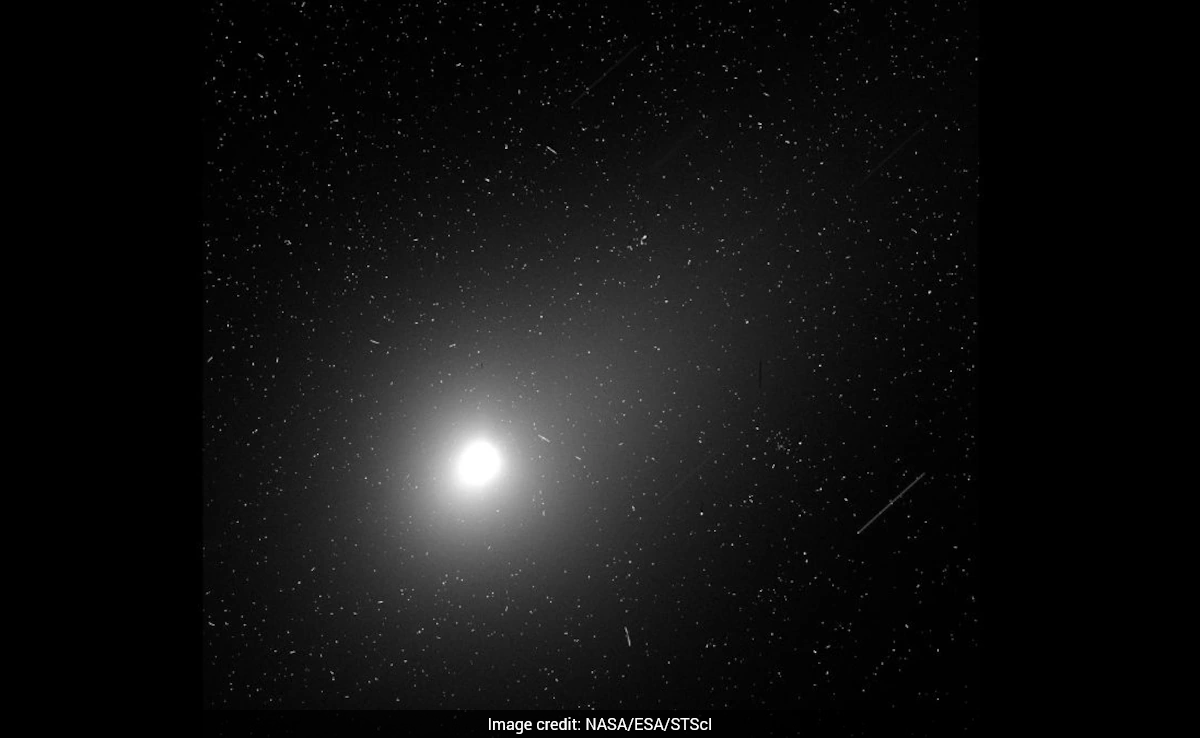
The Hubble Space Telescope has captured striking images of the interstellar comet 3I/ATLAS, the third known interstellar object to enter our solar system. The intriguing images showcase twin jets of material ejected as the comet moves away from the Sun, International Business Times UK reported. The observations, made on December 12 and 27, reveal a double-jet structure, with one jet pointing roughly toward the Sun and the other weaker jet, pointing away.
The twin jets suggest an organised process linked to the comet's rotation and internal structure. The jets' persistence across observations indicates a consistent activity pattern.
Also read | European Space Agency Shares Details Of Martian Ice Age
"Its 7-degree wobble around the rotation axis of 3I/ATLAS implied that it originated near the Sun-facing pole long before perihelion," Harvard Physicist Avi Loeb wrote in a post on Medium.
Loeb further mentioned that, as per his calculation, the "gravitational deflection of 3I/ATLAS by the Sun during perihelion on October 29, 2025, was only by 16 degrees."
Also read | Goodbye To 24-Hour Days? Scientists Predict Earth Will Have 25-Hour-Long Days In The Distant Future
"If the rotation axis did not change orientation between July and December 2025, the original Sun-facing pole is now on the nightside of 3I/ATLAS - opposite to the direction of the Sun."
"It points in the same direction as the weaker jet in the new Hubble images from December 12 and 27, 2025, and is accompanied by a stronger sunward jet from the opposite side of 3I/ATLAS on its way out of the solar system."
As 3I/ATLAS fades, scientists will continue analysing data to understand more about the mysterious comet.
Track Latest News Live on NDTV.com and get news updates from India and around the world

