





Earth is believed to have experienced its most severe ice age around 700 million years ago, which left behind geological features like U-shaped valleys, fjords, moraines, kames, and tarns. But many don't know about the Martian ice age.
Mars, our planetary neighbour, also has some scars of an ancient ice age that shaped its landscape, the European Space Agency (ESA) shared details recently, with intriguing pictures from the High Resolution Stereo Camera on ESA's Mars Express.
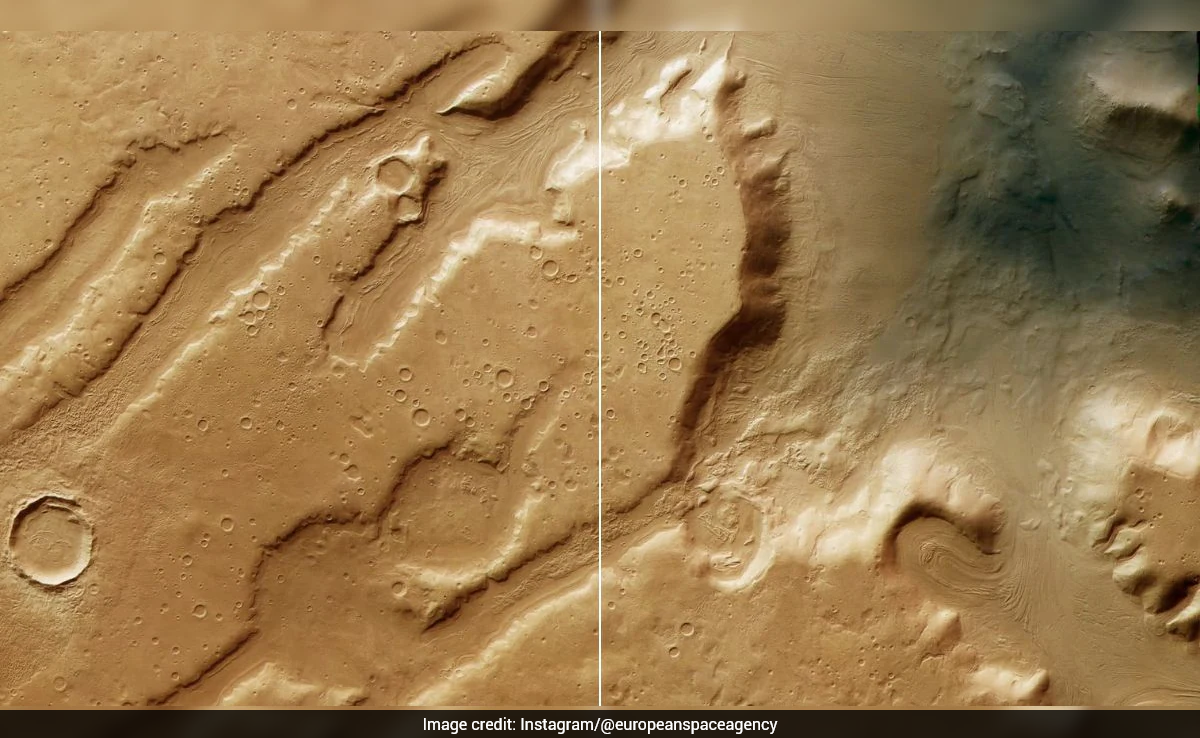
The images shared by ESA show roughly parallel lines slicing the image diagonally, which are called Coloe Fossae. The space agency mentioned that it's a feature created as alternating chunks of ground fell away.
Also read | Goodbye To 24-Hour Days? Scientists Predict Earth Will Have 25-Hour-Long Days In The Distant Future
"Many craters, formed as incoming space rocks collided with the surface", and on the "floors of the valleys and craters is something exciting: patterns of swirling lines that indicate where material flowed during a previous martian ice age".
These patterns are called Lineated Valley Fill (LVF), valleys filled with swirling patterns, indicating slow-moving icy debris flows, and Concentric Crater Fill (CCF), craters with concentric ridges, formed by ice accumulation and deformation.
On the other hand, Lobate Debris Aprons (LDA) are Glacier-like features with rocky debris covering ice.
But this region is at a latitude of 39 degrees N, which is not even close to Mars's north pole (at 90 degrees N). So, exactly how does ice accumulate there?
Also read | Scientists May Have Identified Promising Landing Site On Mars
"The answer lies in the pulse of advancing-retreating glaciers during an ancient ice age. Although Mars is currently dry, it has experienced alternating periods of warm and cold, freeze and thaw, throughout its history, driven by changes in the tilt of its axis," ESA said.
"During cold periods, ice spreads from the martian poles all the way down to these mid-latitudes, before retreating back when things get warmer - but leaving telltale signs behind."
Mars' axial tilt changes drove ice migration from poles to mid-latitudes, leaving behind these glacial features. The ice age likely occurred as recently as 500,000 years ago, ESA mentioned.
Track Latest News Live on NDTV.com and get news updates from India and around the world

