





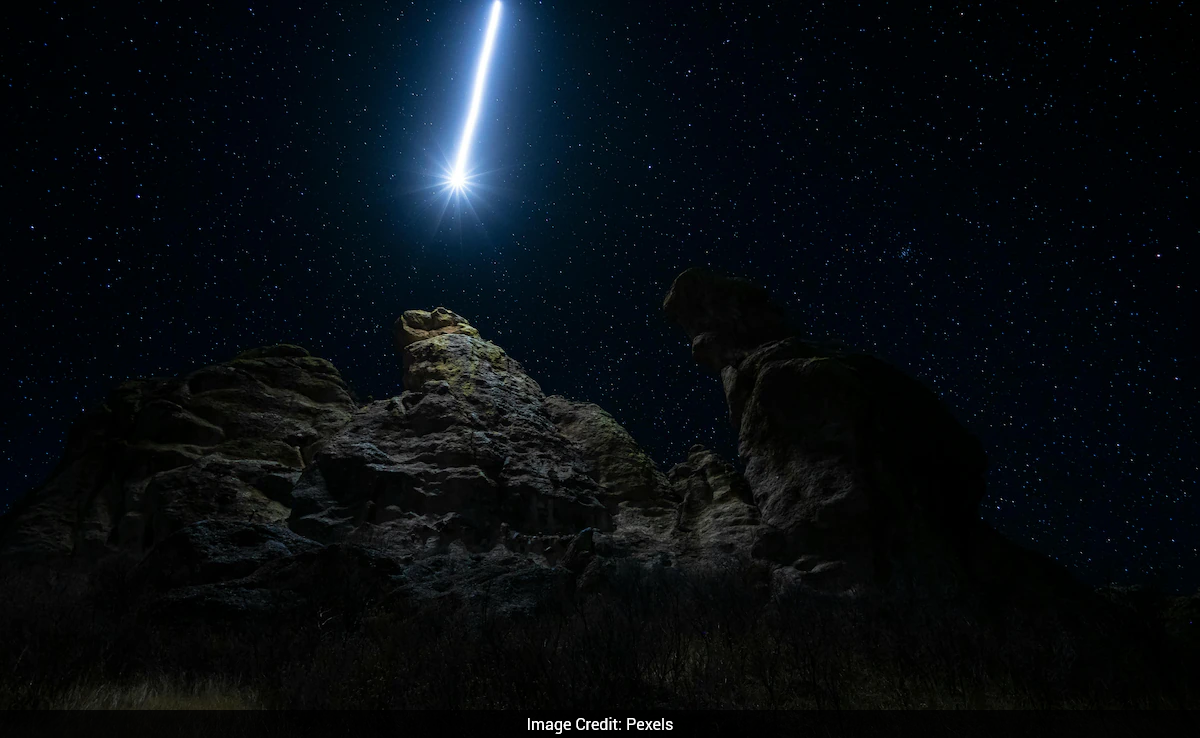
A rare celestial event is set to attract global attention as a large asteroid becomes visible to the naked eye, giving people a unique chance to observe a close approach of a space object, reported ABC news.
Astronomers have confirmed that asteroid 99942 Apophis will safely pass close to Earth on April 13, 2029. The asteroid is named after an Egyptian deity associated with chaos, darkness, and fire.
According to NASA, the asteroid will pass at a distance of around 20,000 miles from Earth. This is nearly 12 times closer than the average distance between the Earth and the Moon, and even closer than many satellites in geosynchronous orbit.
Scientists describe this as one of the closest approaches ever recorded for an object of this size and consider it a very rare event.
This celestial event will be visible to people living in the Eastern Hemisphere, but its visibility will depend on the weather. Astronomers predict the asteroid will be so bright that it will be visible to the naked eye without any instruments, requiring no binoculars or telescopes.
After its discovery in 2004, Apophis was considered a potentially hazardous asteroid, with predictions suggesting it could collide with Earth in 2029, 2036, and 2068.
However, after continuous monitoring using optical telescopes and ground-based radar, scientists concluded that there is no risk of a collision with Earth for at least the next 100 years.
NASA says that when the asteroid passes near Earth in 2029, Earth's gravity may slightly alter its orbit around the Sun. This may enlarge its orbit or increase its orbital time, but it will not affect the likelihood of a collision with Earth.
This close pass will also provide a valuable opportunity for scientists worldwide to study this asteroid in depth and understand its properties.
The name Apophis is derived from the Greek form of the Egyptian god Apep. The asteroid was discovered by astronomers Roy Tucker, David Tholen, and Fabrizio Bernardi at the Kitt Peak National Observatory near Tucson, Arizona.
Apophis is believed to be a remnant of the early solar system, formed approximately 4.6 billion years ago. It is composed of unrefined material that failed to form a planet or moon.
While its exact size is not yet clear, its average diameter is approximately 1,115 feet, while its maximum length is estimated to be at least 1,480 feet.
Scientists believe that its surface has been altered by long-term exposure to cosmic influences such as solar winds and cosmic rays.
Observatories on Earth and in space will monitor this significant event to better understand its physical properties and behaviour.
Track Latest News Live on NDTV.com and get news updates from India and around the world

