





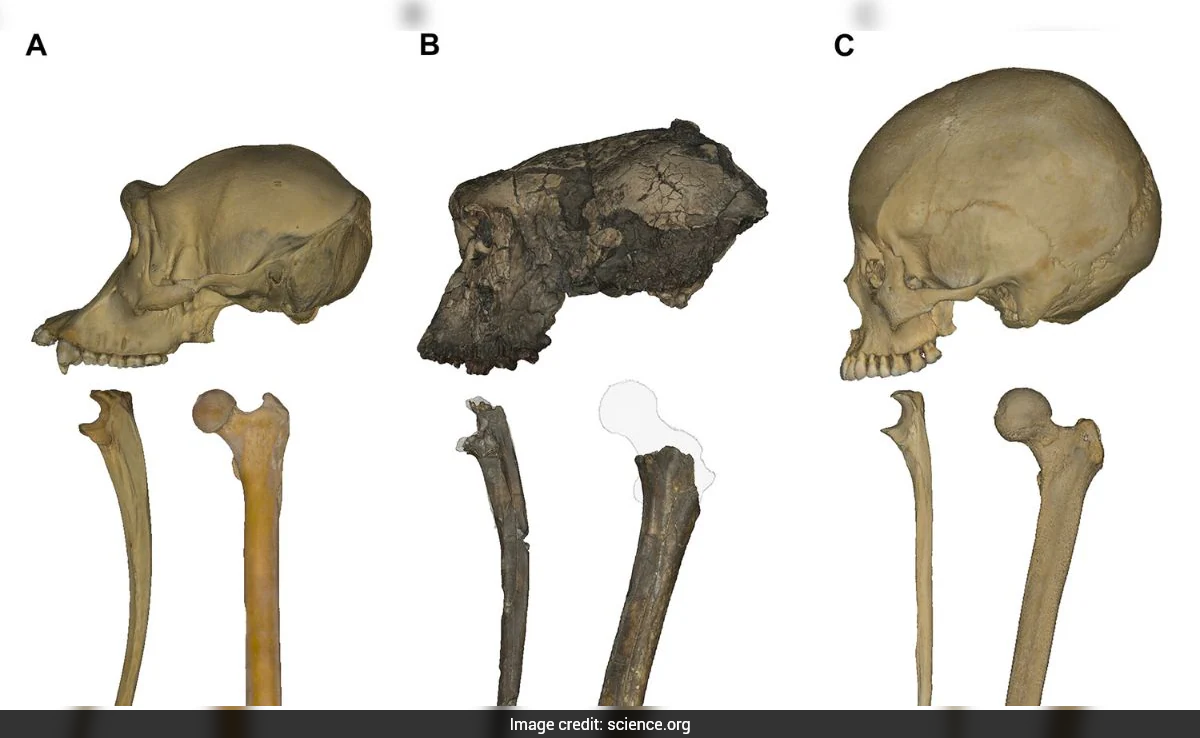
A recent study has suggested that Sahelanthropus tchadensis, an ape-like species that lived in Africa seven million years ago, may be the earliest known human ancestor. The researchers analysed fossilised bones and found evidence of adaptations for bipedalism, which is a key characteristic of the human lineage.
"Bipedalism is a key adaptation that differentiates hominins (humans and our extinct relatives) from living and fossil apes," the researchers wrote in the study published in Science Advances.
Sahelanthropus tchadensis, nicknamed Toumai, was discovered in 2001. It is claimed to be one of the earliest human ancestors, but some experts believe that it was not a direct human antecedent.
Also read | Mysterious Pink Slime On Tasmanian Beach Sparks Algal Bloom Concerns
Researchers used modern technology, and after in-depth analysis, they identified a femoral tubercle, a small bump on the thigh bone, which is associated with upright walking. The researchers also found that the femur's shape and proportions are more similar to those of hominins than African apes.
"Based on the features we've found, this would have looked like a bipedal ape, most similar to a chimpanzee or bonobo," Dr Scott Williams, an associate professor at New York University and the lead author of the study, as quoted by The Guardian.
The study suggested that the species likely walked on two legs, at least partly, while still spending time in trees.
Also read | Malaysian Man Works As Food Delivery Rider Despite Losing Arm In Accident, Inspires Internet
"It's the attachment point for the largest and most powerful ligament in our bodies. When we're seated, that ligament is loose and when we stand it tightens up," Williams said.
"It prevents your torso from falling backward or from side to side as you walk around, so it's a really important adaptation for bipedal walking. As far as I know, this has only been identified in bipedal hominins."
While the findings are intriguing, not all scientists are convinced, as some argue that the evidence is weak and that more fossils are needed to confirm Sahelanthropus' place in the human lineage.
Now, the researchers are planning to return to the original site in Chad to search for more fossils, which could help settle the debate. Until then, the debate continues.
"I think it's a case of too few fossils and too many researchers," said Williams.
Track Latest News Live on NDTV.com and get news updates from India and around the world

