





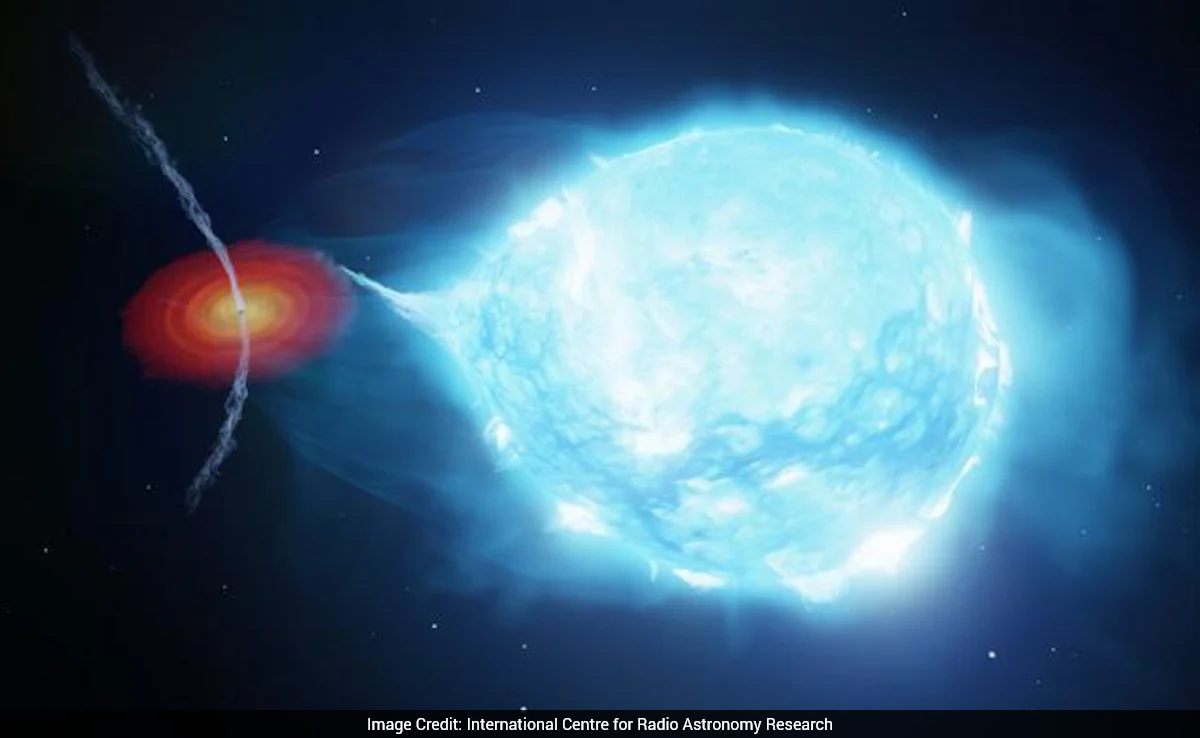
- Cygnus X-1 jets emit energy equal to 10,000 Suns, study finds
- Jets travel at half the speed of light, about 150,000 km/sec
- 10% of energy from infalling matter is carried away by jets
The first black hole to be confirmed, Cygnus X-1, is blasting "dancing jets" into space with the force of 10,000 Suns. While its discovery in 1964 came at a time when scientists still questioned if black holes existed, a new study led by Curtin University, published in Nature Astronomy, has finally quantified its massive energy output by analysing a series of images of these powerful jets.
The jets extending from these black holes can extend millions of light-years in length. They are exceedingly bright because when particles approach the speed of light, they give off a tremendous amount of energy and behave in weird ways that Albert Einstein predicted.
Researchers used a global network of linked telescopes to observe black hole jets being buffeted by stellar winds, similar to how strong winds push water in a fountain. As the black hole orbited, these winds bent the jets, revealing their immense power. After the calculations, the scientists found that the jets travel at about half the speed of light, or 150,000 km per second and generate power that glows as bright as 10,000 suns.
“A key finding from this research is that about 10 per cent of the energy released as matter falls in towards the black hole is carried away by the jets,” said lead author Dr Steve Prabu.
“This is what scientists usually assume in large-scale simulated models of the Universe, but it has been hard to confirm by observation until now," he added.
Also Read | Elon Musk Reveals 'Best Way' To Deal With Mass Unemployment Caused By AI
Cygnus X-1
Located approximately 7,000 light-years from Earth, Cygnus X-1 is a stellar-mass black hole that is approximately 21 times more massive than the Sun. It is locked in a binary orbit with a companion star called HDE 226868 that's nearly twice as big. The pair twirl about each other every 5.6 days.
Cygnus X-1 was officially confirmed in 1971, and since then, it has been one of the most extensively studied black holes. Until recently, it was considered the most massive and fastest-spinning stellar-mass black hole ever seen.
Track Latest News Live on NDTV.com and get news updates from India and around the world

