





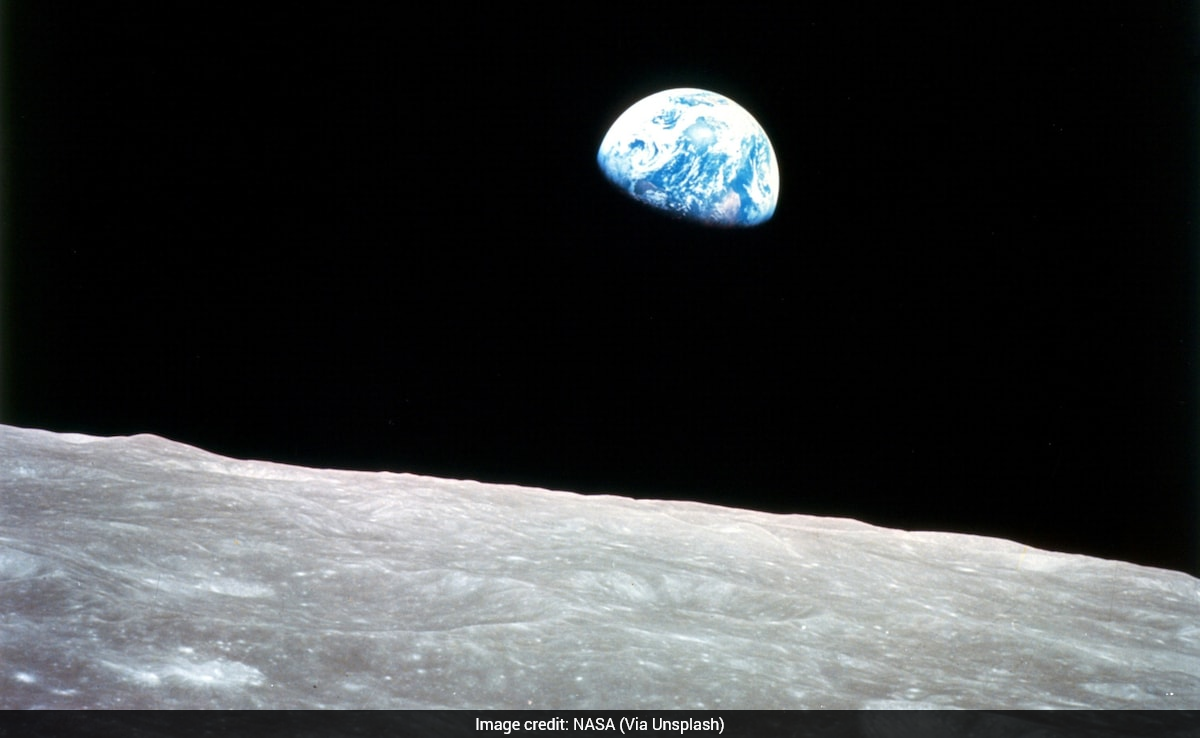
Scientists have found a deep and intricate relationship between Earth and the moon, suggesting that our planet may have played a more significant role in shaping the lunar environment than previously thought. As per the research, Earth's magnetic field has been quietly nourishing the lunar surface with essential nutrients for billions of years, Science Daily reported.
The Moon looks lifeless, but tiny fragments likely reached its surface and were embedded in its soil, with the possibility that one day these materials will help support human activity on the Moon.
In the study, published in Nature Communications Earth and Environment, researchers at the University of Rochester reported that Earth's atmosphere has been assisting this transfer, instead of preventing it.
Also read | All About Deadly 'Superbug' That's Spreading Fast Across US, Raising Concerns
"By combining data from particles preserved in lunar soil with computational modeling of how solar wind interacts with Earth's atmosphere, we can trace the history of Earth's atmosphere and its magnetic field," Eric Blackman, a professor in the Department of Physics and Astronomy and a scientist at URochester's Laboratory for Laser Energetics (LLE).
The process, which existed for billions of years, would eventually turn lunar soil into a long-running archive of Earth's atmosphere.
After analysing Moon rocks and soil which were collected during the Apollo missions in the 1970s, the researchers found that the Moon's surface layer contains substances such as water, carbon dioxide, helium, argon, and nitrogen.
It is understood that some of these particles came with the solar wind, but quantities of some particles, especially nitrogen, suggest that it's not possible that all of it could have come from solar wind alone.
Also read | 12-Year-Old Japanese Gamer Plans To Quit School For Esports Career, Internet Reacts
An old study claimed that these particles reached the lunar surface before Earth developed a magnetic field, because afterwards, the atmospheric particles would be blocked.
However, researchers in the latest study used advanced computer simulations and reached a different conclusion.
"Our study may also have broader implications for understanding early atmospheric escape on planets like Mars, which lacks a global magnetic field today but had one similar to Earth in the past, along with a likely thicker atmosphere," Paramanick said as quoted.
"By examining planetary evolution alongside atmospheric escape across different epochs, we can gain insight into how these processes shape planetary habitability."
Track Latest News Live on NDTV.com and get news updates from India and around the world

