




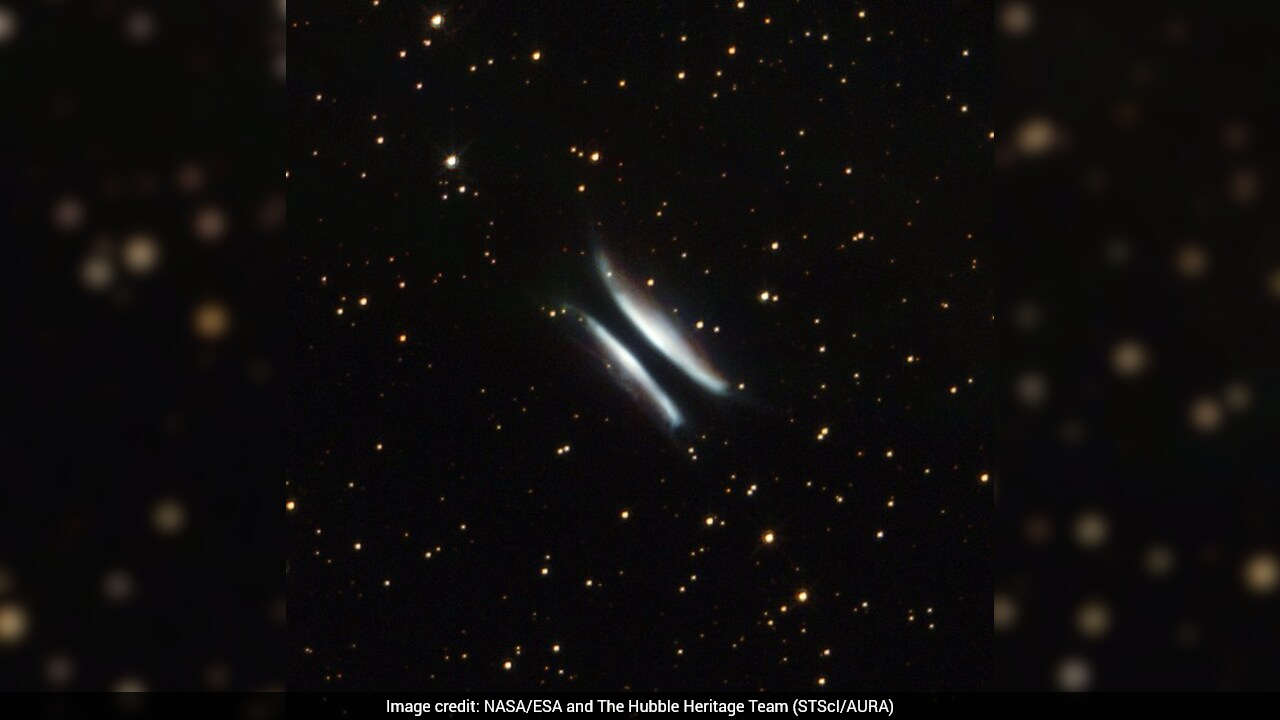
Astronomers recently discovered the earliest phases of giant planet formation between the dense layers of gas and dust in the "Gomez's Hamburger" system, which is called GoHam. The astronomers used the Atacama Large Millimeter/submillimeter Array (ALMA), which offered fresh clues about how giant planets come to life. According to phys.org, the findings were shared at a press conference at the American Astronomical Society's 247th meeting.
Gomez's Hamburger is a giant cloud of dust and gas surrounding a young star. Because scientists view this system almost directly from the side, the thick belt of dust blocks the central star's direct light, while glowing material above and below creates a visual resemblance to a fast-food burger.
-

-
 "High Inflation Is Like Tax On Everyone": RBI Governor At NDTV World Summit
-
 AI Agents To Outnumber Humans Soon? What Futurist Mike Walsh Told NDTV
-
 This Delhi Boy Has 3 Michelin Stars. His Heart Still Goes To Rajindar Da Dhaba
-
 Ashwini Vaishnaw Explains Semiconductor Complexity: 'Everything On This Tiny Nail'
-
 Indian-Branded Mobile Phones By October 23, 2028, Says Ashwini Vaishnaw
-
 AI Law In India Soon? What Ashwini Vaishnaw Said At NDTV World Summit
-
 'Need To Look At Next 10 Years': Bondada Chairperson To NDTV On Solar Energy
-
 World's 1st AI Actor Tilly Norwood Was Asked If She Knew Hindi. A Conversation Followed
-
 AI Law In India Soon? What Ashwini Vaishnaw Said At NDTV World Summit
-
 Iran's Supreme Leader's Representative Says India Can Play 'Big Role' In Middle East Peace
Also read | Tricked By Fake Lottery On Facebook, 71-Year-Old In Singapore Loses Rs 16 Lakh Savings
Using advanced radio telescope arrays, researchers were able to look inside the layers of the cosmic burger. They found that solid dust particles and various gases are neatly separated into distinct vertical levels. The heavier dust grains settle near the middle plane, while the lighter gases puff up far above and below.
The observation has also been accepted for publication in The Astrophysical Journal, and the paper is currently available on the arXiv preprint server.
"GoHam gives us a rare and clear view of the vertical and radial structure of a very large, nearly edge-on disk," Charles Law, an assistant professor at the University of Minnesota and principal investigator on this research, said as quoted by the outlet.
"This makes it a benchmark system for testing detailed models of how planets form and evolve in disks. The combination of extreme disk size, strong asymmetries, winds, and potential planet formation makes it the perfect laboratory for understanding how giant planets can form far from their star, and how their presence reshapes the surrounding gas and dust," he added.
Also read | "Scary": Doorbell Camera Captures Stranger In Joe Biden Mask Eating Banana Outside US Home
The latest, side-on perspective is valuable because it gives scientists a clear, cross-sectional look at a planetary nursery.
Within the system, researchers spotted an unusual chemical arc and a dense clump of material, referred to as a candidate planet-forming region, where matter may be pulling together under gravity to build a massive planet far away from its host star.
While researchers note that they cannot yet confirm a fully formed planet is sitting inside, the detailed look provides a rare chance to study the early stages of planetary creation.
Track Latest News Live on NDTV.com and get news updates from India and around the world

