





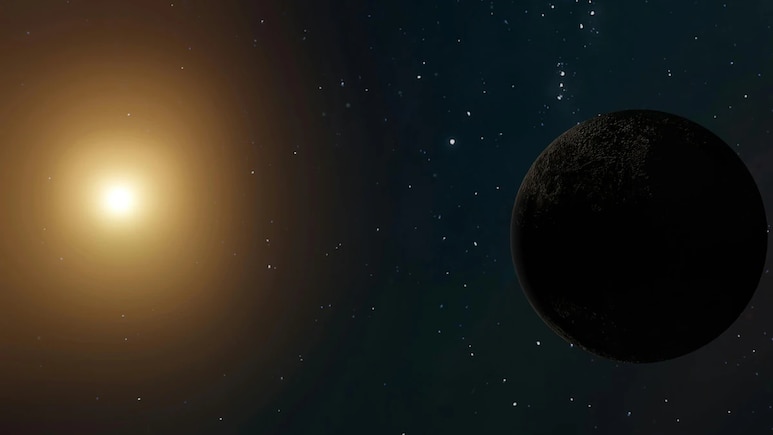
In a discovery that has left astronomers astonished, a rogue planet has been spotted rapidly devouring gas from its surroundings, a phenomenon almost never seen before. The object, known as Cha 1107-7626, lies about 620 light-years away and is estimated to be five to ten times the mass of Jupiter, reported ScienceNews.
It is surrounded by a thick layer of gas and dust and is undergoing rapid evolution. Scientists have observed material falling onto its surface at an incredible rate of six billion tons per second. Over the past few months, this rate suddenly surged, creating a rare explosive event. Researchers believe that magnetic activity may be driving this unusually fast accretion, reported ScienceNews.
During this period, water vapour was detected in the disk around the planet at levels never seen before. This indicates significant changes in the planet's chemical environment and highlights the complex, dynamic nature of planet formation.
The unusual behaviour of Cha 1107-7626 challenges the distinction between stars and planets, suggesting that some rogue planets might form similarly to stars rather than as gas giants ejected from a planetary system.
This sudden increase was first recorded by the Very Large Telescope's X-shooter spectrograph. This was later confirmed by data from the James Webb Space Telescope and earlier observations.
By combining information from various instruments, scientists got deeper into this unprecedented event.
This violent transformation of this stray planet suggests that the process of planet formation may be more chaotic and explosive than previously thought. Such intense explosions can affect planets' atmospheres and even alter the course of moon formation. Future observations will help determine whether such events are common in the galaxy.
Now, astronomers are preparing to conduct long-term studies of other free-floating planets in the Camelion region to understand how frequently such periods of rapid evolution occur. These studies will redefine existing theories of planet formation and help understand how solitary planets evolve.
In the vast depths of space, Cha 1107-7626 provides a reminder of how dynamic and unpredictable planetary life can truly be.
Track Latest News Live on NDTV.com and get news updates from India and around the world

