





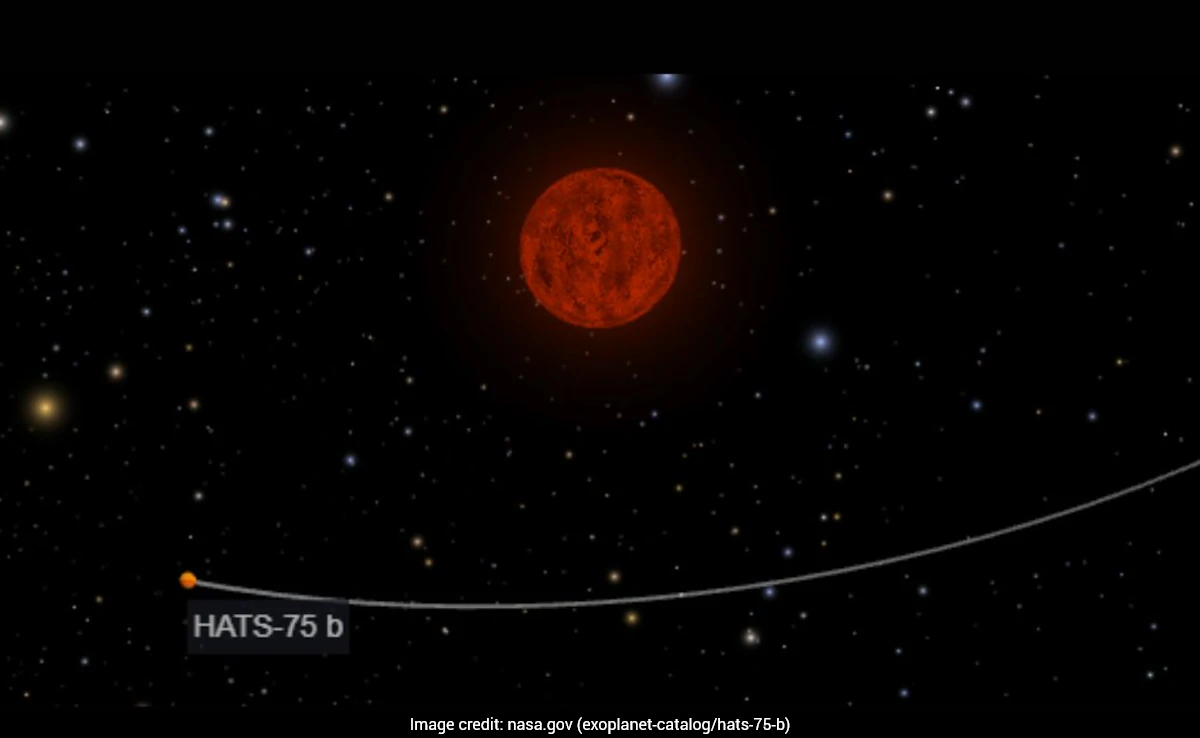
Astronomers from Johns Hopkins University (JHU) used the James Webb Space Telescope (JWST) to observe a giant exoplanet known as HATS-75 b, which is one of the recently discovered Giant Exoplanets orbiting M-dwarf Stars (GEMS). Precisely, it was discovered in 2021 with the help of Automated Telescope Network-South (HATSouth) and NASA's Transiting Exoplanet Survey Satellite (TESS). This exoplanet is at a distance of some 637 light-years.
Astronomers have analysed various aspects of the exoplanet, but recently, it was revisited by a team of astronomers led by JHU's Reza Ashtari. They investigated the chemical composition of HATS-75 b's atmosphere.
Also read | Chandrayaan-3: Vikram's Hop Offers Fresh Insights On Moon's Surface
"Our observations offer an opportunity not only to characterise the atmospheric composition of HATS-75 b, but also to explore how stellar heterogeneity influences the interpretation of transmission spectra in low-mass star systems," they wrote in the paper.
The astronomers revealed that they observed three transits of HATS-75 b with the NIRSpec PRISM instrument. "The planet's spectra exhibit a slightly larger transit depth at shorter wavelengths, indicative of hazes or stellar contamination due to stellar heterogeneities outside the transit chord, i.e., the transit light source (TLS) effect," they wrote.
"While both a hazy atmospheric model or TLS model can replicate the transmission spectrum, independent evidence (.e.g, stellar rotation, spot-crossing events) favours a model that includes contamination from unocculted starspots and faculae," they added.
Also read | Ex-SpaceX Engineer Bets On Solar Power To Revolutionise Space Travel
"HATS-75 b thus joins the rare population of giant planets around M-dwarfs observed with JWST, underscoring both the challenges of stellar contamination in transmission spectroscopy and the importance of careful host-star treatment in revealing the true chemistry of these uncommon worlds," the scientists conclude.

