





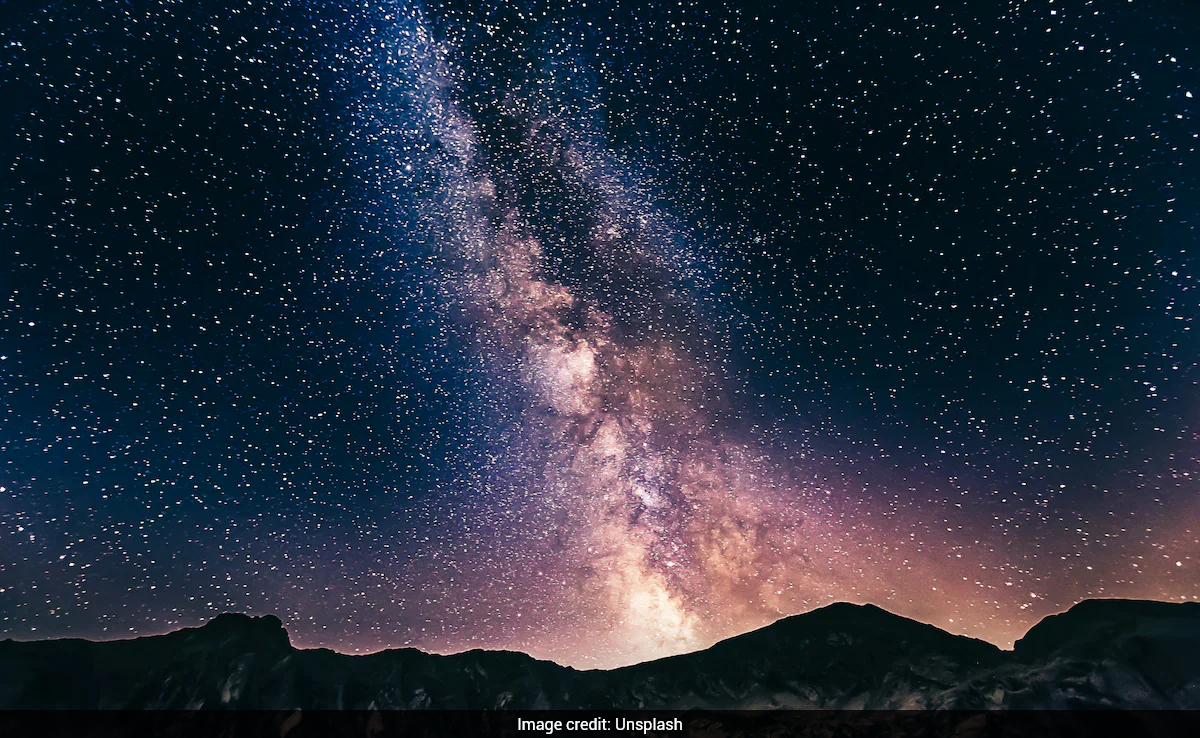
Scientists claimed to have uncovered fresh evidence of the Milky Way eating up another galaxy about 10 billion years ago, suggesting that our galaxy didn't grow alone; it got bigger by devouring smaller neighbours, CNN reported. The Milky Way has been building itself up through mergers for about 12 billion years. When a large galaxy's gravity pulls in a smaller one, the smaller galaxy gets torn apart. Its stars, gas, and dark matter scatter through the Milky Way, leaving behind remnants that astronomers can still identify today.
These remnants are key to reconstructing the Milky Way's growth history. Big mergers can reshape the galaxy's structure, while smaller ones add streams of stars to the halo. A study, published in the journal Monthly Notices of the Royal Astronomical Society, points to evidence of a major merger with a galaxy nicknamed Loki.
Also read | NASA Explains Why Earth Appears Glowing Orange In Stunning Space Photo
Researchers argue that Loki's impact may have been almost as significant as the well-known Gaia-Sausage-Enceladus event, which occurred 8-10 billion years ago and helped turn the early Milky Way into the stable disk we see today.
"This study is novel as there was no other high-resolution spectroscopic campaign of these low-metallicity stars that move close to the Milky Way disc, and with observed spectra at such high quality," lead author of the study Federico Sestito, who is from the University of Hertfordshire, told IFLScience.
"The kinematics of the oldest and most metal-poor stars is informative of the assembly of our galaxy. We might have found one of the building blocks, which we dubbed 'Loki', that contributed to form our Milky Way. We derived its mass and chemical evolution, including the various nucleosynthetic channels that contributed to the elemental abundances of these stars."
Also read | NASA's Psyche Mission Captures Stunning View Of Huygens Crater On Mars
Loki's traces are harder to find because they're buried near the Milky Way's dense disk. If confirmed, it would mean our picture of the galaxy's formation is missing a major chapter.
"If the single scenario is not the case, the simplest alternative would be to have two formation sites: one site for the retrograde and one for the prograde population. These two systems would have had a very similar, if not identical, chemical evolution, with the same nucleosynthetic channels," Sestito explained.
How can scientists see the remnants?
Missions like ESA's Gaia satellite map billions of stars and their motions. By looking for groups of stars moving together, with unusual orbits or chemical signatures, astronomers can pick out stars that didn't form in the Milky Way but were brought in during a merger.
These findings would help the scientists piece together a fossil record. It would tell us how the Milky Way assembled and how often it collided with neighbours.
Track Latest News Live on NDTV.com and get news updates from India and around the world

