





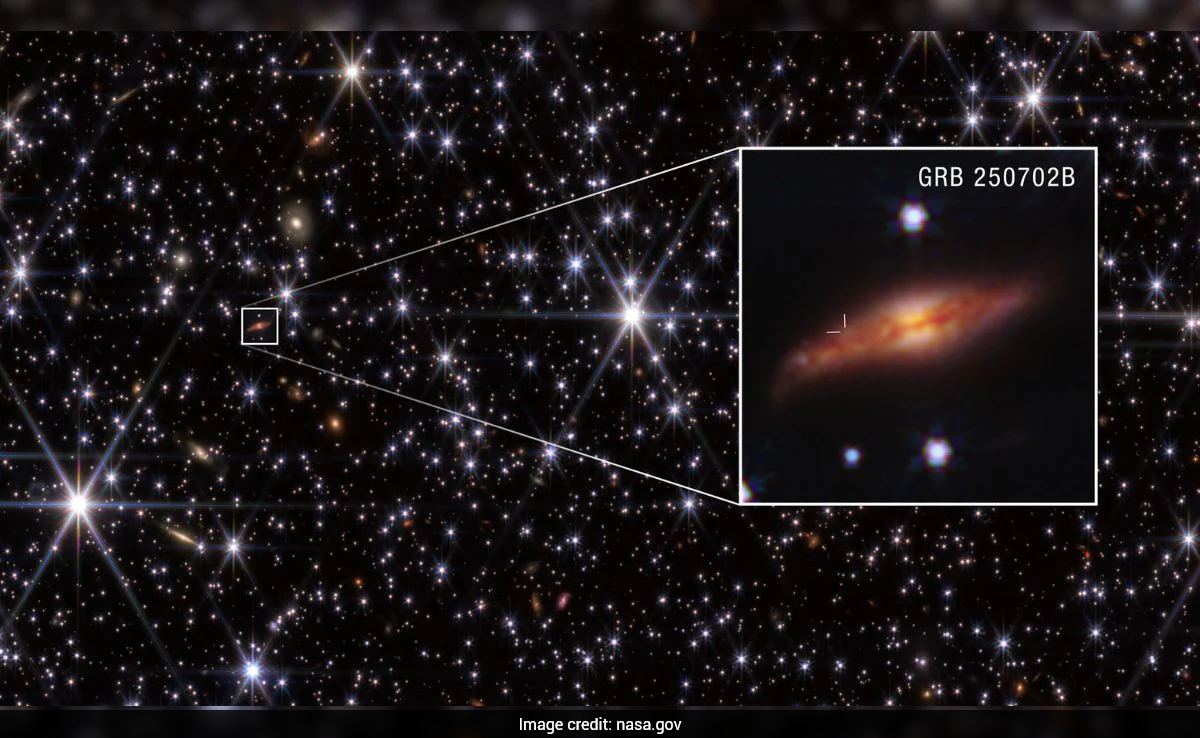
Astronomers last year detected a strong signal, a blast or a burst, from space lasting seven hours. They were stunned by the extraordinary duration, but recently, a scientist, among the first ones to detect it, provided possible explanations. The signal, known as GRB 250702B, was a gamma-ray burst (GRB), which are intense source of high-energy radiation that can be detected on Earth in the form of gamma rays. According to a report by BBC Sky at Night Magazine, Eliza Neights, a researcher at NASA Goddard Space Flight Center, shared details about the signal detected by NASA's Fermi Gamma-Ray Space Telescope.
"The initial wave of gamma rays lasted at least 7 hours, nearly twice the duration of the longest GRB seen previously, and we detected other unusual properties," Neights said as quoted in an old NASA report. "This is certainly an outburst unlike any other we've seen in the past 50 years."
She revealed to the outlet that she was on shift when the strange pattern of three gamma-ray bursts was recorded, coming from the same place in space. It was the longest-lasting GRB ever recorded. They had to combine data from five powerful telescopes to figure out that it lasted around seven hours (25,000 seconds).
Also read | Study Reveals Why Some Auroras Have Breathtaking Wave Patterns
What are the possible explanations?
The report mentioned that the signal could be because of a helium merger, as a black hole orbiting a helium star could have caused the prolonged gamma-ray burst. As the black hole consumes the star, it releases massive energy, producing a long-lasting jet.
It could also be a tidal disruption event, because when a black hole tears apart a companion star, such bursts can happen. The gamma-ray bursts could also be a new cosmic phenomenon, as some scientists have proposed that GRB 250702B represents an entirely new type of cosmic explosion.
Also read | All About Sarvam AI, India's "Sovereign" AI That Beat Google Gemini and ChatGPT
This discovery challenges existing models of gamma-ray bursts and stellar death, offering insights into extreme cosmic environments.
"The burst went on for so long that no high-energy monitor in space was equipped to fully observe it," Eric Burns, an astrophysicist at Louisiana State University in Baton Rouge, said as quoted by NASA. "Only through the combined power of instruments on multiple spacecraft could we understand this event." Burns is a member of Neights' team studying the burst's gamma-ray glow.
Track Latest News Live on NDTV.com and get news updates from India and around the world

