




After much back and forth, the election in Bangladesh was finally announced for February 12. Tarique Rahman, the son of former Bangladeshi Prime Minister Khaleda Zia, promised that the election would take place on that date following Muhammad Yunus's meeting with him in London. However, doubts persisted over whether the election would actually be held.
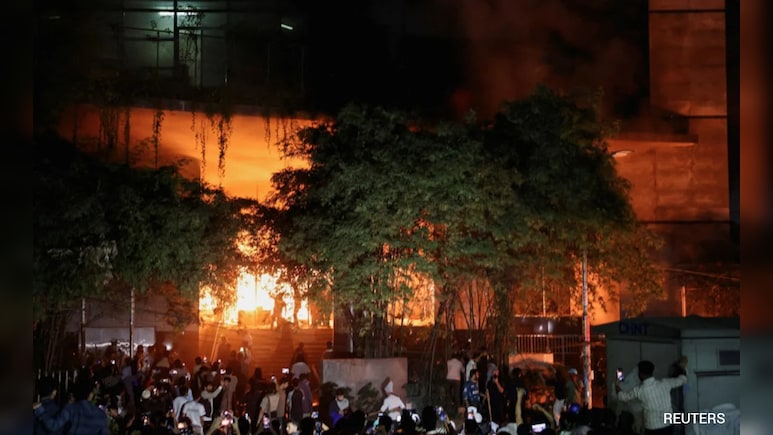
At present, the situation in Bangladesh is on the brink of eruption. The political chaos has coincided with attacks on the minority Hindu community. The residence of Bangabandhu Sheikh Mujibur Rahman was attacked after the Awami League headquarters was vandalised. Although the election has been scheduled for February 12, such incidents are making the situation increasingly unmanageable. The Indian government is closely monitoring developments to assess how it unfolds.
The primary concern is India's position in the context of its long-standing relationship with Bangladesh. Another key question is who is responsible for the unrest. Islamic fundamentalist forces appear to be playing a role, and suspicion has fallen on Jamaat-e-Islami, the largest fundamentalist group in the country.
The son of BNP leader Khaleda Zia has now declared that he will return to Bangladesh before Christmas, and the BNP has been communicating with India about its desire to maintain cordial bilateral relations. It remains unclear whether the BNP, Jamaat, student organisations, or NCP-linked militants are responsible for the unrest. Regardless of party affiliation, India seeks a stable relationship with Bangladesh. At the same time, concerns have grown over Pakistan's role, particularly after the visit of the ISI chief to Dhaka, raising questions about whether Pakistan has contributed to the sudden escalation.
On December 17, Bangladesh's High Commissioner in Delhi, Riaz Hamidullah, was summoned by India, and a formal diplomatic protest was lodged over the deteriorating security situation in Dhaka. Notably, this occurred on the same day that the main India visa application centre at Jamuna Future Park in Dhaka closed at 2 pm due to security concerns. Prior to New Delhi's move, the Bangladeshi government had summoned the Indian High Commissioner. Before India's decision, Bangladesh's High Commissioner in Delhi had also been called in for consultations.
Following New Delhi's decision to summon the Bangladesh High Commissioner, anti-Indian protesters gathered outside the Indian High Commission in Dhaka on December 17, triggering a diplomatic controversy. The High Commissioner had earlier been summoned in July after 'Oikyo' groups called for a march to the Indian mission, demanding the extradition of ousted former Prime Minister Sheikh Hasina and others who have taken refuge in India since the student protests of July-August 2024. The groups formed during last year's uprising are collectively known as July Oikyo.
So, what does India expect from Bangladesh during this tense phase?
It does not want to meddle in Bangladesh's domestic politics, but it does want a free and peaceful election in the neighbouring sovereign state. It has also made clear that anti-Indian activities will not be tolerated. According to intelligence assessments, Paresh Baruah, a senior militant leader, has returned to Dhaka. He had earlier fled to Myanmar during Sheikh Hasina's tenure after being barred from remaining in Bangladesh. There is also concern that extremist groups may once again use Bangladeshi territory against India. These concerns have been conveyed to Dhaka.
Over the last few years, the Jamaat's political influence among Bangladeshis has grown, though a Jamaat constituency has always existed in the country. Bengali nationalism triumphed in 1971 when Urdu nationalism was defeated, leading to the creation of Bangladesh under Sheikh Mujibur Rahman. The Awami League emerged as the dominant force, while Jamaat was suppressed. Later, Sheikh Hasina led successive governments, with power alternating between the Awami League and Khaleda Zia's BNP. The BNP has historically supported Jamaat, which maintains ideological proximity to Pakistan, and this legacy continues to shape political perceptions.
The Jamaat itself has rarely contested elections independently and has largely functioned as an ideological force outside Parliament, with the BNP relying on its support. However, following Sheikh Hasina's removal, the political landscape has changed. The Jamaat now seeks to re-emerge as a mainstream political party. There have been demands for India to hand over Sheikh Hasina so that judicial verdicts can be implemented. The Jamaat, in turn, argues that this would pave the way for a new political order. But whether the outfit has the capacity to govern and unify Bangladesh remains an open question.
It was initially assumed that Jamaat and the BNP would contest the election together, as the former is unlikely to win on its own. However, it gradually distanced itself from the BNP over seat-sharing disputes; the BNP is unwilling to concede too many seats, while the Jamaat believes it can secure a significant vote share. If the Jamaat wins more seats, it could wield greater influence in Parliament. But if the BNP dominates, Jamaat risks marginalisation.
Tarique Rahman was expected to return in December, ahead of the election, with Ramzan set to begin on February 17. His reluctance to return has fuelled speculation that the BNP may seek a postponement. While the BNP has not issued a formal statement, it has conveyed to India that elections should be held as soon as possible. At the same time, there have been suggestions that Yunus may wish to delay the polls to consolidate his position and organise a student-backed political platform.
Khaleda Zia's deteriorating health has added another layer of uncertainty. Although there were discussions about transferring her to London for treatment, concerns remain over logistics and her ability to travel. India has called for elections to be held promptly, stressing the importance of democratic legitimacy. The United States has also urged that elections take place as scheduled. Following the announcement of the election, Khaleda Zia decided to continue her treatment in Dhaka.
Despite the election announcement, there remains speculation in Delhi that polls could be cancelled if law and order deteriorates further, communal tensions intensify, or attacks on Hindus increase. Sheikh Hasina does not wish to return, and India is not pressuring her to do so. The Awami League, barred from contesting, sought India's assistance to participate in the election, even exploring cooperation with the BNP. These efforts failed, leading to dissatisfaction within the party over India's restrained role.
So, what is India looking for?
India is not endorsing Jamaat in any form and remains opposed to Islamic fundamentalism and any pro-Pakistan tilt in Bangladesh's foreign policy. In a regional environment where Pakistan and China maintain close ties, India remains cautious.
Bangladesh's interim administration has accused Sheikh Hasina of making provocative statements from Indian soil. India's Ministry of External Affairs has rejected these allegations, reiterating its call for a free, fair, inclusive, and peaceful election. The term "inclusive" is widely understood to imply the participation of the Awami League. India has also stressed that its territory must not be used for activities that undermine Bangladesh's stability.
Dhaka has claimed that Sheikh Hasina and former Home Minister Asaduzzaman Khan Kamal have been convicted by an international tribunal and must be extradited. India has not accepted this position.
External Affairs Minister S. Jaishankar has reiterated India's desire to maintain strong bilateral relations with Bangladesh. Diplomatic sources suggest that all major political forces in Bangladesh ultimately seek workable relations with India. However, the legacy of 1971 remains central. Any attempt to downplay the Liberation War or constitutionally realign with Pakistan would fundamentally alter bilateral ties. Bangladesh is aware of this reality, which explains its continued symbolic gestures, including Victory Day commemorations in Delhi.
India's earlier policy of placing all its weight behind Sheikh Hasina contributed to anti-Indian sentiment in Bangladesh. New Delhi has since recalibrated its approach and no longer wishes to put all its eggs in one basket. While India respects the choice of the Bangladeshi people, it remains committed to protecting minorities, preventing extremism, and ensuring that Bangladeshi territory is not used for anti-Indian activities.
There are persistent rumours that the election may yet be postponed. India wants the polls to be held on the announced date, freely and peacefully. At the same time, New Delhi remains alert to Pakistan's growing engagement with Dhaka.
Ultimately, Bangladesh must demonstrate - through actions rather than assurances - that it intends to preserve its relationship with India and uphold regional stability.
(The author is Consultant Editor, NDTV)
Disclaimer: These are the personal opinions of the author

