






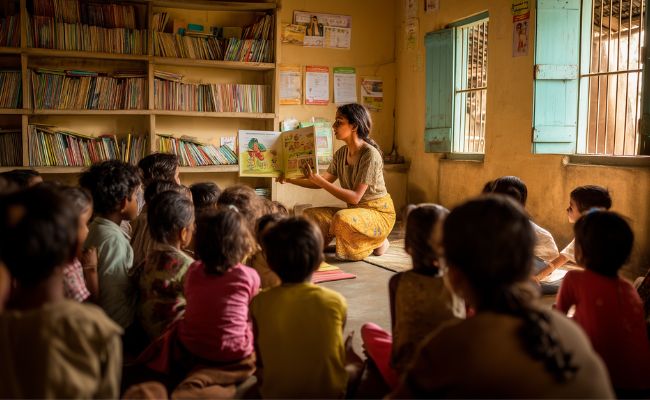
Much of the public conversation about education focuses on curriculum. We ask what children should know, how quickly they should learn it, and how systems can measure whether learning is happening at scale. These questions matter, especially in countries like India where millions of children are moving through education systems at the same time. But anyone who spends time observing young children knows that the foundations of learning are laid long before formal schooling takes shape. In the early years of life, children are forming the capacities that will guide them through everything that comes later. They are learning how to persist with a task that is difficult.
They are discovering how to regulate frustration. They are learning how to trust others and how to work alongside them. These are often called “all-round skills,” but they are simply the human abilities that allow us to navigate life with other people. What makes these skills difficult to build through policy alone is that they do not emerge primarily from instruction. They grow through repeated interactions with adults and with the environments children inhabit. A small example illustrates the point. When an adult tells a child they will return in ten minutes and then actually does so, something meaningful is taking place.
The child is not simply waiting. They are experiencing consistency. They are learning that the world has rhythms they can rely on. When this happens repeatedly, children begin to feel confident exploring beyond immediate reassurance. They try things that may not work the first time. They ask questions that may not have immediate answers. Over time, these interactions accumulate into something larger. Trust begins to form. Confidence grows. The child develops the emotional stability that allows learning to take root. In many ways this is the true work of early childhood.
It happens through ordinary moments that rarely appear in assessment frameworks. A teacher noticing when a child is discouraged and encouraging them to try again. A caregiver responding to a question with patience rather than dismissal. A group of children solving a problem together without an adult stepping in immediately.
These interactions shape the way children approach the world. Some children come to see effort as something worthwhile because they have experienced encouragement when they tried. Others hesitate because earlier experiences have taught them that mistakes lead to correction rather than curiosity. The environments surrounding children are now shifting rapidly. Digital tools and intelligent systems are entering homes and classrooms with increasing speed. In many situations they offer real advantages. Teachers managing large classrooms can use them to organise information more efficiently. Programmes working across entire districts can identify patterns in learning that might otherwise take months to detect. Yet the deeper question remains whether these systems strengthen the conditions through which children develop the abilities that sustain them through life.
Technology can organise information and reduce administrative burden. It can offer educators insights that help them plan better. But the core experiences through which children develop resilience, trust, and curiosity still emerge through human interaction. Children learn persistence by encountering challenges that require effort. They learn empathy through relationships with other people. They develop problem-solving skills by trying things that do not always work immediately. These processes cannot be compressed without changing their nature. The challenge for education systems is therefore not whether to introduce technology, but how to ensure that technological systems support rather than replace the relational foundations of learning.
This requires careful design choices. Systems that assist teachers rather than override their judgment. Tools that reduce administrative work so that educators can spend more time observing and responding to children. Platforms that encourage exploration rather than simply rewarding speed and correctness. If the goal of education is to prepare children for life, then the skills that sustain life must remain central to the environments we build. Long after the details of a curriculum fade, the habits children develop in the early years continue to shape how they face uncertainty, how they work with others, and how they approach the challenges ahead.
(About The Author: Social entrepreneur and co-founder of Rocket Learning, one of India's largest early childhood development non-profits, impacting 4 million low-income children in India. He serves on the Indian government's and Karnataka state's Early Childhood Care and Education (ECCE) Taskforces and has served on UNICEF's working groups.)

