




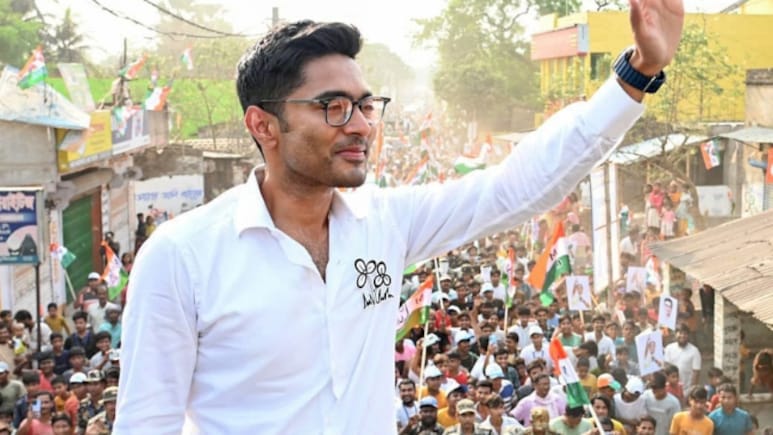
As Trinamool Congress (TMC) national general secretary Abhishek Banerjee steps into the vibrant landscape of Bengal with his latest yatra, "Abar Jitbe Bangla" (Bengal will win again), the air is thick with anticipation.
This statewide odyssey is not just another political pilgrimage; it is a calculated move, a pulse-check on the resilient spirit of the Trinamool as it braces for the Assembly elections, which are expected to be held in April.
Abhishek Banerjee, at 38, embodies the very essence of modern leadership - a blend of youthful energy and seasoned ambition, poised to rally a state that has historically danced on the edges of political upheaval and cultural richness.
His quest is not merely to showcase the achievements of the Mamata Banerjee-led Trinamool government over three consecutive terms but also to re-engage with the populace in a manner that resonates deeply, drawing a line against what the party perceives as the authoritarian tendencies of the Bharatiya Janata Party (BJP). Through a series of roadshows, public meetings, and community interactions, he aims to reaffirm Bengal's identity, a narrative woven into the very fabric of its sociopolitical consciousness.
A Campaign of Contrast
"Abar Jitbe Bangla" serves as an antidote to the BJP's heavy-handed tactics, which the Trinamool claims have sought to undermine Bengal's dignity and rights. The slogan embodies resilience: "Jotoi koro hamla, Abar jitbe Bangla" (Regardless of the Centre's attacks, Bengal will win again) - the spirit of defiance against oppression.
Abhishek's role becomes multifaceted; he is an architect of hope, but also a guardian of Bengal's rich cultural tapestry and the custodian of its unique identity. He will not merely enumerate welfare schemes of the Trinamool government but will rally the spirit of solidarity that has historically characterised Bengal's political landscape.
Drawing on the successes of his previous "Nabo Joar Yatra" (New Wave Yatra), which galvanised support ahead of the 2023 panchayat elections, he strategically ties his current campaign to a broader narrative of renewal and resurgence. In a state forever caught in the crossfire of political machinations, Abhishek seeks to emerge as a beacon of authenticity, contrasting sharply with the increasingly alienated national narrative pushed by the BJP.
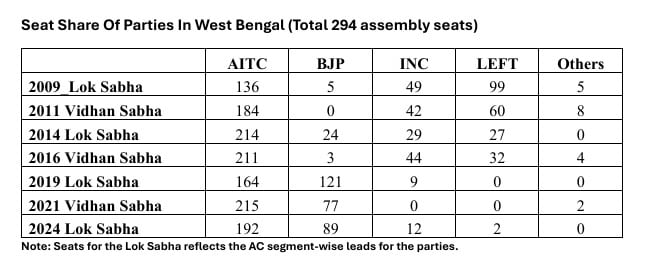
The Nabo Joar Yatra of 2023 has become a template for Bengal's Trinamool campaign led by Abhishek. It was the Nobo Joar Yatra that propelled the Trinamool's massive victory in the 2024 Lok Sabha elections in Bengal, when the Trinamool won 29 seats, reducing the BJP's share to merely 12.
The Trinamool Congress regularly points fingers towards the BJP-led Central government's systematic suppression policies towards Bengal. As strong evidence, the Trinamool leaders cite the figure: "Rs 1.96 lakh crore dues pending with the Centre."
To add salt to injury, Abhishek Banerjee points towards the Election Commission's highly controversial Special Intensive Revision (SIR) of electoral rolls. "An exercise to disenfranchise Bengalis."
The Personal and the Political
Abhishek Banerjee's ascent to prominence within the Trinamool is as much about lineage – being the Bhaipo (nephew) of Mamata Banerjee – as it is about his individual quest for political gravitas. His early campaigns have seen him develop a unique persona; he is often viewed as Mamata's right-hand, yet he is now carving a niche that many within the party regard as pivotal. His recent elevation to Trinamool's leader in the Lok Sabha signals a vote of confidence, one that aligns with his current endeavours.
Banerjee's ability to navigate internal party dynamics, particularly through moments of friction with the old guard, has been instrumental in solidifying his authority. His choices for candidates in the 2024 Lok Sabha elections – like the audacious decision to field previously untested personalities – demonstrate not merely tactical acumen but also a willingness to redefine political expectations.
Consider Abhishek's choice of candidates in 2024: Banerjee selected ace cricketer Yusuf Pathan against the then Congress President Adhir Ranjan Chowdhury, who daily targeted the Trinamool and was the main hurdle in allying between the Congress and the Trinamool – the two partners of the INDIA coalition. Abhishek personally chose Jagdish Chandra Barma Basunia from the northern constituency of Cooch Behar, who defeated the BJP's Union Minister, Nisith Pramanik. Abhishek handpicked greenhorns such as Kalipada Soren from Jhargram, Bapi Halder from Mathurapur, and Mitali Bagh from Arambagh. All three won decisively. His only candidate who lost was Uttam Barik from Kanthi.
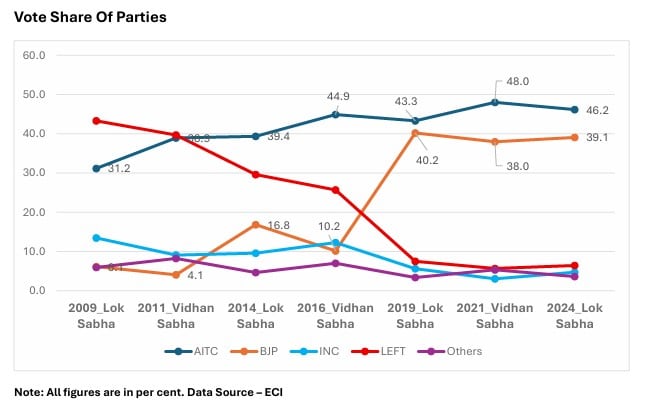
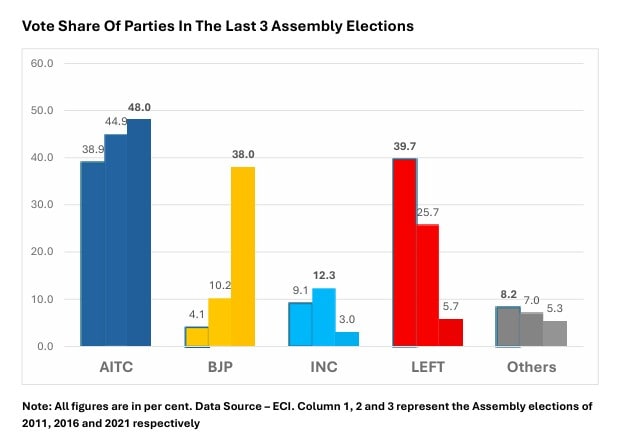
Abhishek emerged as the Trinamool's number two in the 2021 assembly polls, becoming the party's general secretary soon after the tsunamic victory by the Trinamool, in which the Trinamool won the highest tally in the Vidhan Sabha of 213, reducing the BJP to a mere 77 seats. In terms of vote share, the Trinamool has registered an all-time high of 47.9 per cent votes. In 2016, the Trinamool had won 211 seats and registered a vote share of 44.9 per cent.
A Modern Political Merchant
Abhishek Banerjee emerges as a contemporary political merchant, adept at crafting narratives that resonate with the electorate. His articulation of grievances against the Election Commission's actions encapsulates this approach. He frames these administrative challenges not just as bureaucratic issues but as existential threats to the very identity of Bengalis. By labelling the central government's policies as suppressive, he reframes regional pride and self-determination as core issues in the upcoming electoral contest.
Moreover, Banerjee's emphasis on grassroots feedback during his tour hints at an evolving relationship between leaders and their constituents. This reflects his understanding of modern governance – a call back to the basics of political accountability and community engagement, bridging the gap between a leader and the people he serves.
Navigating Critique: Can Abhishek's Yatra prove to be a poll game-changer?
Yet, the landscape is fraught with scepticism. Detractors from rival parties dismiss his yatra as disconnected from the common man, branding it a "five-star yatra." Such criticisms sharpen the focus on whether the vibrancy of his campaign can translate into tangible votes, given 15 years of fierce anti-incumbency. The question remains: can a polished political strategy galvanise a weary electorate that feels increasingly disenchanted? Can Abhishek's Yatra prove to be a poll game-changer?
Abhishek Banerjee stands at a crossroads – his success or failure may redefine not only his destiny but also the Trinamool's future in the turbulent waters of Bengal's politics. In this yatra, he aims to reclaim a narrative of hope, resilience, and cultural pride in a state grappling with its political identity. As the drums of the campaign beat on, only time will tell if "Abar Jitbe Bangla" will ring true in the hearts of voters, or if it will echo as yet another unfulfilled promise in the chronicles of Bengal's storied past.
(The author, Ajit Kumar Jha, is Editor, Research of NDTV)
Disclaimer: These are the personal opinions of the author

