






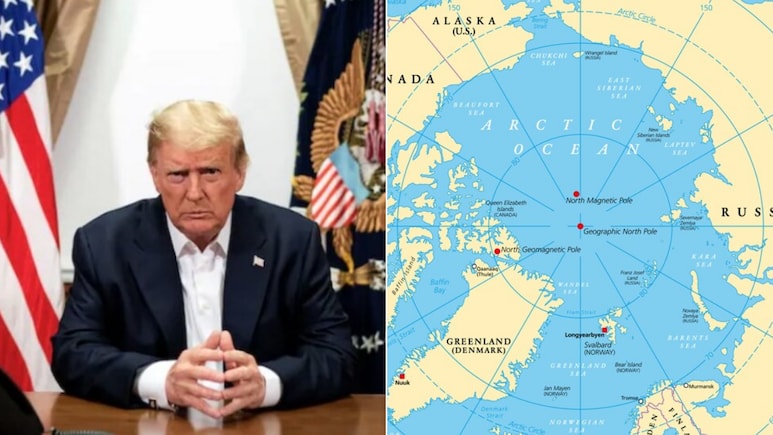
In my long journalistic career, I have never seen European leaders as bewildered and on edge as they appear today. Their political leadership and media, until now secure in the knowledge that they had the backing of the world's most powerful country, appear shell-shocked. For decades, they have enjoyed an easy ride under the US security umbrella, with Washington acting as their protector-in-chief. But President Trump's continued insistence that he wants Greenland at all costs has now turned the White Western world order on its head.
However, from an Indian and Global South perspective, this spectacle looks less shocking and even welcoming in some quarters. For decades, NATO was presented as the gold standard of collective security. After the Second World War, a defensive alliance was built on shared values, mutual respect and the promise that an attack on one would be treated as an attack on all. (stated in NATO's Article 5). That promise, it now appears, comes with conditions. Support American territorial ambition, or pay the price.
Do we really need NATO?
Many critics of NATO argue that it has outlived much of its original utility because it was designed for a world that no longer exists. It was created as a Cold War military bloc to deter the powerful Leftist ideology of the USSR, under conditions of bipolar global power. That context has vanished.
Since then, the alliance has struggled to redefine its purpose without either expanding its footprint or manufacturing new threats. Instead of providing collective security, NATO has increasingly become associated with interventionism. This is why the potential weakening or even dismantling of NATO does not provoke tears outside the Western hemisphere. In Asia, Africa and much of the Global South, NATO is not remembered primarily for preserving peace. It is often seen as synonymous with interventions in other countries' internal affairs, regime-change adventures and wars that destabilised entire regions. Yugoslavia, Afghanistan and Libya remain enduring examples.
President Trump's obsession with Greenland and his willingness to threaten economic punishment (increasing tariffs by 10 per cent against a bunch of European countries, all NATO members) or even hint at force, has exposed the structure beneath the alliance. I have always felt that NATO has structurally been a hierarchy. It is another matter that the European leaders pretended it was a partnership of equals. The truth is that by outsourcing security to Washington for decades, European states underinvested in defence and often swept difficult strategic choices under the carpet. Trump's threats are now forcing a rethink, albeit reluctantly, across the continent.
Needless to say, this debate resonates strongly in India. Strategic autonomy has long been a guiding principle of India's foreign policy. It avoided formal military alliances during the Cold War and continues to resist them today. India abhors defence alliances. It does not have allies. It has partners. India believes in developing partnerships on an equal footing. This is rooted in a clear understanding that alliances dominated by a single power inevitably demand obedience. Consider how interesting India's situation is: today it works with the US in the Indo-Pacific, buys weapons and oil from Russia, trades extensively with China, supports Palestinian rights and yet has deepened ties with Israel. Critics often dismiss this as fence-sitting, someone who is afraid to take sides. In reality, it is a balanced approach in an increasingly chaotic world
Saudi-Pak defence pact
India's strategic autonomy doctrine is now being tested not only by Western powers but also by shifting security alignments closer to home. Saudi Arabia and Pakistan signed a Strategic Mutual Defence Agreement in September 2025, formalising their long-standing military relationship and introducing a collective defence clause under which an attack on one would be treated as an attack on both. In a region already undergoing rapid realignment, the pact has raised serious concerns in New Delhi and Tel Aviv about the strategic balance ahead. I will not at all be surprised if India forms a security partnership with the UAE and other regional nations to deter the threat posed by the Pak-Saudi defence agreement
Pakistan's military experience and strategic posture, combined with Saudi Arabia's financial strength and regional influence, create a partnership that cannot be ignored. Even if the agreement remains limited on paper, its signalling value matters. It tells the region that traditional alliances are shifting and that old assumptions about security guarantees are no longer reliable.
For India, strategic autonomy does not mean standing still. It means staying ahead of emerging risks. Strengthening security cooperation with the UAE, Israel and other like-minded partners would be a logical response. Such partnerships can focus on intelligence sharing, maritime security, cyber defence and counter-terror cooperation, without locking India into rigid military blocs. In a more fragmented world, India's ability to build flexible, interest-based security arrangements may prove to be its strongest strategic asset.
What triggered this trend?
Trump's unconventional worldview and wildly unpredictable action is helping accelerate this trend. His administration has shown little respect for multilateral institutions created after the Second World War. NATO, the United Nations, eveand n the idea of collective decision-making itself appear secondary to bilateral deals and personal leverage. Trump's proposed Board of Peace for Gaza, complete with a hefty price tag for permanent membership, only reinforces the impression that global governance is being reimagined as a club for the wealthy and compliant.
Trump's chaos makes Beijing look so orderly
China and Russia are watching all this with interest. From Beijing's perspective, Western unity is weakening. The US and Europe, once tightly knit, now look increasingly divided. This creates opportunity. China hopes that Washington's unpredictability will make Beijing appear a more stable and reliable partner, especially for countries tired of conditional alliances and moral policing.
Take for example, Canada. During Prime Minister Carney's recent visit to China his efforts to reduce exposure to Washington by engaging more with China are a quiet signal of this shift. So too are moves by middle powers across Asia, the Middle East and Latin America to diversify partnerships and avoid overreliance on any single security guarantor.
The core question, then, is not whether NATO will collapse tomorrow. It is whether the model it represents still fits the world we live in. Security arrangements built around one dominant power may have made sense in a bipolar Cold War. In an increasingly multipolar world, they generate resentment, vulnerability and eventually coercion
For Europe, Trump's second term is proving to be a nightmare. They have gotten out of their comfort zones and are looking for ways and means to defy Trump without annoying him. They are all still scared of him. The Western leaders in Davos are blowing hot and cold, unable to understand how to deal with a leader who does not warm up to his trusted allies. Their choice is limited. They are still fine-tuning their collective strategy to 'manage' Trump. For the Global South, including India, the message is that dependence is risky.
In my view, Trump may yet climb down on Greenland. Tariffs may be delayed or not imposed at all. It all may end up in a compromise. But the damage is done. Trust in unconditional security guarantees has been shaken. Alliances once presented as permanent now look shaky, even wobbly. And that, perhaps, is the real legacy of our time. Not the fate of Greenland, but the exposure of a global security architecture that has outlived its original objectives. For Europe, this is a shock. For the rest of the world, it is confirmation.
(Syed Zubair Ahmed is a London-based senior Indian journalist with three decades of experience with the Western media)
Disclaimer: These are the personal opinions of the author

