






After the momentum gained by keeping the BJP under the majority mark in the 2024 Lok Sabha polls, a string of setbacks in assembly elections over the last two years for the Congress and the opposition bloc in Maharashtra, Haryana and Bihar has put the opposition decisively in a weak national spot. Hence, the importance of a win in the coming round of Assembly polls cannot be overstated.
Three vital opposition-ruled states - West Bengal, Tamil Nadu and Kerala - are in the fray in April-May, along with NDA-ruled Assam and Puducherry. While the Congress hopes to wrest Kerala from the LDF and Puducherry from the NDA, in West Bengal, it is a marginal player, and in Tamil Nadu it is a critical ally. In Assam, it remains the principal challenger. The results in all these states will have a considerable national impact.
Existential Contests For Congress
If the Bharatiya Janata Party (BJP) were to oust Mamata Banerjee in West Bengal, or if the DMK were to lose power in Tamil Nadu, it would be a body blow to the national opposition. Regional parties weakened at home tend to recalibrate their equations with the Centre. A diminished regional ecosystem ultimately weakens any anti-BJP national front.
From the Congress's standpoint, Kerala and Assam are existential contests. In Kerala, the party-led United Democratic Front (UDF) is locked in a bipolar battle with the CPI(M)-led Left Democratic Front, and the Congress is on a strong wicket in a traditional anti-incumbency state. In Assam, despite the BJP's entrenched position under Chief Minister Himanta Biswa Sarma, the Congress maintains a statewide organisational footprint capable of mounting a serious challenge.
A defeat in both states, or even one, would be devastating for the Congress. A win in at least one will restore credibility. This is what sets up the thorny Tamil Nadu question for the Congress and the DMK as they haggle amid threats of a breakup.
The Need To Reflect
There is undeniable resentment among Congress workers in the state over the DMK not giving them their due share of power at the grassroots. The Congress has legitimate grounds to seek a better seat-sharing arrangement and a greater share of power. History provides context. In 2006, when the DMK fell short of a majority, Congress extended outside support and stayed out of government. In 2021, Congress contested only 25 seats in the 234-member Assembly - a sacrifice of 16 seats from the 41 it got in 2016 to accommodate more allies. Congress leaders point to these facts as they demand more from the DMK, even as a section of the party pushes for aligning with actor Vijay's TVK.
But Congress leaders making demands must admit that the party's independent strength in Tamil Nadu has eroded dramatically. GK Moopanar, who passed away in 2001, was the last mass Congress leader in the state. Whether in parliamentary elections or Assembly polls, since 2004, even senior leaders and party presidents have relied entirely on the DMK to remain electorally viable. It would not be wrong to say that there may not be a single Congress leader who can categorically challenge the DMK and AIADMK and win a seat on his own steam in the state. The alliance with the DMK, which has held firm for 23 years, broke briefly in the aftermath of the 2G scam in 2014; both parties were swept out of all 39 Lok Sabha seats in the state in that election.
In the subsequent Assembly election in 2016, both came back together, but the late J Jayalalithaa scripted history by retaining her AIADMK in power with a marginally higher vote share. This was the first time since 1989 that an incumbent won a re-election.
How The Equations Have Changed
Since then, Tamil Nadu politics has undergone a tectonic shift following the deaths of J Jayalalithaa and M. Karunanidhi. The DMK-Congress alliance scored sweeping victories in the 2019 and 2024 Lok Sabha elections, and the DMK returned to power in 2021 under MK Stalin. But after a decade out of office, the DMK in power has been a different beast, sharing little with Congress workers and MLAs.
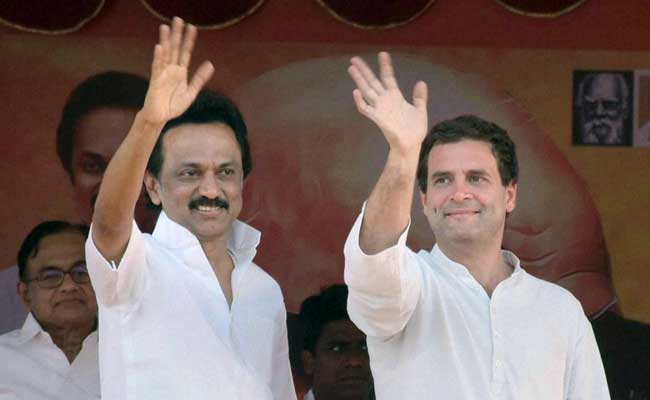
Stalin publicly declared Rahul Gandhi as the prime ministerial face of the INDIA bloc ahead of 2024 - a symbolic gesture of loyalty that even sections within Congress hesitated to formalise. Both parties' MPs have stood together against the BJP in Parliament, and a few senior Congress leaders have been accommodated by the DMK. This is what the DMK has given the national party in the last five years.
Now, the emergence of actor-turned-politician Vijay and his party, Tamizhaga Vettri Kazhagam (TVK), has unsettled the chessboard. Sections in the Congress see an opportunity: break from the DMK, align with the TVK, negotiate a stronger position, secure numbers in the Assembly, and then decide a post-poll strategy. It would be a high-risk gamble.
Vijay Is Still A Gamble
Congress breaking away will weaken the DMK alliance, but it would not necessarily strengthen the Congress - which would then be dependent on Vijay's untested political appeal. The minority vote - Christian and Muslim - is around 13% in Tamil Nadu and is a core DMK-Congress constituency.
Vijay is already threatening to breach this base, along with the youth and Dalit vote. Congress aligning with the TVK would make Vijay's pitch to minorities stronger, and that would be tough for the DMK to negate. But against the DMK's powerful grassroots structure and organisation, Vijay remains a gamble. Losing the Congress would also weaken the DMK's ability to combat the BJP at the national level, just as it would weaken the Congress in Parliament.
From a narrow state perspective, a move towards Vijay may be seen as a declaration that the national party will not be treated as a pushover in a state where it lost power in 1967. But from a national perspective, it could mean the end of the INDIA bloc at a moment when coherence is essential, both in Parliament and outside.
This Is A Two-Way Street
This is not a one-sided argument. The DMK must recognise that durable alliances require mutual respect. Alienating Congress workers at the grassroots and denying the party a meaningful share of power will lead to instability. Even if the leadership stays together, the cadres may not. Tamil Nadu's election may well be closely contested; complacency would be dangerous.
The Congress, too, must weigh its ambitions against ground realities. Reinvention in Tamil Nadu is necessary, but timing is crucial. Attempting a reset in a high-stakes election cycle could carry unintended national consequences.
Tamil Nadu is only one piece of the puzzle. Assam demands organisational focus and narrative clarity. Kerala presents a real opportunity if unity is maintained. Puducherry is small but important, and West Bengal is crucial from a broader opposition standpoint.
If there is any realistic prospect of countering the BJP's formidable electoral machinery, it will emerge from this cycle of assembly elections. For that to happen, Congress must project steadiness, discipline and cohesion - within states and across alliances.
At this time, recent headlines have not helped the Congress's optics ahead of such a crucial round of polls. The exit of former Assam Congress chief Bhupen Kumar Borah, controversial remarks by Mani Shankar Aiyar, and open questions about the Congress's - or rather Rahul Gandhi's - stewardship of the INDIA alliance are hurting perceptions. Aiyar may be irrelevant to the Congress, Bhupen Borah may just be another loyalist without mass appeal who has walked away, and questions over who should lead the INDIA bloc have surfaced before. But taken together, this is not a healthy conversation during poll season.
What next for the INDIA bloc now seems left to the Congress to decide. And what it does with the DMK will shape that future, just as how it manages Assam and Kerala will determine what lies ahead for the Congress itself.
Ultimately, for the Congress to lead a national opposition, that opposition must first remain intact. It may not be wise to dismantle regional forces at a time when it is battling the BJP, in Parliament and beyond.
(The author is Executive Editor, NDTV)
Disclaimer: These are the personal opinions of the author

