






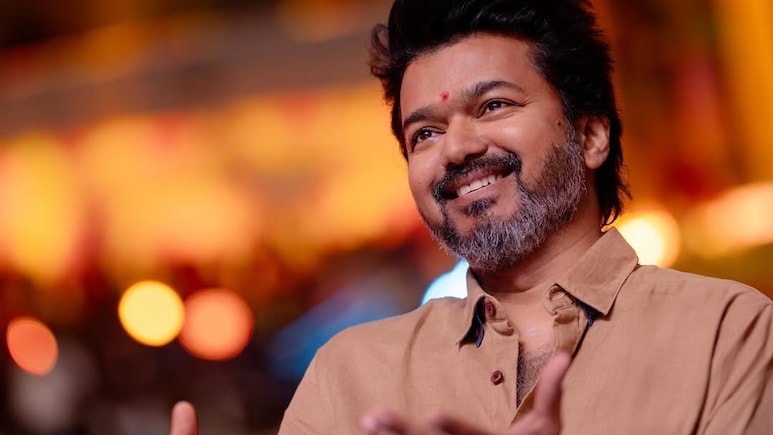
The neon-lit history of Tamil Nadu politics isn't written in ink; it is etched in celluloid and projected at 24 frames per second. The silver screen has never been just entertainment. It has been the primary incubator for political power for over 50 years. The celluloid screen is where a man's mythology is manufactured before it is tested at the ballot box. The journey from reel life to real life, from the cinema hall to the secretariat is the climactic career arc. Joseph Vijay Chandrasekhar, "Thalapathy," the Commander is the newest debutante switching roles as the state heads to the polls on April 23, 2026. Public attention will measure his bid to be a real-life Jana Nayagan; this is Vijay's riskiest production. It is moot whether Vijay is the new Enga Veettu Pillai the state has yearned for or another Puli whose roar fades after the show.
History is replete with many film stars aspiring to aspire. Does Vijay have it? The gold standard for the transition from films to politics is MGR - the celluloid giant who turned films into a political laboratory. MG Ramachandran - MGR, Makkal Thilagam, "Darling of the People" evangelised as he acted. The films, the script and the dialogues were verily aspiration wrapped in ideology, ambition in motion.
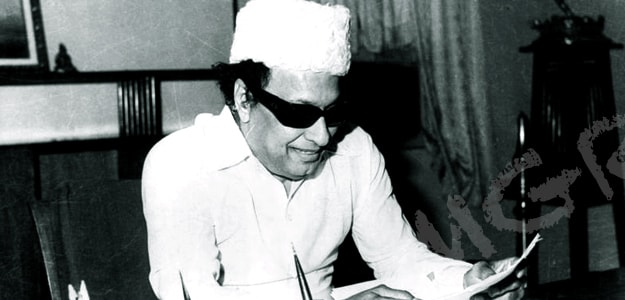
In Enga Veetu Pillai, he said, "Once I take oath the poor will not suffer," and Tamil Nadu roared in approval. He was the labourer-messiah of the poor in Rickshaw Karan, the wandering king of Nadodi Manan who delivered justice - a manifesto disguised in a double role. He was always the subaltern avatar, the mama's boy, the lady's saviour. By the time he completed his two-decade internship in the DMK, he was ready to step out of the reels and into real life. He and his 80,000 fan clubs wrote a new script in 1972 forming the AIADMK.
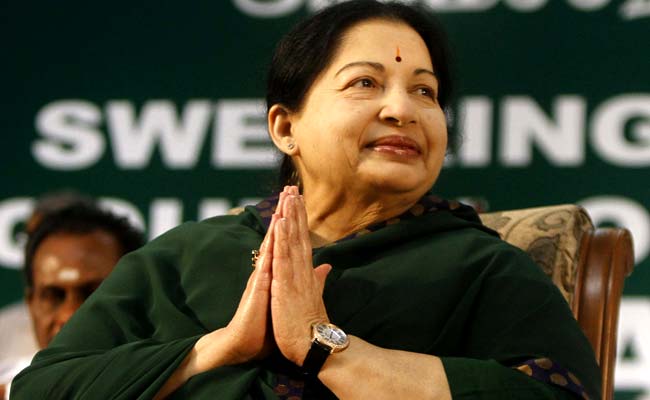
His protege, Jayalalithaa, learnt at his feet and rose from his leading lady to propaganda secretary to heir-at-large. Jayalalithaa leveraged resilience from Adimai Penn, to survive a brutal and public inheritance battle after MGR's death. Her rise is an all-time masterclass on capitalising opportunity in grief. Her grasp of politics and gravitas in administration enabled her to take the seat of chief minister five times. Every welfare idea of hers - Amma canteen or Amma medicine - is a legend and has been dubbed in other states.

Vijayakanth, "Captain," had political acumen and challenged the status quo. Displaying innate screen sense he arrived at his party's launch in MGR's old van, positioning himself as the dark-skinned avatar of MGR. He had done the tutorials, paid obeisance to mass misery. Ramanaa, Rajadhi Raja portrayed the patriotic, anti-corruption hero who takes on a broken system with bare hands. In real life he had the potential to disrupt the duopoly of DMK-ADMK but his party, the DMDK which won 29 seats in 2011 lacked the cadre and organisation to leverage his halo.
The lesson from history is clear: the screen character must morph into the street character, bleed and blend into the landscape and yet retain the messianic presence. The transition is not easy nor is it automatic. For years folks would quote Rajnikanth 'Naan late-aa vandhalum, latest-aa varuvein". (Even if I come late, I will come as the latest) from his hit Baba to argue, insist that the mega star would join politics and that hope has faded with the credits.
Like Rajnikanth aka Shivaji Gaekwad, Vijay has been auditioning for the role, seen with folks from the national parties and strategists of the regional parties. The superstar brings with him an arsenal none of his predecessors could imagine. Vijay arrives with an army of Gen Z (and a chunk of millennial fans) who have watched and whistled as he broke systems on screen. Unlike Kamal Hassan, whose appeal was limited to the cerebral types, Vijay straddles mass not class, rural and urban appeal. However, he has rarely been heard before his debut this year to speak on issues or take a stand.
Vijay and his team would like the voters to believe that he has spoken through his films. Mersal attacked GST and healthcare inequity, and the outrage only made it more popular. Sarkar mobilised the "common man" against dynastic corruption; its hero returns NRI wealth and demands accountability. Master placed an idealist inside a broken institution and asked whether a flawed man could still be the right man. Kaththi was an agrarian crisis wrapped in a mass entertainer. Bigil used women's football as a metaphor for collective dignity against caste and entitlement.
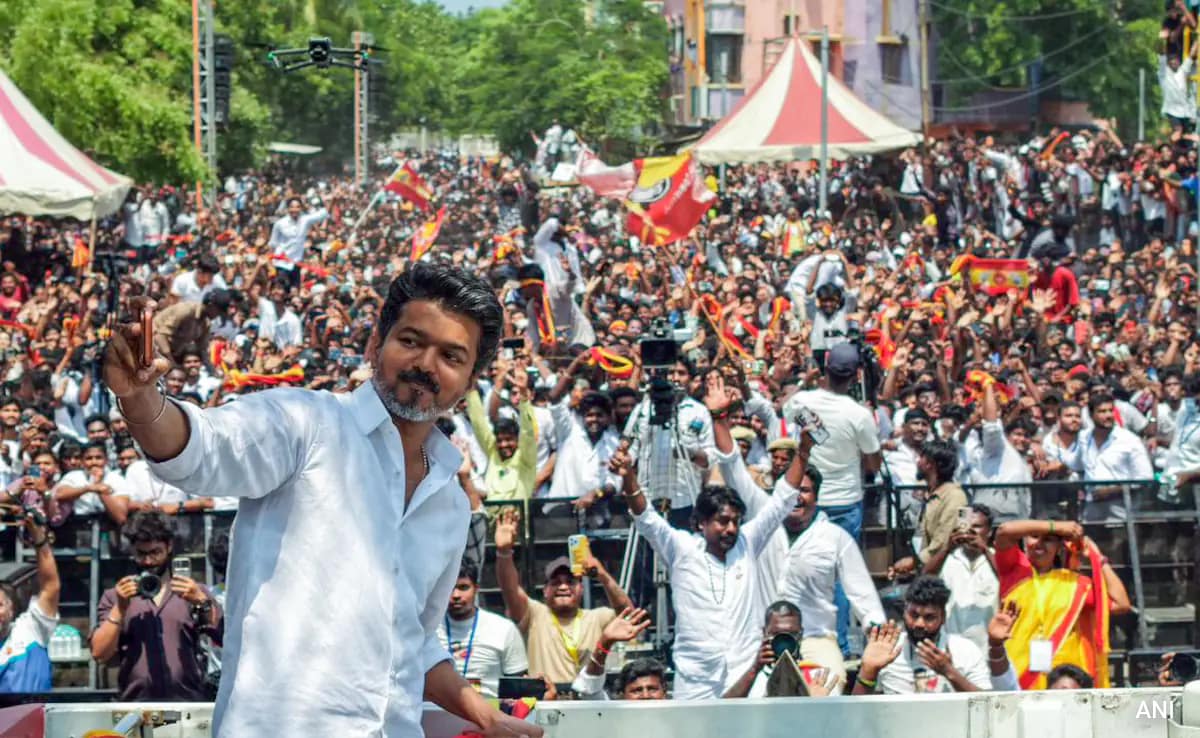
There is a clear attempt, at least in the titles, to forge a broad coalition. Vijay consciously promoted the concept of whistle revolution, egging folks to blow the whistle on wrongdoing, a kind of vigilante reformer through his films, for some time before he put up the first posters and founded the TVK. His party shadow-marketed and tested his ideas; his fan clubs won over a hundred seats in local body polls. If private polls are to be believed Vijay and the TVK are a draw among the 30 to 45 age band, those who have voted for and experienced both Dravidian parties and who ostensibly are looking for a third alternative.
The fact that his draw survives his and his party's mis-steps -including the stampede in Karur- is a worry for both the AIADMK and DMK fronts. Typical of Tamil Nadu assessments of Vijay's prospects are tags based on his hit or flop films; it ranges from being tagged as the next Prashant Kishore-led Jan Suraj to a super disrupter like Vijaykanth and DMDK. Pollsters are divided on who the TVK will damage more - the anti-incumbency votes which AIADMK is wooing or the minority and youth votes DMK is betting on.
Vijay is challenged by a gap on his CV which cannot be upskilled - the lack of an active internship and the absence of an ideological north star is a glaring vulnerability. MGR had Dravidian foundationalism as his political DNA. Jayalalithaa apprenticed under MGR for over a decade before she bid for and seized the throne. Vijaykanth confronted and then collaborated with the Dravidian parties, Kamal Hasan tried the lateral entry.
Vijay is attempting to crash through the barricades. He has played footsie with the Congress during the GST drama, then with the AIADMK folks and again with Congress. In Tamil Nadu, politicians cannot wait for the dialogue to be written when confronted with questions such as Cauvery waters or imposition of Hindi. His positioning, secular social justice, may offend nobody but could end up inspiring none either given the hard binaries holding Tamil Nadu politics.
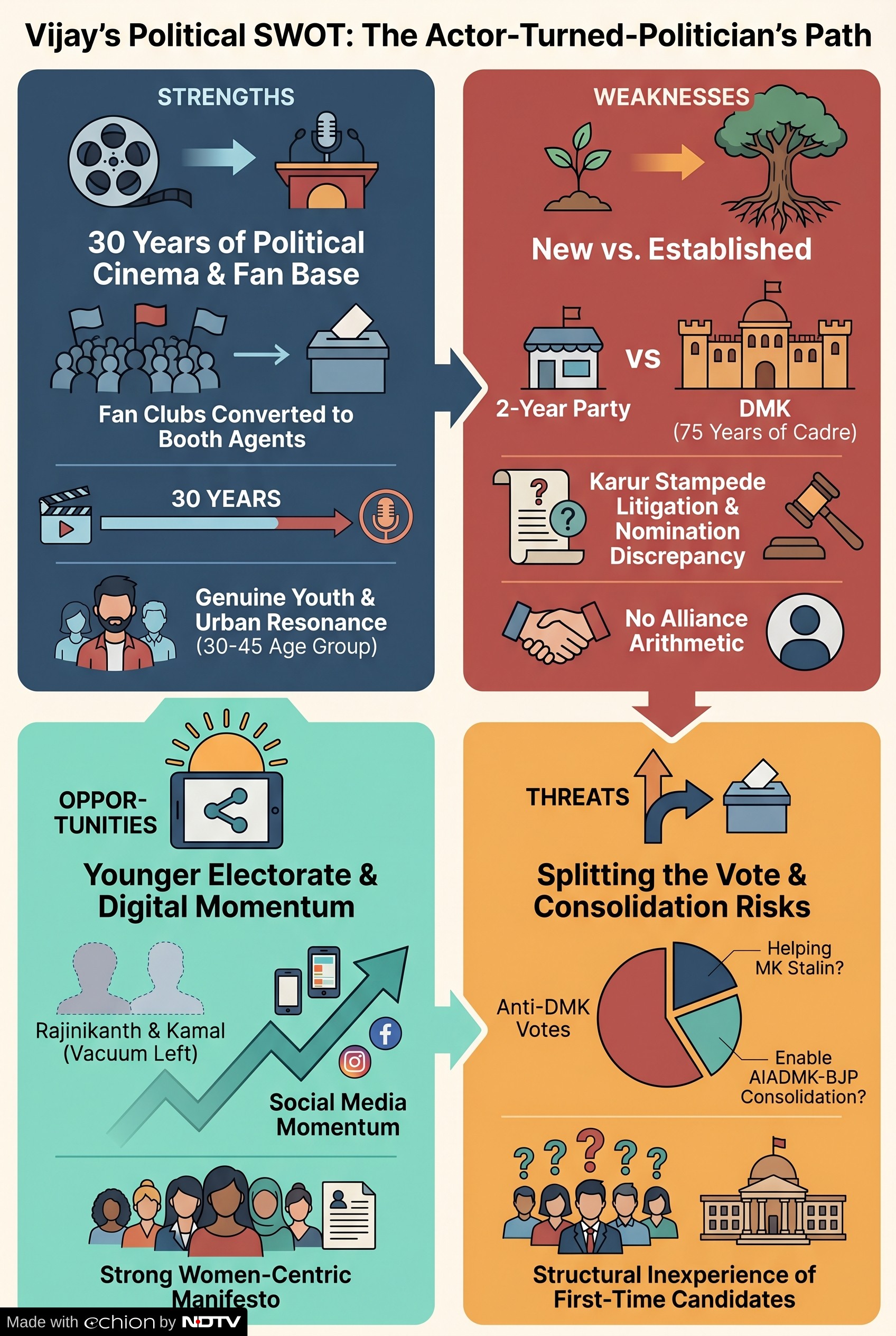
All said and done, the opportunity in 2026 is historic precisely because there is a real urge among people for an alternative model and the vacuum is real. The AIADMK is still searching for its soul; the tie-up with BJP is seen as a compulsion. The DMK has much to claim and much to more to answer for. The anti-establishment space that Rajinikanth teased for a decade, announcing his party in 2017 and retreating in 2020, remains unclaimed.
Vijay walked through that door. His manifesto is a calculated populist blend: drug-free state, job assurance, collateral-free startup and education loans, monthly financial assistance for women, free LPG, one sovereign of gold for brides. It is, in structure and spirit, MGR's on-screen generosity converted to policy, updated for 2026. He is contesting personally from Perambur and Trichy East which is surprising for the hero of Ghilli who roared, "This place or that place is all Ghilli's place."
He may buy into his lines from the 2003 flick Thirumalai, that life is a game - the winner also loses and the loser also wins. Off the screen the challenge is beyond clever lines. The audience in Tamil Nadu is ferociously loyal. They built temples to MGR. They wept in the streets for Jayalalithaa. But the Tamil voter, for all their cinematic devotion, has never once forgiven a bad performance on the biggest stage of all. Lights Camera Sarkar! And this time, there is no retake.
(Shankkar Aiyar is a political economy analyst and author)
Disclaimer: These are the perosnal opinions of the author.

