






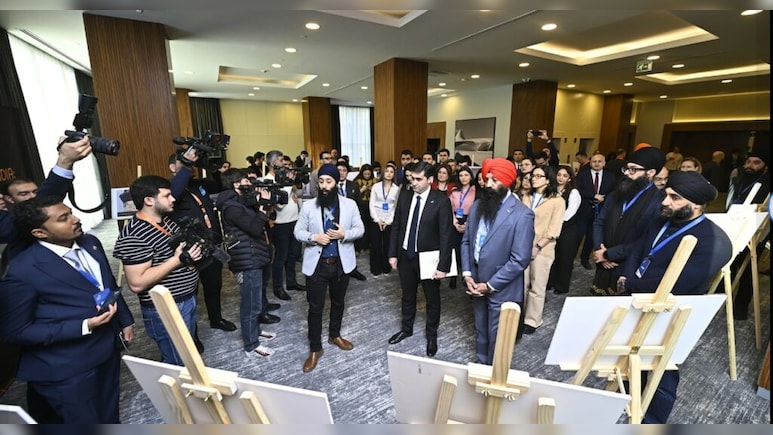
Azerbaijan has suddenly discovered minority rights and concerns, only not those of minority communities in its territory, but in India.
On February 3, it allowed the Pakistani Embassy in Azerbaijan to hold an event marking Kashmir Solidarity Day, with the country's ambassador to Baku, Qasim Mohiuddin, attending alongside diplomatic staff and media representatives. As usual, wild allegations were made against India, with the ambassador reaffirming Pakistan's "unwavering moral, diplomatic, and political support for the Kashmiri people and their right to self-determination".
Hosting Khalistani Representatives
While such "Kashmir Days" have become routine, this year, it was preceded by yet another event - a conference organised by a group calling itself the Baku Initiative Group (BIG) on (lack of) minority rights in India. This was actually a euphemism for driving the Khalistani narrative. In attendance were representatives of different Khalistani organisations, such as the Sikh Federation International (SFI), as well as the Minority Affairs Minister from Pakistan, Ramesh Singh Arora, whom the Azerbaijani press falsely introduced as a Minister from India's Punjab province. Doing away with all pretences, the conference openly called for international support for the establishment of a separate Khalistani state. A booklet titled The Khalistan Movement: Past Roots, Global Dimensions and Modern Landscape was also released.
An Absurd Move
The very act of hosting such a conference in Baku is so ridiculous that it evokes more amusement than concern. After all, Azerbaijan is no paragon of liberty and pluralism. It is an autocratic state where power remains controlled by a single family. It neither allows dissent, freedom of expression, nor a free press. It has no opposition, and critics of the government are routinely rounded up and silenced. The presidential and parliamentary elections in February and September, respectively, failed to meet standards for a free and fair vote. International observers found them "marked by the stifling of critical voices" and "devoid of competition".
Take, for instance, the fact that in 2024, the Parliamentary Assembly of the Council of Europe resolved not to ratify the credentials of the Azerbaijani delegation, concluding that the country has "not fulfilled major commitments" stemming from its joining the Council of Europe 20 years ago.
"Very serious concerns remain as to [Azerbaijan's] ability to conduct free and fair elections, the separation of powers, the weakness of its legislature vis-à-vis the executive, the independence of the judiciary and respect for human rights, as illustrated by numerous judgments of the European Court of Human Rights and opinions of the Venice Commission," the Assembly said in a resolution.
Baku also stands charged with war crimes in Nagorno-Karabakh, which it wrested from Armenian control during the 2020 war. It is accused of committing ethnic cleansing in the enclave - all very serious allegations. These are just some examples of the country's track record.
Why, then, does it want to highlight "discrimination " elsewhere, especially in a functioning and vibrant democracy like India? The immediate temptation is to say that it is a good way to defect from Baku's own deficiencies.
What Even Is 'BIG'?
The antecedents of the Baku Initiative Group are just as dubious. It appeared only in 2023 as a platform to ostensibly counter "colonialism" and neo-colonialism, but so far has trained its guns only on France, and now India - two countries that pursue close relations with Armenia, an arch-rival of Azerbaijan. The group has accused France of continuing to colonise New Caledonia, forcing the indigenous Kanak population into displacement.
As for India, over the past few years, it has deepened cooperation with Armenia, including in defence. At the time of writing this piece, the Indian Chief of Defence Staff, General Anil Chauhan, was on a visit to Yerevan. In spite of its many defence partnerships, including with NATO-member Turkey, Azerbaijan has been very apprehensive of India's engagement with Armenia.
At the same time, it is also entirely plausible that it is a way of getting back at India, for, as Baku alleges, India was blocking its entry into the Shanghai Cooperation Council last year at the SCO Summit in Tianjin.
A New Khalistani Playground?
On the other hand, the Khalistani movement is also gradually and steadily losing ground in places like Canada and the UK, the traditional strongholds. Is it now opening up a new front in Azerbaijan? Since Pakistan is one of, if not the major, drivers of the Khalistani movement, and given its proximity to Azerbaijan, the latter becomes an ideal platform. Moreover, the lack of freedom of expression or criticism ensures that no one will question Baku's move to allow the movement a voice there.
What Azerbaijan might not understand is that it is one thing to take up the cause of New Caledonia, but intervening in the Khalistani movement is playing with fire. The BIG has conveniently overlooked the terrorism perpetrated by members of the movement, which has claimed hundreds of innocent lives - both Indian and foreign - the daily threats, the vandalism against Indian interests, the involvement in drug and human trafficking, among many other things.
More importantly, in supporting the Khalistani movement, Azerbaijan seems to be forgetting its own actions in Nagorno-Karabakh.
What Emboldens Baku
This approach of Baku may have been prompted by its many geopolitical successes over the past few years. Its victory over Armenia and the wresting of the disputed enclave of Nagorno-Karabakh has imbued it with a kind of triumphalism that is hard to miss. Its many human rights violations in the enclave and charges of ethnic cleansing have not deterred global powers from forging close relations with it. The latest is the strategic partnership it signed with the US this week during the visit of Vice-President JD Vance. Baku has also been adroitly managing its relations with both Turkey and Israel, both of whom are its close allies. As a member of the Organisation of Turkic States, it has deepened its cooperation with Central Asian states even while reaching out to the Arab world. Last week, in the UAE, President Aliyev, together with Armenian Prime Minister Nikol Pashinyan, was honoured with the Zayed Award for Human Fraternity for agreeing to establish a framework for peace, in which Azerbaijan retains the upper hand.
If this was not enough, its success over the Karabakh conflict and US intervention has handed it a long-coveted wish - the Zangezur Corridor (renamed the Trump Route for Peace and Prosperity or TRIPP), which allows it unimpeded land access to its enclave of Nakhichevan, separated by Armenian territory, and further to Turkey. It unlocks all the connectivity potential of the country, which will not only facilitate greater trade with the rest of the world but also boost its position as a transport and energy hub.
At the same time, its other neighbour, Iran, with which Baku has had a complicated, sometimes even confrontational, relationship, is also being subdued with the threat of US military intervention over its nuclear programme, hanging over its head as the proverbial Damocles' sword. Ironically also, Pakistan, Azerbaijan's close ally, has been concluding defence deals with a number of countries, including regional and energy heavyweights such as Saudi Arabia.
These victories and geopolitical realignments may have convinced Baku that it has the wherewithal to needle India, especially at a time when India faces constraints on a number of fronts. The BIG conference occurred just when India was finalising its free trade agreement with the EU. Nonetheless, the deal sailed through. India also continues to face tensions on the US front, and regarding its oil purchases from Russia.
A Clear Understanding
But Baku must not confuse restraint with inability. India has the wherewithal to withstand both internal and external pressures. It has an excellent track record of handling internal grievances along with secessionist threats. Today, the Khalistan movement has no takers in India. With Operation Sindoor, India demonstrated both its military preparedness and the quiet resolve to take on external threats - even alone. It withstood US tariff pressure and went around concluding FTAs and economic and trade agreements with a range of important economies: the EU, the UK, Oman, to name a few. And it certainly has other leverages with countries like Azerbaijan, which witnessed a 30% decline in tourist arrivals from India in 2025, according to the Azerbaijan Tourism Board. This is a direct result of the country's support to Pakistan during Operation Sindoor, and a loss for its coffers.
It is, therefore, entirely up to Baku to choose whether it wants to flog a dead horse or salvage its relations with an emerging and resilient global power.
(The author is a senior journalist)
Disclaimer: These are the personal opinions of the author

