







Kerala is once again on the cusp of a tightly fought electoral contest, with the ruling Left Democratic Front (LDF) and the opposition United Democratic Front (UDF) locked in a familiar battle, even as the Bharatiya Janata Party (BJP) attempts to expand its footprint in a state where it has historically struggled.
For decades, Kerala's politics followed a predictable rhythm. Since 1982, voters alternated between the LDF and UDF every five years, ensuring no government grew too comfortable in power. That pattern was dramatically broken in 2021 when the LDF, led by Chief Minister Pinarayi Vijayan, secured a second consecutive term.
Now, as Vijayan completes a decade in office at the age of 80, the question is whether Kerala will revert to its instinct for change.
Anti-Incumbency
There are early signs that anti-incumbency is building. The UDF's strong performance in the December local body elections has energised its cadre and revived hopes of a comeback. After ten years out of power, the Congress-led alliance appears hungry.
The LDF has long been considered the 'majority' party of Kerala that enjoys Hindu support, while the UDF enjoys minority backing. However, the BJP's rise in the state has come at the expense of the UDF, with the saffron party pulling some Hindu votes from the opposition bloc. The UDF has in its fold the IUML and the Kerala Congress, which respectively cater to 27% Muslims and 18% Christians.
Kerala's Electoral Geography
To understand Kerala's electoral dynamics, one must look beyond statewide narratives and examine its zonal and demographic structure.
The state is broadly divided into three regions:
• North Kerala (48 seats): Muslim-heavy, with around 47% Muslim population.
• Central Kerala (53 seats): Christian-influenced, with about 28% Christian population.
• South Kerala (39 seats): Predominantly Hindu, and the BJP's strongest zone.
As much as 63% of the Muslim population of the state resides in the North, while 56% of Christians reside in the Central zone.
A few key districts are also critical to the results:
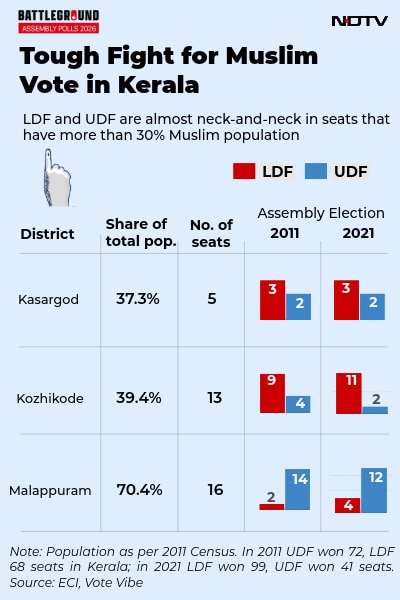
- Three districts, which have more than 30% Muslim population - Kasargod, Kozhikode and Malappuram - account for 34 seats.
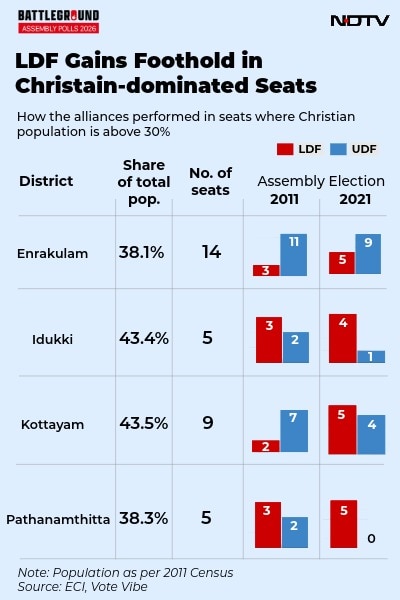
- Five districts - Eranukulam, Idduki, Kottayam, Pathnamthita - have 33 seats, accounting for more than 30% Christian population
- Five districts - Waynad, Malappuram, Eranukulam, Idduki, Kottayam - have 47 seats and make up for more than 50% minority population (Muslim + Christian)
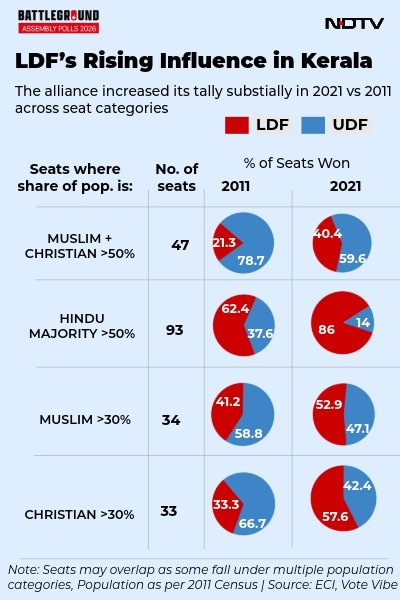
- Nine districts - Kasargod, Kozhikode, Kannur, Palakkad, Thrissur, Alappuzha, Pathanamthitta, Kollam and Thiruvananthapuram - are Hindu-majority and account for about 93 seats.
The Congress is considered traditionally strong in the North zone. South has the highest Hindu population, and it's here that the BJP is the strongest, though it has also made some inroads in the Christian belt, winning the Thrissur Lok Sabha seat from the Central zone. In municipal corporations, it successfully installed its Mayor in Thiruvananthapuram.
How LDF Broke The Trend In 2021
In 2011, the UDF won the elections narrowly, bagging 72 of the 140 seats, while the LDF got 68. Of the 34 Muslim-dominated seats, the UDF won 20, while the LDF bagged 14. Of the 33 Christian-dominated seats, the UDF had won 22, while the LDF had won 11. And, of the 47 minority majority seats (what are minority majority seats), the UDF won 37 - a strike rate of 79% - while the LDF got just 10. This gave an edge to the UDF.
In 2016, the LDF won the elections as the trend of alternate governments continued, getting 91 seats as against the UDF's 49.
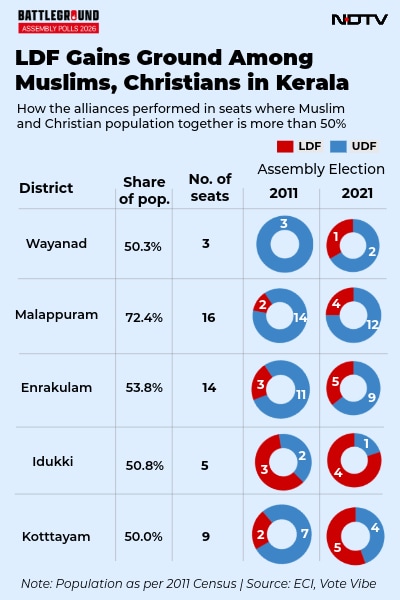
In 2021, however, the LDF retained power, causing an upset and breaking the trend. The LDF won the elections, bagging 99 of the 140 seats (a growth of eight), while the LDF trailed at 41. Of the 34 Muslim-dominated seats, the LDF won 18 (+4) and the UDF 16 (-4). Of the 33 Christian-dominated seats, the UDF won 14 (-8) and the LDF got 19 (+8). And, of the 47 minority-majority seats, the UDF won 28 (-9) and the LDF 19 (+9). The LDF edged out the UDF even in its stronghold of North and Central Zones.
As per Axis My India exit poll, the LDF got 50% Muslim and 44% Christian support as against the UDF's 45% and 43% support from the two respective communities.
Who Will Win This Time?
This time, local body polls and initial surveys suggest that the UDF is marginally ahead, but it faces factionalism. If the BJP-led alliance matches its 2024 Lok Sabha vote share of 19%, then it could gain 7% from its 2021 performance. But, at whose expense would this be? Does it dent the LDF, pulling its core Hindu votes, or does it strike the UDF, pulling leftover Hindu votes?
How will the Christian and Muslim communities vote, and will they go back to the Congress or remain with the LDF, with a section feeling that it could be better positioned to defeat the BJP?
The outcomes in the 47 seats dominated by these two communities could ultimately decide the course of 2026 elections. Whoever wins these seats might end up winning the state.
(Amitabh Tiwari is a political strategist and commentator. In his earlier avatar, he was a corporate and investment banker)
Disclaimer: These are the personal opinions of the author

