





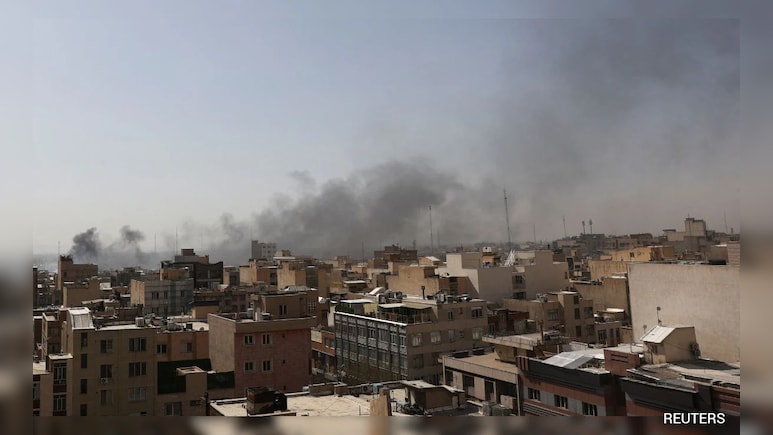
What happens when war comes to a city? Many of us imagine that wars are fought between soldiers far in the mountains, in the deep sea, or high in the clouds. But Tehran is neither of those things.
I've lived through a war in Tehran before, and I know a little of what it feels like. It feels like a bad dream. A very bad one.
With a population of nearly 14 million, ringed by snow-capped mountains to the north and dotted with green parks, Tehran looks like Srinagar with skyscrapers. The bulk of the city's elite and upper middle class, as well as government and security buildings that are targets of hourly airstrikes now, are based in the north of the city. The roads are clean and in excellent condition, but they meander, and traffic jams around the bends are frequent. With good schools, universities, museums, cafes, art galleries, a metro system, spacious public squares with street musicians singing 'Hotel California' and Farsi rap with equal gusto, Tehran is a vibrant, modern city.
But if you lived in Tehran today, what would you do? Anyone who could has already left the city. Roads leading out of the city were choked with traffic in the first two days of the airstrikes. But now the question is, if 174 cities have been bombed across the country, where is it safe to go? When a cruise missile slams into concrete within hearing distance, your first thought is of your children. Parents rushed to schools to pull children out immediately after the first airstrikes on February 28. But how do you explain the reasons for this conflict to your crying child, especially when every consecutive night comes with louder explosions?
You decide to stay at home, as some of the war advisories ask you to. But what do you do all day? The offices are closed. There is an ongoing internet blackout. You can't "work from home", or get on social media or answer a WhatsApp call from a family member abroad. Depending on the channel, the TV only spouts war propaganda from one side or the other. All you can do is stand on the terrace and watch precision bombing spring ten-storey high mushroom clouds in the distance.
It's possible that one of the bombs lands too close and shatters your windows. Your spouse is hurt but not fatally. But the hospitals are too full of casualties to attend to your minor injury. You decide to self-medicate, but as many international drug patents exclude Iran, the pharmacy only sells locally made drugs, and you don't trust their quality.
If you have a dog, as many in north Tehran do, you can't afford to take it out for a walk, and none of the kennels answers the phone. The dog cowers under the bed and whimpers at every explosion.
You decide to go check on a friend. But how do you move around the city? You could take the metro, but several of the major metro stations have been converted into bomb shelters. You can drive, but many of the underground parking areas are also now bomb shelters. Alternatively, you can leave the car parked in the street, exposed to falling debris.
You could always take a taxi and pay the all-day long surge pricing. But most drivers in the city are dependent on Google Maps and Wayz. And the maps get hacked before every round of conflict, showing your location 10 miles far from where you are. How does the cab driver then find your pick-up location? Even if the cab finds you, the driver is unable to navigate and asks you for directions to the destination.
Since the January 2026 protests, internet access has been uneven. In the current internet blackout, only a select few white (unfiltered) SIM cards have been allowed internet access by the authorities. And so it is that the favour you seek from that special friend in high office is not a job or a loan or for your file to be pushed up the queue. All you ask for is a "white" SIM card.
You decide to wait the war out and focus on caring for your elderly parents. Iran has a strong joint-family system, and it's common for working adults to live with their parents. Given economic distress and shrinking wages, many young people in Tehran do not marry until their 30s. And even those who marry can't afford to buy a home of their own (which, on average, can be worth 100 years of earnings). It's common to see couples postpone or give up on having children due to pessimism about the future. Divorce rate too remains high.
You're at home, but you're hungry. You would like to cook, and some supermarkets are open, but they only sell canned food and bottled water now. You could try ordering in food delivery, but how do you do it if the internet is down? And even if you do, how does the deliveryman find your house (since the maps have been hacked)?
Assuming you're able to order in, hopefully you're able to pay for it online, if yours is not one of the banks linked to the security establishment which has been hacked by the attacking side. Iran has no real credit card system. Due to unilateral sanctions, there are no Visa/Mastercard/Amex in the country. The most common way to pay is through a debit card swiped at a POS terminal, or by transferring money from one card to another through an ATM or a mobile app. But it's a debit card, so you are limited by the extent of your savings. And if your bank's network has been hacked, there is no credit card to fall back upon.
You opt to pay with cash. But to control inflation, the ATMs in Iran only allow you to withdraw the equivalent of Rs 200 a day, when even a short taxi ride costs Rs 150. So your cash for the day translates into one-way cab fare at best. You've planned ahead and have USD or Euros stashed at home for the crisis. But you still need to convert it at a money exchange. And the square where most of the money exchanges are located was bombed earlier this week; you're not sure if any are open. In case your cash stash at home is in Iranian rials, you'd have to carry a suitcase full of it to buy your weekly groceries. Between February 2023 and February 2026, the value of the currency fell by 400%. And if you cross the border into another country to flee the war, you may not find a place that will accept rials.
You decide to stay in bed. But in this seismically sensitive zone, an earthquake strikes every far too often, as it did in a nearby town earlier this week...amid the explosions.
You decide to get up and drink some water. But due to a water crisis since December 2025, the water supply is often off from 11 pm to 6 am. And now the authorities warn of water contamination. There are occasional electricity blackouts, so you just want to open the windows and take a deep breath. But there is the risk that one of the nuclear research reactors in the city that is said to be a target is not far from you, and if that last airstrike you heard was related to it, you fear you'll be breathing in radioactive air. You planned for the contingency, and you're among the privileged who got potassium iodide pills to prevent radioactive fallout on your thyroid. But if you're over 40, the pills apparently can't prevent you from getting cancer from exposure to radioactivity.
Yes, you work hard and make a decent living. You have a loving family and friends. You do not indulge in politics or weigh in on geopolitics. You never even went into the streets to protest. But you're in Tehran right now, and suddenly your access to your money, the water, the electricity, the phone lines, the internet, the roads, your home's proximity to one of the targets, and the structural soundness of your walls - every aspect of life that any of us takes for granted - everything is uncertain. All that you can hope for is that this war is just a bad dream.
(Raja Karthikeya is a former international civil servant)
Disclaimer: These are the personal opinions of the author

