






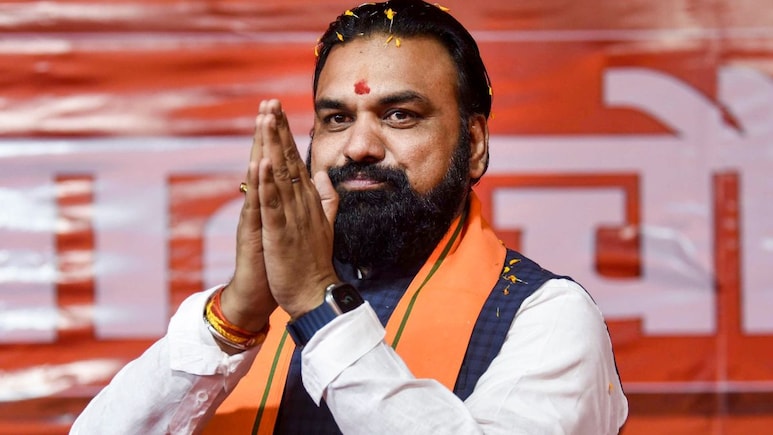
The swearing-in of Samrat Choudhary as Bihar's first-ever BJP chief minister on Wednesday marks a decisive political transition-ending the long dominance of Nitish Kumar of Janata Dal (United) and ushering in a new phase of governance.
Choudhary's promotion to the CM's post follows the exit of Nitish Kumar, who stepped down after being nominated to the Rajya Sabha. It also marks a major political transition in Bihar after more than two decades of Kumar's supremacy.
Although Choudhary is the face of the government, Bihar remains a coalition system involving the BJP, JD(U) and other regional parties. This builds inherent tension for the top man.
Choudhary inherits not just power, but a structurally constrained state battling poverty, migration, weak industrialisation, and entrenched social fault lines. His tenure will be judged not by continuity, but by transformation.
The BJP's rise to the "big brother" role signals a shift in power balance, but also introduces friction over caste equations, leadership space, and policy priorities. Keeping symbolism aside, the real test for Choudhary and the BJP begins now.
Continuing social coalition
Bihar politics is inseparable from caste. Choudhary's elevation as an OBC leader (belongs to Koeri/Kushwaha community) is a calculated move to consolidate backward caste support. Though Choudhury is the central leadership's pick, some within the party's traditional organisational structure have been sceptical about his suitability since he comes from outside the 'original' BJP cadre (having previously been in RJD and JD(U)). The RSS may still have reservations about his leadership style or background.
The state's social fabric remains fragmented amidst upper castes (traditional BJP base), OBCs and EBCs (politically decisive), Dalits and Mahadalits and Muslims (significant minority bloc). Choudhary must now find ways to get support of the EBCs and Dalits to counter the RJD's strong base.
For maintaining a broad coalition without alienating key groups -especially in a post-Nitish political landscape - Choudhary will require careful calibration, not just rhetoric.
Being the first BJP Chief Minister in Bihar is both an opportunity and a burden. Expectations from the party, the central leadership, and voters are unusually high.
The onus is on Choudhary to prove that the BJP can govern independently in Bihar. For this, he must deliver faster results than previous regimes and prepare the ground for future electoral dominance.
In fact, Choudhary's failure would not just be personal-it would raise questions about the BJP's long-term strategy in eastern India.
Need for structural transformation
For nearly two decades, Bihar focused on restoring governance-improving roads, law and order, and welfare delivery. These gains, while significant, have plateaued.
The next phase demands structural economic change: industrialisation, job creation, and urbanisation. The key challenge is shifting Bihar from stability to actual transformation.
Despite recent claims of growth above 10% and millions lifted out of poverty, Bihar still ranks among India's poorest states in per capita income. The state's economy remains heavily dependent on agriculture and remittances from migrant labour. Inheriting a legacy which contains neither a manufacturing base nor major private investment, Choudhary faces the classic 'low-income trap'.
Perhaps, the most politically explosive challenge is unemployment. Bihar sends millions of workers to states like Maharashtra, Gujarat, and Delhi every year. Government job creation - such as the announcement of over 30,000 posts -offers limited relief in a state of over 120 million people.
The BJP's 'double engine' promise - alignment with the central government - raises expectations of large-scale investment. Last year, in May, Prime Minister Narendra Modi had announced massive infrastructure investments and projects worth over Rs 48,000 crore, which signal intent. But Bihar's challenge is not just building roads or metros; it is converting infrastructure into economic productivity. Past experiences have shown that infrastructure announcements alone do not translate into sustainable employment. Delivering jobs, not just schemes, will define Choudhary's credibility among youth.
Without industrial corridors, skilled labour, and policy stability, these remain isolated gains. The gap between infrastructure creation and economic transformation remains wide.
Administrative and governance issues
As the deputy chief minister, Choudhary has built his political persona partly around a tough law-and-order approach, crackdowns on mafias, fast-track courts, and policing reforms. However, Bihar's crime narrative is complex.
While stricter policing may produce short-term optics, deeper issues - political-criminal nexus, and policing capacity - require systemic reform. The risk is that governance becomes overly focused on visible enforcement rather than institutional strengthening.
Similarly, Bihar's governance capacity remains uneven. While welfare delivery has improved, issues persist. There are leakages in government schemes; local governance institutions are weak and bureaucracy faces capacity constraints.
Choudhary's experience as finance and home minister gives him administrative grounding, but scaling governance reforms across districts is a different challenge altogether.
Choudhary steps into office at a moment of political symbolism and structural urgency. Bihar is no longer a state that needs mere governance repair- it needs economic reinvention.
His success will depend on whether he can move beyond incrementalism and address the core challenges: jobs, industrialisation, social cohesion, and institutional reform. The transition from Nitish Kumar's era to a BJP-led government is complete; the transition from stagnation to transformation is not.
That is the real test-one that will define not just his tenure, but Bihar's trajectory in the coming decade.
(The author is Contributing Editor, NDTV)
Disclaimer: These are the personal opinions of the author

