






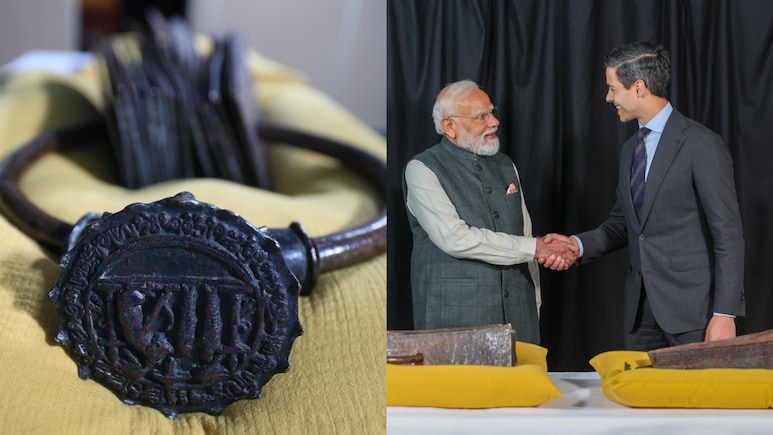
In a major cultural restitution move, the Netherlands formally returned a set of 11th-century Chola-era copper plates to India on Saturday during Prime Minister Narendra Modi's visit to the European country. The handover marked the culmination of years of diplomatic efforts by New Delhi.
The Aannaimangalam - or Leiden - plates consist of 21 copper plates held together by a massive bronze ring bearing the seal of Rājendra Chola I. This charter and another one (Or. 1688) were taken from India by Mr Florentius Camper (1675-1748), Minister of Faith in Batavia from 1703-1712. Both charters (Or. 1687, Or. 1688) came into the possession of his great-granddaughter Johanna Camper (1797-1835), who was married to Professor Hendrik Arent Hamaker (1789-1835), and were donated in 1862 by the successors to Hamaker's estate. The plates were probably excavated or acquired by the Dutch East India Company (VOC) in Nagapattinam between 1687 and 1700, and taken away. The Colonial Collections Committee concluded that the removal amounted to 'involuntary loss of possession' and recommended their unconditional return to India. Leiden University accepted the recommendation.
The Leiden Copper Plates feature royal charters from the Chola dynasty written in both Sanskrit and Tamil in the Grantha script. The Sanskrit inscription (5 plates) traces the mythical genealogy of the Chola dynasty, from Lord Vishnu, through the Sun, to legendary kings like Sibi and the Sun dynasty. The Tamil inscription (16 plates) lays out legal and administrative details. The massive bronze ring binding the plates features the Chola emblem of a tiger, the Pandya emblem of two fish, the Chera emblem of a bow, and an umbrella above them all, flanked by two lamps indicating auspiciousness and two chamaras indicating royalty. A Sanskrit line in Grantha script states: "This is the order of Rajendra Chola Parakesari, whose command shines among the rows of jewels on the crowns of kings and princes".
The Cholas were the rulers of the Bay of Bengal and South India, and actively supported maritime mercantile activities. In the large plates, it is mentioned that Rajendra Chola's father maintained friendly relations with the kings of the Sailendra dynasty, who ruled over Malaya and Java (Srivijaya). During the period of Rajaraja I (985-1014 CE) and Rajendra Chola (1014-1044 CE), Kadaram and Srivijaya were held by the Sailendras, who were in regular communication with China and India. At Srivijaya, there was a remarkable seat of Buddhist learning which I-Tsing, who travelled from Canton to Srivijaya, recommended to Chinese priests for training before proceeding to India for learning. Kedah, the ancient seat of Kadaram or Kataha, was an important naval base and commercial centre under the Sailendras, and from here they exercised control over their empire.
The Sailendra kings mentioned in the larger Leiden plates are Sri Chulamanivarmadeva and his son Sri Maravijayottungavarman. They were on friendly terms with Rajaraja Chola and obtained permission to build a vihara at Nagapattinaam, a renowned Buddhist centre, from Rajaraja, who made land endowments to a palli (a place of education) in the 21st year of his reign (1006 CE).
The Sanskrit portion of the larger Leiden plates mentions that King Rajaraja gave, in the 21st year of his reign, the entire village of Aanaimangalam (about 13 kilometres from Nagapattinam) and its land to build a shrine of the Buddha in the Chulamanivarma vihara. Maravijayottungavarman of the Sailendra family and son of Chulamanivarman, had erected it in the name of his father in the "delightful city of Nagapattinam in Pattanakurran, a sub-division of Kshatriyasikhamani-Valanadu. After Rajaraja passed away, his son Madurantaka, or Rajendra Chola, issued a permanent edict for the village granted by his father. Thus, said king Rajendra Chola, "As long as Shesha, the lord of serpents, sustains the entire earth, so long may this vihara last in this world with its endowment. This lord of Kataha (Malaya) of great valour, the abode of virtues, thus prays to all future kings: Protect forever this my charity." A verbal promise by Rajaraja I was converted to an edict by his son Rajendra Chola I. Twenty-six villages surrounding Anaimangalam were donated for a Buddhist vihara, known as Chulamanivarmavihara, built by the Malay king of Srivijaya in Nagapattinam, a port town on the Coromandel Coast. This Chulamanivarma vihara, the construction of which started in the reign of Rajaraja and was completed after nine years in the reign of Rajendra Chola, thrived from the yield from the village of Anaimangalam, amounting to about 8,943 kalam of paddy, which was spent annually for its maintenance.
Till 1878, this lofty vihara stood in a desolate condition within about 3 kilometres to the north of Nagapattinaam. It was demolished under the orders of the Governor in Council at the request of the Jesuits in 1878. Sir W. Elliot made the following observations about this vihara: "I found it to be a somewhat four-sided tower of three storeys, constructed of bricks closely fitted together without cement, the first and the second storeys divided by corniced mouldings, with an opening for a door or window in the middle of each side. At the top of the lower storey were marks in the wall shading where the floor of the second had been fixed. The top was open. The base of the ground storey was worn."
Rajendra Chola issued the grants for this vihara, immortalised in the Leiden plates. It did not prevent him from conquering Kadara-Srivijaya later, when they gave trouble to Indian merchants as they travelled from India to China via Srivijaya. But it also proves that the Cholas, who were diehard Shaivites, did not allow bigotry to stand in the way of support for other sects.
(Nanditha Krishna is an Indian author, environmentalist and educationist)
Disclaimer: These are the personal opinions of the author

