






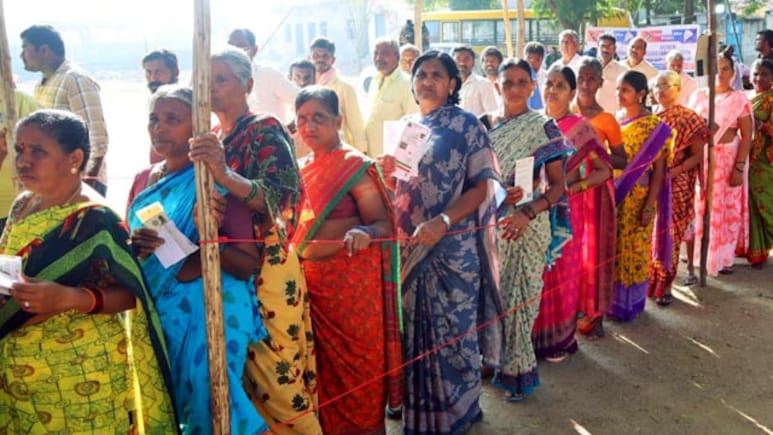
As the West Bengal assembly election enters its decisive phase, the issue of women's reservation has emerged as a major political flashpoint, shaping both narrative and strategy on the ground.
The debate intensified after Prime Minister Narendra Modi accused opposition parties, including the Congress, DMK, Trinamool Congress and Samajwadi Party of effectively committing foeticide by opposing what he described as a genuine constitutional effort to fast-track women's reservation in legislatures. He reiterated that his government remains committed to ensuring representation for women and positioned the quota push as a necessary democratic reform.
However, Mamata Banerjee has not taken a defensive stance. Instead, she has turned the issue into a counter-narrative. The Trinamool is actively highlighting that it has fielded one of the highest numbers of women candidates in the state, arguing that its commitment to women's empowerment is not merely rhetorical but already visible in practice.
Banerjee has repeatedly pointed out that long before this national debate gained momentum, her government had implemented reservations for women at multiple levels, from panchayats to legislative representation. She has also emphasised the presence of women MPs from her party in parliament.
She has been conducting padayatras alongside women leaders across constituencies, turning the campaign into a direct engagement with women voters. It has now become a clear case of tit-for-tat politics, where both sides are attempting to claim moral and political ownership over the issue.
In a statement posted on X, Banerjee said that while she supports women's reservation in principle, a stance she has maintained since 1996, her party believes that the quota should be 50 per cent, not 33 per cent. This position has also been echoed by Trinamool MP Kakoli Ghosh Dastidar, who publicly demanded a higher share of representation for women.
The political complexity deepens when the legislative timeline is seen. In September 2023, when the Women's Reservation Bill was passed in parliament with an overwhelming majority (454-2 in the Lok Sabha), the Trinamool had supported it. The only dissent came from two MPs of All India Majlis-e-Ittehadul Muslimeen. However, even while supporting the bill, the Trinamool had raised two concerns: the absence of a sub-quota for OBC women and the delay in implementation, which was linked to the census and delimitation process.
The situation changed this month when the Constitution (131st Amendment) Bill was introduced. This time, the Trinamool voted against it, and the bill failed to pass (298-230). Banerjee argued that the Centre had strategically linked women's reservation with the delimitation exercise, which she believes is aimed at increasing Lok Sabha seats from around 550 to nearly 850. According to her, such a move could disrupt the federal balance of the country. She described the bill as a "disguise," suggesting that women's reservations were being used as a front to push through a politically motivated delimitation agenda.
Banerjee has also highlighted her government's track record. In the 2024 Lok Sabha elections, the Trinamool sent 11 women MPs out of 29, approximately 38 per cent, significantly higher than the national average of around 14 per cent. She has also pointed to flagship welfare schemes such as Kanyashree, Rupashree, and Lakshmir Bhandar as evidence of her long-standing focus on women-centric governance.
Her stance has found support among opposition leaders. Congress leader Sonia Gandhi reportedly reached out to Banerjee, appreciating her role in maintaining opposition unity on the issue. Rahul Gandhi has also expressed satisfaction with the coordinated opposition response. In effect, this has brought multiple opposition parties onto a common platform, at least on the question of how the reservation policy is being framed and implemented.
Congress leader P Chidambaram has said the original constitutional amendment passed in September 2023 had already inserted Article 334A, making the legal framework clear. The delay in notifying and implementing the provision, followed by its sudden revival in April 2026, raised legitimate questions, he added.
Banerjee alleged the timing of the move right before state elections raises doubts about its political motivations.
(Jayanta Ghosal is Contributing Editor, NDTV)
Disclaimer: These are the personal opinions of the author

