






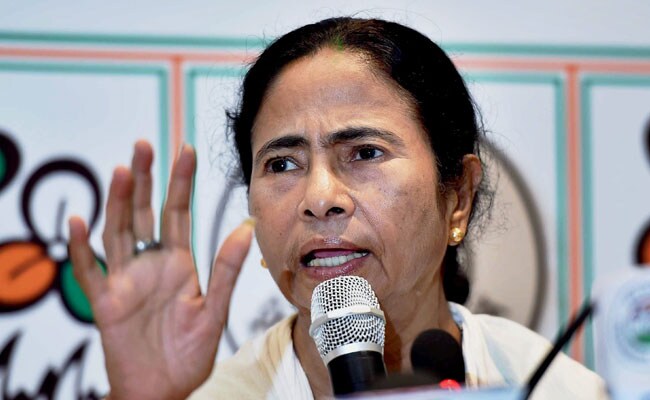
There is a particular weather to political voyages: not the weather the meteorologist reads, but the climate that surrounds a leader as she steps from the capital, Kolkata, into places that hold both memory and mystery. Bengal Chief Minister Mamata Banerjee's sudden pivot north after unfurling the Trinamool Congress manifesto in Kolkata last week felt like that kind of atmospheric change - as if the very air of West Bengal had shifted its axis, and she, who has long been mistress of the south (Central Bengal) and the city (Greater Kolkata region and the metropolis), was now testing the gusts of a different wind.
There are journeys that are outward but inward at the same time - trains that are maps of the self, landscapes that reflect an inner composition. Banerjee's barnstorming of North Bengal over the past three days has a similar double vision. On the surface, it is a tautly strategic exercise: rallies in Maynaguri, Dabgram-Fulbari, Naxalbari; speeches on the grounds of Jabravita High School and Nandaprasad High School; logistics checked and rechecked by cops and administrators. Underneath, though, there is an old story being reread - of a leader known for populist intimacy, threading herself through markets and alleys, now reaching for constituencies that have long been resistant to her voice.
Mamata Faces a Challenge From Saffron, Not Erstwhile 'Red Brigade'
Historically, Naxalbari was the place where the CPI-ML had its genesis, hence the Naxalite movement. But that was decades ago, in the era of 1967 to 1969, when the Maoists under Charu Mazumdar and Kanu Sanyal had begun the peasant uprising. Mamata Banerjee, however, rushed to the erstwhile revolutionary zone not to face the gauntlet from the Red revolutionaries but to meet an electoral challenge from a different hue: the Saffron brigade.
Numbers, of course, are blunt and crystalline companions to any political pilgrimage. In the last assembly round, the TMC's wounds in the north were visible not just in seats but in the geometry of votes: 23 seats out of 215 for Banerjee's TMC party, while the BJP pocketed 30 of 77 in that very region; a vote share where TMC's 44.53% faced the BJP's 42.27%, margins thin enough to be measured in gestures and grievances.
North Is a Different Mood
If the map of Bengal is divided into quadrants of mood and memory, the north stands as a different country to which Mamata must now become an eligible immigrant: not only to be seen, but to be heard, recognised, forgiven, persuaded.
There is a peculiar restlessness in Cooch Behar these days, as if a quiet tea-stall conversation has spilled into the high rooms of power. The TMC - long accustomed to the rhythms of Bengal's politics - now finds itself tugged in different directions, not by an external foe but by the uneasy strains of its own inside chorus. With the assembly elections approaching, dissatisfaction has seeped into the veins of the party in the district, making what was once a simple contest into something knottier.
Consider Khokon Mian, whose resignation reads less like a rupture and more like a small, telling admission of a larger unsettlement. Once a close companion of Rabindranath Ghosh - the district's steady hand for more than 20 years - Mian has moved across the aisle to the Congress Party. In such moments, allegiance shifts not because of one glaring betrayal but because the ground beneath many feet feels less sure.
Ghosh himself, a former MLA and minister, has been quietly sidelined after the party declined to give him the Natabari ticket. His response was characteristically low-key: a retreat, a pause. "I am taking a break and am currently resting," he said.
But the unease is not his alone. A cluster of senior figures - former ministers like Binay Krishna Barman and Jiten Barman, and Suchismita Deb Sharma, who leads the district's women's wing - have also found themselves without tickets. They have not staged loud rebellions; instead, their silence and absence from campaigning is conspicuous, a negative space on the political canvas that observers cannot help but notice.
The Fault Lines In Cooch Behar
These fissures arrive against a backdrop that is already unforgiving. In 2021, the BJP captured seven of Cooch Behar's nine Assembly seats, leaving Trinamool with barely a foothold; a later bypoll reclaimed one seat, but the larger map still favours the BJP. When a party that once felt at home in a place finds itself reduced to tentative holdouts, anxiety multiplies.
Another fault line is representation. The party's decision not to field any candidates from the district's sizeable Muslim community has stung. For many in the Muslim community, politics is not merely transactional; it is a question of presence, of seeing oneself reflected in the corridors of influence. One local leader voiced the sentiment plainly: "Are minorities to remain mere vote banks, present to rally and to vote but never to lead?" In a set of four general seats, surely one might have borne the face of that community.
Abhishek Banerjee Starts From Natabari
Into this simmering scene comes Abhishek Banerjee, the nephew of Mamata Banerjee, set to launch the campaign from Natabari on March 26. His arrival is intended as a steadying gesture, a moment to draw loose threads together and remind local cadres of the party's larger narrative. Whether it will soothe the bruises or simply paper over them remains the open question.
Some local leaders, perhaps out of loyalty or habit, insist that all is well. Yet reassurance and reality often travel different roads. In Cooch Behar, the party now faces the old political paradox: when the centre cannot reach every corner, corners begin to tug at one another, and the map of allegiance is redrawn in soft, sometimes painful strokes.
The Rush To Cooch Behar
There is something almost cinematic about a charismatic leader like Mamata Banerjee who, just after announcing a manifesto in the cosmopolitan heart of Kolkata, drives into places that feel lateral to the capital's rhythm. Ditto for the nephew Abhishek, who rushes to Cooch Behar to clean the Augean stables. The manifesto is the anchor, the public ledger of promise; the tour is its human appendix, the tactile translation of policy into handshake and eye contact.
Banerjee's tour is, then, a lesson in politics as pilgrimage: the manifesto declares the route, the campaign makes the pilgrimage plausible. She does not merely send emissaries; she goes herself. Soon after her, the trusted nephew follows. That is the old, reliable magic in Indian politics - the presence of the chief minister, and her trusted lieutenant, realised as a form of currency that can be spent to redeem doubts and galvanise cadres.
The Diversity of the North
Yet there is an old discomfort in such ventures. North Bengal is not a single place but a layered topography of identities - tea-garden labourers and hillside communities, Bengali plain folks and Nepali-speaking populations, a region historically attentive to different narratives. To win it is not only to offer better gas subsidies or slicker social programmes; it is to listen to long-held anxieties about representation, language, culture and the peculiar calculus of local alliances.
The BJP's ascent here was not conjured entirely out of policy wins; it was, crucially, a story of resonance. It reflected grievances nourished over years, and in that sense, Banerjee's rallies must do more than be loud: they must translate the intimacy of a Kolkata meeting into a credibility that can be felt on a tea estate and in a hillside village.
The administration's visible choreographing - police commissioners inspecting routes, officials tightening security, venues picked with the care of stage designers - signals the importance attached to optics as much as to outreach. There is a theatre to it: the stage at Naxalbari, the bus that arrives in Maynaguri, the banners fluttering over the high-school grounds. Political theatre, however, only extends so far; the audience that mattered in the last election was not won by spectacle alone. Local mutinies within the BJP over candidate choices, or rumblings about NRC-CAA, the confusion among the electorate about the SIR supplementary list and the pinch of rising cooking-gas prices, may have opened windows for the TMC. But windows can be drafty; the challenge is to convert a draft into a sustained warmth in the cold climes of the Himalayas and the Terai region.
The Inversion of Mamata's Political Geography
Perhaps what is most interesting about this northern push is the inversion it suggests of Banerjee's own political geography. Once, she was the undoubted empress of the southern plains and the urban matrix of Kolkata; now she appears as an itinerant figure, travelling to peripheries that, until recently, seemed tangential to her political map. It is a measure of both urgency and adaptability. If politics is the art of making neighbours of strangers, then these days Banerjee walks that art as if it were a rope bridge: one step at a time, testing the sway, listening for the creak that might presage a fall.
Beyond the immediate calculations - the rallies on March 24 and 25; the tight security; the activists' rising excitement - there is a quieter test taking place. Can a campaign that was born in the manifesto halls of Kolkata translate into moments of recognition at a tea stall in Jalpaiguri, or on the stairs of a school in Darjeeling? Can a leader whose charisma is often visible in rural countryside and in the urban suburbs of Bhadralok Kolkata, rediscover an idiom that belongs to the valley and the hill? The answer will not be found in a single speech but in a succession of small exchanges: a promise kept, an old grievance acknowledged, an everyday worry relieved.
Ambition Mixed With Anxiety
Travel reveals more about where we are than where we go. A desperate Mamata Banerjee's northern foray reveals, perhaps, as much about the TMC as it does about North Bengal. It is a sign of ambition, certainly, but also of anxiety: an admission that the party cannot take its footholds for granted. In that sense, the tour is not merely about stealing seats back from an ascendant rival, the BJP, which has begun a sophisticated blitzkrieg campaign across the state. It is a study in the fragile, human business of political belonging. The real drama will be less about the rallies themselves than about whether those gatherings can reshape the long, patient architecture of trust.
For now, the north has become, briefly, the Chief Minister's horizon. She will speak on school grounds and in market squares; she will measure applause and pick up worries. If politics is ultimately a practice of proximity, then this is Banerjee's attempt to be near once more, to convert manifesto lines into living lines of contact. Whether proximity will suffice, whether presence will translate into preference, remains the delicate question. And that is where the weather of this journey will be decided - not by the flags and microphones, but by the small, decisive breezes of human assent that cannot be manufactured, only earned with a high-stakes campaign grind.
(The author is Editor, Research, NDTV. Views are personal)
Disclaimer: These are the personal opinions of the author

