





Mumbai, the financial capital of India, has absorbed waves of migrants for decades, both from within the state of Maharashtra and outside. A new study titled 'Illegal Immigration to Mumbai: An Analysis of Socio-Economic and Political Consequences', suggests that the influx of undocumented migrants from Bangladesh and Myanmar is threatening the city's capacity.
Professor Medha Tapiawala from Mumbai School of Economics and Public Policy and Souvik Mondal, Assistant Professor, Galgotias University have detailed the findings based on the results of a survey, covering over 3,000 respondents in migrant-dominated areas and conducted between July 2024 and July 2025, qualitative interviews, case studies, and focus group discussions.
A City Under Demographic Pressure
Among the 43 per cent of the migrant population of Mumbai, documented migrants have contributed to economic growth, but undocumented migrants present a range of challenges, according to the paper. The rising migrant influx has also put considerable pressure on the city's housing, transportation, and healthcare systems.
"The rise in migrant numbers cannot be attributed to the birth rate," said Mondal, while elaborating on the movement of undocumented migrants being a major cause of the increase.
The study also cites religious demographics to underscore the point. The Hindu population share has fallen from 90 per cent in 1951 to 65 per cent in 2011, whereas the Muslim population has increased by 10 per cent in the same period, according to the Census.
Undocumented Migrants
Among the 3,014 respondents:
- 67 per cent were men and 33 per cent were women, confirming a male-dominated migration wave driven mainly by labour demand.
- Over 96 per cent identified as Muslim.
- 41.6 per cent were illiterate.
The report identifies undocumented migrants as those who overstayed their visas, had unauthorised border crossings, or entered the informal labour market.
Settlement Patterns And Urban Stress
According to the findings, undocumented, mostly Bengali-speaking migrants are densely clustered in Govandi, Kurla, Mankhurd, Cheeta Camp, Versova, and parts of Bandra East. These areas are also marked by weak infrastructure and pose ecological challenges.
Such clusters put pressure on the city's healthcare systems. Overcrowding, averaging three persons per room, raises the risk of disease spread among children and the elderly.
Mangroves in the city, which have largely been eliminated because of infrastructure development, are also affected by these clusters.
"The ecological imbalance causes these clusters to be more prone to floods and increases the chances of underground contamination," said Mondal.
Economic Trade-Offs
The biggest challenge of undocumented migration, according to the study, is its impact on the city. Professor Sanjay Mohanty from the International Institute for Population Sciences highlighted the difference between unskilled and skilled labour migration.
"While unskilled labour reduces employment opportunities for natives, puts pressure on public institutions, and contributes little to the economy, skilled labour does the exact opposite."
The report notes that the demand for cheap labour in Mumbai attracts more undocumented migrants, most of whom are unskilled labourers.
The higher density of low-wage workers in the city leads to job displacement and puts pressure on wages for low-skilled native labourers. Nearly 40 per cent of surveyed migrants reported sending remittances outside India.
Governance, Politics, and Security Concerns
Given the backdrop of the upcoming BMC polls, the study becomes crucial. The report also suggests that political patronage from different parties has helped undocumented labourers obtain housing, forged documents, and protection.
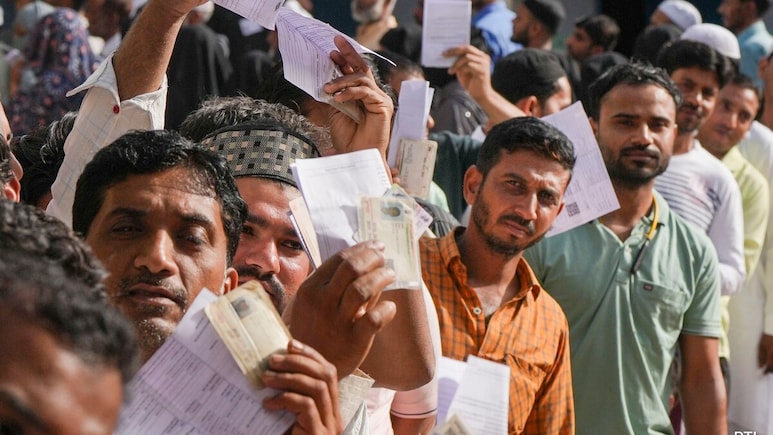
"70 per cent of the undocumented labourers have voter cards in the city," said Mondal, stressing on the challenge it might pose ahead of the upcoming BMC polls.
It further argues that forged documents compromise electoral rolls and welfare schemes aimed at helping native residents.
Policy expert JK Bajaj suggests avoiding politicisation of the subject.
"The migration caused by religious migration can cause an imbalance, but it is a civilisational issue and not a political one."
Track Latest News Live on NDTV.com and get news updates from India and around the world

