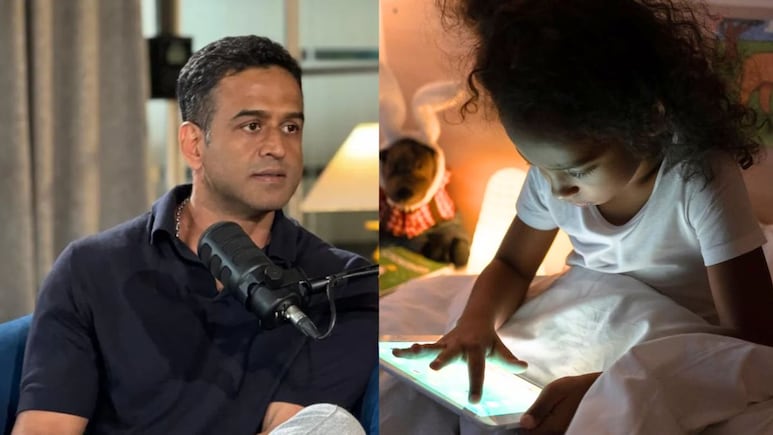
Zerodha co-founder and billionaire entrepreneur Nithin Kamath has raised concerns about the growing impact of excessive screen time on children's behaviour and brain development. In a recent social media post, he warned that while digital devices often help parents manage their schedules, they can also create long-term dependency among children.
Details
Kamath said the issue is personally relevant to him. He shared that his son studies at a school where digital devices are not permitted, and screen use at home is restricted to 30 minutes a day. Despite these limits, he pointed out how quickly children become drawn to short-form digital content.
Kamath wrote, "For most parents, digital devices have become a pacifier; it's a way to keep 'em quiet, and it's understandable, but it ends up creating a dependency in the long run."
He added, "At Kiaan's (son's) school, no digital device is allowed, and at home, we restrict screen time to 30 mins a day. But even then, it is crazy, the addiction to reels/clips; I normally catch him browsing through that."
For most parents, digital devices have become a pacifier😬, it's a way to keep em quiet, and it's understandable, but ends up creating a dependency in the long run.
— Nithin Kamath (@Nithin0dha) April 19, 2026
At Kiaan's(son's) school, no digital device is allowed and at home, we restrict screen time to 30 mins a day. But… pic.twitter.com/NTJpBamVil
Along with his post, Kamath shared a video by cognitive neuroscientist Jared Cooney Horvath, who spoke about a decline in learning abilities among younger generations. Horvath said children today appear to lag behind previous generations in areas such as attention span, memory, literacy, numeracy, and executive function, despite spending more time in formal education.
He linked this trend to the increasing use of digital technology in learning and daily life, cautioning that constant exposure to screens may be affecting how children process information and retain knowledge.
Internet Reacts
Kamath's post sparked discussion online. One user agreed and wrote, "Completely agree. 2 decades back freetime wasn't considered boredom. Today high productivity parents want to manage every minute of their kids calendar. We are building humanoids at home."
Another user commented, "Not a screen-time problem. An attention problem. We've replaced boredom with distraction and lost the space where creativity actually begins."
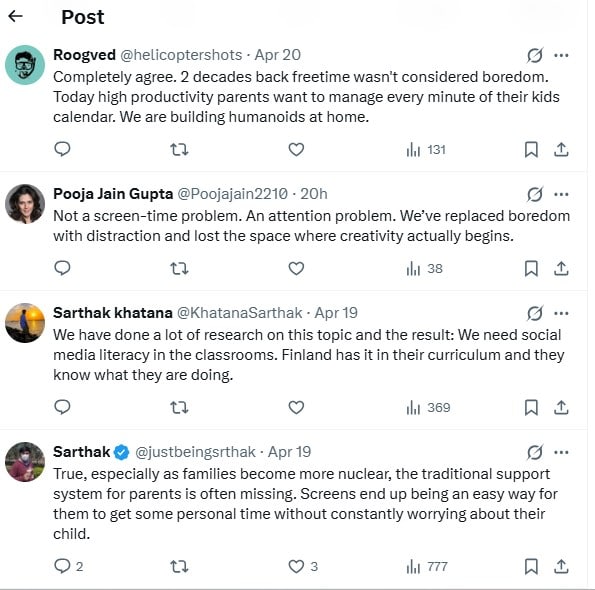
"True, especially as families become more nuclear, the traditional support system for parents is often missing. Screens end up being an easy way for them to get some personal time without constantly worrying about their child," read another comment.
Also Read: Dhurandhar Singer Jasmine Sandlas Reveals Premanand Maharaj's Life-Changing Advice: 'Tattooed In My Brain'
Track Latest News Live on NDTV.com and get news updates from India and around the world
