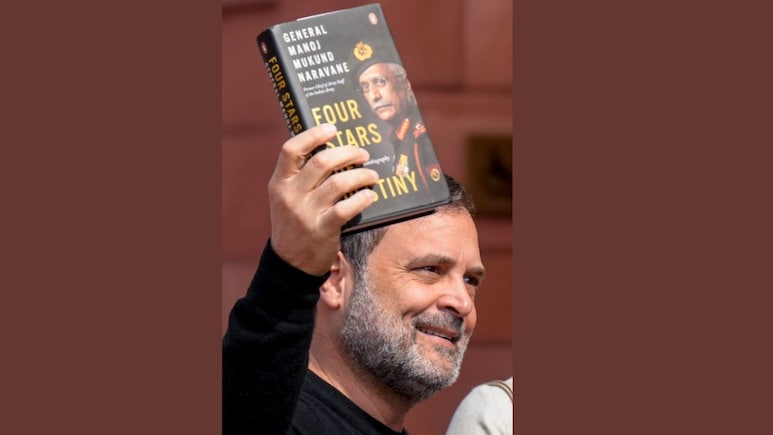
- Rahul Gandhi showed a hardbound copy of General Naravane's unpublished memoir in Parliament
- This incident highlighted the question of what happens after writing a book
- We tracked the journey of a manuscript from submission to shelf
When Rahul Gandhi waved a hardbound copy of former Army Chief General MM Naravane's 'unpublished' memoir Four Stars of Destiny inside and outside Parliament earlier this month, it triggered more than a political storm.
The book was slated for publication by Penguin Random House India. According to the Ministry of Defence, the book has not yet been cleared by them. The publisher has clarified that no official copies have been released or distributed, and Delhi Police has since registered an FIR to investigate the alleged circulation of pre-print copies and PDFs.
Hello friends. My book is available now. Just follow the link. Happy reading. Jai Hind pic.twitter.com/VCiLiZOWIi
— Manoj Naravane (@ManojNaravane) December 15, 2023
Gandhi, however, pointed to a December 2023 tweet from General Naravane, a screenshot of which suggested Penguin was "lying".
"Here is a tweet from (General) Naravane which says, 'Just follow the link to my book'...," Gandhi told reporters outside Parliament. "The point I am making is this: either (General) Naravane is lying, or Penguin is lying (and) I do not think the former Army Chief would lie."
The controversy has raised a curious question beyond politics and national security. If a book is not officially out, but a pre-order link was generated, how does a hardbound copy exist? What exactly happens between the moment an author types 'The End' and the day the book reaches a reader's hands?
We tracked the journey of a manuscript from submission to shelf, and spoke to authors with very different experiences of publishing.
As it turns out, every book travels its own road, shaped by genre, author profile, publisher strategy and sometimes, official clearance.
So, You've Written A Book. What Happens Next?
The romantic idea is simple: you finish writing, send it to a publisher, and it appears in bookshops. The reality is far more layered.
Sayantan Ghosh, Editorial Director, Simon & Schuster and author of the novel, Lonely People Meet, explains that once a manuscript is submitted and accepted, the timeline is never uniform. It could be six months, a year, or even two years before release, depending on how early the book was commissioned and what both author and publisher agreed to in the contract.
"The first formal stage is editing. This may involve structural editing, where large portions are reworked, rearranged or rewritten. Editors collaborate closely with the author, often sending marked-up documents with queries and suggested changes. Authors typically have a week or two to respond. For some books, this back-and-forth can stretch over months," he explains.
Once structural edits are complete, the manuscript goes through copy editing. Here, the focus shifts to language, clarity, consistency and factual accuracy. After that, the document is handed to a typesetter, who converts the Word file into a print-ready layout. These are known as uncorrected proofs.
The proofs then undergo proofreading, usually handled in-house at major publishing houses. The proofreader checks for typographical errors and minor inconsistencies. Authors may not always interact directly with proofreaders, though they are often sent the proofs for a final review.
This stage can involve one or two rounds, sometimes more for complex manuscripts. Only after corrections are incorporated does the book become print-ready. Printing in English can take roughly three weeks.
Ghosh points out that scheduling plays a major role in when a book actually releases. Publishers often time books strategically. Light reads may be scheduled for the summer airport rush, political or policy titles around national holidays, and celebrity books close to film releases or birthdays. These are not rigid rules, but commercial strategies.
For authors unfamiliar with the publishing trade, the process can feel opaque and slow. Ghosh says that he had an advantage because he has worked in publishing and understood why delays happen.
Two Ways A Book Begins
A book can comes into existence two ways.
One is when an author completes the entire manuscript independently and then approaches a publisher. The other is when a publisher commissions a book based on an idea and works with the author from the outset.
Many senior editors, writers, take the second way: publishers expresses interest in a concept, a deal is signed, and then the writer begins writing chapter by chapter. Each chapter is submitted to the editorial team as it is completed.
For editing in both the cases, multiple layers are followed. Line edits, paragraph edits and broader editorial suggestions are exchanged between author and publisher. Once both sides are satisfied, the manuscript is considered finished from their perspective.
Here's where the real deal begins for some. For books dealing with sensitive subjects, especially the armed forces, another layer enters the picture. When writing about military operations, manuscripts are submitted to the Ministry of Defence for vetting. This is standard practice worldwide for books that contain operational details.
The Ministry may then issue a 'No Objection Certificate' or suggest modifications. These can be basic changes (removing specific place names, distances between posts, or identities of special forces personnel) or major ones depending on the book. The author and the publishing house can appeal these changes if they disagree with them. This process could also go on for weeks.
Here, note that only after this clearance does the book move to final proof stage. At this point, publishers may print a small batch of proof copies, clearly marked as 'Not for Sale'.
These are then sent to reviewers, influencers and media outlets. Pre-order links are also generated at this stage, which may also go live on online platforms, allowing readers to place advance orders even though the book is not yet in stores.
Pre-orders can influence the initial print run. A standard first print might range from 2,000 to 10,000 copies, but strong demand can push that number much higher. Once the printing plates are set, no further changes can be made. From ready-to-print to availability, the process usually takes two weeks to a month.
This sheds light on how a book can have pre-order links and even physical proof copies without being officially published. It also explains how sensitive content can halt the process mid-way.
The Legal And Commercial Filters
Deep Halder, senior journalist and author of four books including bestsellers like Blood Island: An Oral History of the Marichjhapi Massacre and Inshallah Bangladesh, who has worked with both established and newer publishing houses, emphasises another crucial stage: legal vetting.
With larger publishers, once the manuscript is edited, it is reviewed by a legal team. Every chapter is looked over for potentially defamatory or controversial content. Sentences and paragraphs may be flagged for rephrasing or removal. This layer is especially important for political or investigative non-fiction, where a single line can trigger litigation.
Halder explains that before printing, publishers prepare what is called a Corrected Reading Copy, or 'CRC'. This is the finalised PDF, ready for plates. Around this stage, cover designs and acknowledgements are shared with the author.
"Advance copies may be printed for critics and major reviewers. These are limited in number and clearly marked as not for sale. They may not always feature the final cover design. Pre-order campaigns begin to build anticipation, and publishers may prepare promotional notes and endorsements to be added to the jacket," he adds.
From the moment a pre-order link goes live to the book appearing on shelves, Halder estimates the timeline at roughly one month. Others say it can be even less.
For established writers, publishers may commission books based on current events, sometimes asking for a few sample chapters and a detailed synopsis before signing a contract. For debut authors, the process can be tougher. They may need to submit a full manuscript before any discussion begins.
Each Book, Its Own Journey
The journey of a book is rarely linear. Fiction may undergo heavy structural edits. Memoirs of public figures can attract intense legal scrutiny. Military or national security titles may require government clearance. Commercial considerations influence release dates. Pre-orders and proof copies can exist even when a book is technically unpublished.
For readers, a book appears as a finished object on a shelf. For authors, it is the culmination of months or years of drafting, redrafting, editing, negotiating and waiting. And for publishers, it is a careful balancing act between creative freedom, legal caution, market timing and distribution logistics.
So, what happens once you've written a book? The short answer is: it is when the real work begins.
Track Latest News Live on NDTV.com and get news updates from India and around the world
