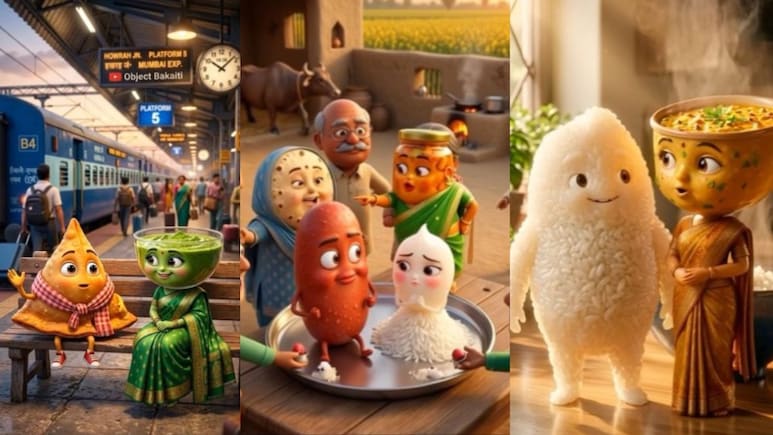
- AI slop is low-quality, AI-generated content designed to grab attention quickly
- Indian AI slop localises content with relatable, dramatic food and cultural stories
- These videos exploit emotional triggers and algorithms to maximize engagement
Somewhere between a crying samosa begging not to be eaten and a dramatic Rajma leaving Chawal for Taco, you've probably paused mid-scroll, mildly horrified yet oddly invested.
The background music swells, the "characters" emote with suspiciously human expressions, and before you know it, you're watching episode three of a love triangle between rajma, chawal and an interfering bowl of raita.
You didn't go looking for it. But it found you.
The AI Slop Flood You Didn't Ask For
If you've spent even five minutes on Instagram Reels or YouTube Shorts lately, you've seen them. Anthropomorphic fruits cheating on each other, vegetables with abandonment issues, desi food items and animals (especially cats) stuck in toxic relationships. The plots are wildly dramatic, the visuals slightly off, and the storytelling strangely addictive.
This isn't a one-off trend. It's an influx. A full-blown genre called AI slop has quietly taken over social media feeds.
Let's break it down.
What Is AI Slop, Really
In simple terms, AI slop refers to low-quality, mass-produced content generated using artificial intelligence tools. These could be text, images, or videos created quickly, often with minimal human input, designed purely to grab attention rather than offer real value.
What makes it distinct is the illusion of effort. It looks polished enough to pass, but beneath the surface, it's repetitive, formulaic, and often nonsensical.
Think dramatic storytelling with glitches, exaggerated emotions, and plots that escalate purely because the algorithm rewards intensity.
It's easy to make, easy to consume, and incredibly hard to ignore.
From Crying Nuggets To Fruit Love Islands
And just when you think you've seen enough with Ganji Chudail having its moment, AI Slop comes in, knocking on the door. One of the biggest examples of AI slop, which recently went viral, was Fruit Love Island (It has its own Wikipedia page now, btw).
Yep, it's exactly how it sounds. A viral AI-generated series where characters like Bananito and Strawberina flirt, fight, and get "recoupled" like contestants on a reality dating show. It gained millions of followers in days, with each episode clocking massive views.
But the ecosystem didn't start there. Before the fruits came emotional storylines involving talking objects. A sad chicken nugget separated from its mother. A broccoli parent abandoning its child. A citrus fruit disowns its son. Each story more dramatic than the last.
Have a look at some of them:
The Indian Slop Universe
Indian creators didn't just replicate the trend, they localised it.
Suddenly, it wasn't just fruits. It was rajma-chawal heartbreaks, chai-parle g arranged marriages, pav-vada love triangles.
That emotional layer changes everything. The absurdity becomes relatable. The joke becomes a story.
And that's where Indian AI slop stands apart. It isn't just random chaos. It mirrors the storytelling we've grown up with. It's part of the reason why Indians, especially Gen Z, love these videos.
Look at actress Banita Sandhu's comment on one of these videos:

Why Indians Love AI Slop
Part of the answer lies in conditioning.
Indian audiences have grown up on high-drama television. They have secretly hate-watched their parents (or have watched) watching daily soaps packed with betrayal, reincarnation, family politics, and moral policing.
From supernatural sagas like Naagin to fantastical shows like Baal Veer, absurdity has always been part of the entertainment diet.
AI slop simply compresses that into bite-sized, hyper-dramatic clips.
There's also the emotional hook. These stories tap into basic human triggers: love, betrayal, guilt, and family honour. So when these emotions came in a 30-60 second Reel, the emotions felt oddly familiar.
Then comes accessibility. Anyone with a phone can create these videos. No actors, no sets, no production costs. Just prompts and uploads. It democratises content creation, but also floods the internet with near-identical material.
And finally, there's the algorithm. It doesn't care if you love-watch or hate-watch. Engagement is engagement. The more outrageous the content, the more it spreads.
The Real Problem With AI Slop
For all its absurd charm, AI slop has a darker undercurrent.
- A lot of these stories recycle regressive tropes. Women characters are often portrayed as manipulative, unfaithful, or materialistic. Male characters are victims or moral judges. Themes of purity, honour, and control frequently show up, dressed as "drama".
- Misogyny isn't incidental here; it's baked into the storytelling because it performs well.
- There's also casual inclusion of troubling narratives. Homophobia, body shaming, and even hints of abuse are used as plot devices, often without any nuance or accountability.
- Then there's the broader issue of attention-economy manipulation. These videos are engineered to provoke emotion quickly. They train viewers to respond to exaggerated stimuli, slowly lowering the threshold for what holds attention.
- And perhaps most concerning, they blur the line between fiction and emotional manipulation. Today it's a crying samosa. Tomorrow, the same storytelling format could be used for misinformation, propaganda, or deepfakes that feel just as emotionally convincing.
So, Why Does It Still Work
AI slop thrives on instinct, not intellect. It doesn't want you to think, it wants you to feel, react, scroll, and repeat.
And in a country that has always loved a good dramatic storyline, even if it involves a jealous bowl of dal, that formula is hard to resist.
Track Latest News Live on NDTV.com and get news updates from India and around the world
